Showing posts with label body of Christ. Show all posts

Tuesday, March 08, 2016

Sacred Mess: Crumbs at communion and discerning the body

Disclaimer: I am neither a sacramentologist, nor the son of a sacramentologist. Take the following with a grain of salt. For lightly salted bread is delicious.

When celebrating the sacraments, some Christians focus on the holiness of the elements (bread, wine, water).* And this is good. It is beneficial to stop and reflect on the ways that everyday objects can speak to us of divine realities of grace, forgiveness, promise and fellowship, even to wonder at the sacredness of all creation in pointing to God's beauty, mystery, wisdom and power. We worship a God who became flesh and blood, ate bread and wine, washed in water and shared the very air we now breathe. The incarnation is thus the main theological grounding for refusing to draw a sharp line between the physical and the spiritual. The divine Spirit sanctifies physical objects to point us towards and bring us into the presence of, and union with, Jesus.
*Leaving aside for the moment the question of how many sacraments there are and proceeding on the minimalist assumption of the two on which nearly all agree: Holy Communion and Holy Baptism.

Yet too much focus on the elements themselves can lead to some sacraments being exercises in holy carefulness, lest the body and blood of Christ be wasted or disrespected, lest any be dropped, lost or inadvertently trodden underfoot. At its extreme, only priests can handle the elements, bread-like wafers replace everyday bread, the boisterous unpredictability of children is excluded until such time as they are able to participate with due solemnity, a special plate is held under the mouths of communicants to catch any wayward pieces, and sometimes lay people are not trusted with the cup at all.

But this is not the only way of conceiving of the holiness of sacraments. Instead, or perhaps alongside, of the Spirit sanctifying everyday objects, perhaps we may also speak of the Spirit sanctifying human actions. The washing of baptism and the sharing of communion (or the thanksgiving of the eucharist, depending on linguistic preference) become enacted parables of the kingdom, pointing in the performance of them to the spiritual realities of spiritual cleansing through immersion into the life of Christ, spiritual feeding upon the saving death of Christ. If so, then it is not such much the bread and wine themselves that are special, but the eating of them in thankful fellowship, remembering Christ's death and embracing the promise of his coming.

And if we thus shift the focus from holy elements to holy activities, then we may end up with a different set of assumptions about how to proceed. If we think of holy washing (baptism) and holy sharing/thanksgiving (communion/eucharist), then the human acts are foregrounded, rather than the physical objects used in doing them. God is manifest not simply in the atoms of alcohol, simple carbohydrates, water, ethyl acetate and so on, but in the act of drinking in fellowship with others. And if we make this shift, then rather than ensuring nothing is done to conceivably dishonour the elements in any way, the focus is on honouring the actions.

When sharing a meal with friends, you're not going to deliberately dump the food on the floor, but you're also not going to obsess over avoiding any tiny spill or mess. What is important is that the food mediates joyful, honest, reciprocal relationships. A meal in which everyone is doing their utmost not to leave a skerrick or morsel wasted or out of place is probably not a meal in which everyone is enjoying one another's company.

Exegetically, this distinction turns upon the two meanings of "body" in 1 Corinthians 11.29:
For all who eat and drink without discerning the body, eat and drink judgement against themselves.
Traditionally, many interpreters took "body" (soma) to mean the presence of Christ in the elements. Thus, those who fail to discern the body are unbelievers, or those who lack due reverence for the elements. The corollary is that it is better to fence off communion from the young, the ambiguously repentant, the partially orthodox, lest we encourage them to eat and drink judgement upon themselves. Better to accidentally exclude someone who could have been included than include someone would ought to have been excluded. And better to ensure that no one fails to show due respect to the body and blood of Christ, even by accident, than to open the possibility of mess.

But we must read verse 29 in the immediate context of verses 17-22, where the apostle Paul scolds the Corinthians for failing to acknowledge one another, with some (likely the wealthy) stuffing themselves at the holy meal before others (likely the slaves) had a chance to turn up. His criticism is not that they were disrespecting the body of Christ through disrespecting the elements, but disrespecting the body of Christ through disrespecting their fellow believers. They show "contempt for the church God" through "humiliat[ing] those who have nothing" and through the divisions and factions they have allowed to form within the body of believers. The entire letter emphasises this problem, from the opening salvo in 1.10-17 through to the famous "body of Christ" passage in 12.12-31, which in turn leads into the even more famous love-poem in 1 Corinthians 13 (which is more about how Christians are to treat one another as a church than about a healthy marriage, despite its near ubiquity in weddings). Therefore, in both the immediate context and the context of the whole epistle, it is far more natural to read "body" in 11.29 as the body of believers. Thus, those who eat and drink judgement upon themselves are those whose celebration of the holy meal is insufficiently interpersonal, insufficiently attentive to our neighbour, insufficiently focused on the act of eating in fellowship and thankfulness. On this reading, it is better to include some who perhaps ought to have been excluded than to exclude anyone who really ought to have been included. Ironically, the reading of "body" that emphasises the holiness of the elements can itself sometimes be the cause of our failure to honour one another or the holiness of the sharing Paul (and Jesus) invites us into.

Bottom line: when it comes to celebrating sacraments, the more the merrier. Share with children. Share with the ambiguously faithful, the confused and doubting, the seeking and struggling. Share with the sick and with those whose hands shake so much that they might spill. Obsess less over what ends up on the floor and more on the faces with whom we share a gracious feast of love.

Baptisms should leave the floor wet. Communion should leave holy crumbs.

Wednesday, October 08, 2008

The Word became flesh: looking again at Jesus VIII

A sermon from John 1.1-14: Part VIII
3. FLESH – carnal spirituality

The Word became flesh and made his dwelling among us. The light that gives light to everyone came into the world. But not as a brilliant and dazzlingly bright burning star that consumed and destroyed everything it touched. The Word, the eternal divine self-expression, the perfection through which the world was made, became flesh. Sweaty, spongy, smelly, unsightly, weak, vulnerable, graspable, pinchable, piercable, crucifiable flesh. Just like you, just like me: flesh. The infinite wisdom of eternity became limited, ignorant, mortal flesh.

If you weren’t offended by God’s verbosity in the Word, if you weren’t turned off by the promise of public disclosure in the Light, then you probably weren’t paying attention. But if the Word becoming flesh doesn’t make your eyes goggle, then you haven’t understood it.

The Word became flesh. Just as God took the initiative from the start, so he also took the first step in our need, in our disconnection from him, in our love of the darkness.

The Word became flesh. God’s love doesn’t wait for us to become something else first; he runs to embrace us as we are, to show us the hidden depths and beauty of being human.

The Word became flesh and made his dwelling among us. And so God is with us, amongst us, for us – not distant and cold.

The Word became flesh, without ceasing to the Word, without contradicting who he was. So this man – this humble, loving, gentle, provocative, grace-filled, honest man – this one is what God himself is like.

The Word became flesh: truly, fully human flesh. And so this man lives how humans are meant to live: thankful, trusting, obedient, compassionate, bold, genuine, unafraid, fully alive.

The Word became flesh. And so to be mere flesh is not automatically to fail. Our bodies, our finite, weak and vulnerable lives, are able to hear and touch and begin to know God in the flesh. Spirituality is not just about the mind, or about transcending the physical or the particular. Spirituality is carnal, fleshy; it’s able to be lived. What we do with our body matters. Christianity is not abstract or theoretical.
Series: I; II; III; IV; V; VI; VII; VIII; IX; X.

Tuesday, October 07, 2008

This is my body...

I've been pondering recently the words of administration used in Communion/Eucharist/Lord's Supper services when the elements are served to the communicants. I'm no sacramentologist or liturgical historian and don't really want to get into debates about real presence, however, a little piece of liturgical history might help give some context for those unfamiliar with such debates.

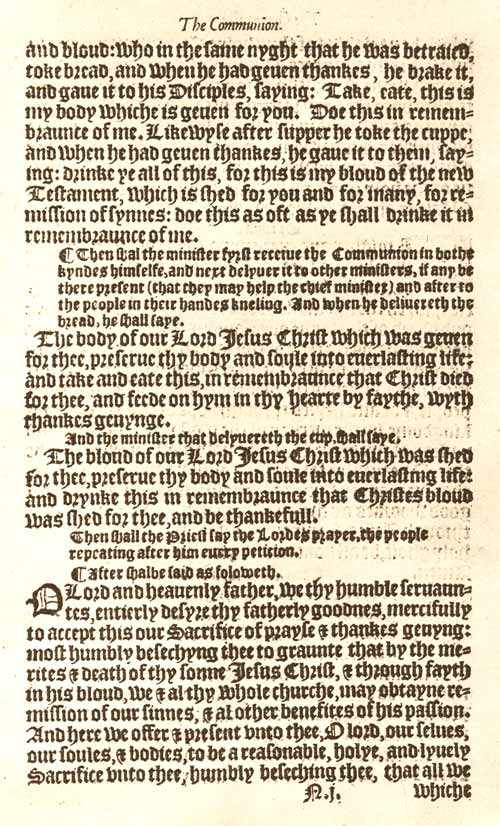
In his 1549 Book of Common Prayer, the first of its kind in English, Anglican Reformer Archbishop Cranmer instructed that these words be used by the minister "when he delivereth the Bread/Cup to anyone":

The body/blood of our Lord Jesus Christ which was given/shed for thee, preserve thy body and soul unto everlasting life.
These words are often read as referring to the identity of the elements so that (in some "physical" sense) the bread is Christ's body and the wine is his blood. However, notice that Cranmer's words are ambiguous. Taking the form of a prayer, they simply petition God for the preservation of the communicant's salvation (notice too the good resurrection theology implied in body and soul) through the broken body and shed blood of Christ. Nothing is said explicitly here about the status of the elements, leaving open a variety of different understandings about the relationship between the bread and wine being consumed and the body and blood which save.

By the 1552 edition of the prayer book, Archbishop Cranmer replaced the words of administration with this formula:
Take and eat this, in remembrance that Christ died for thee, and feed on him in thy heart by faith, with thanksgiving. ... Drink this in remembrance that Christ's blood was shed for thee, and be thankful.
The feeding upon Christ is now explicitly in thy heart and by faith. Notice again, however, that nothing is said explicitly about the status of the elements.

Part of Cranmer's genius in both formulations is to shift our attention from the status of the elements to the meaning of the act of eating them. This meaning is tied in with Christ's saving work in his death; to speak of shed blood and a broken body make a closer reference to the narrative of Christ's passion than simply mentioning body and blood.

In 1559, after Cranmer's execution, a third English prayer book was approved by Elizabeth I. The words of administration were simply a combination of 1549 and 1552:
The body of our Lord Jesus Christ which was given for thee, preserve thy body and soul unto everlasting life; and take and eat this, in remembrance that Christ died for thee, and feed on him in thy heart by faith, with thanksgiving. ... The blood of our Lord Jesus Christ which was shed for thee, preserve thy body and soul unto everlasting life; and drink this in remembrance that Christ's blood was shed for thee, and be thankful.
It's quite a mouthful, but it was this form that was picked up and used again in the definitive 1662 Book of Common Prayer, which continued to be the standard until a series of liturgical revisions across the Anglican communion in the twentieth century.

In Scotland, the words of administration were revised a number of time. In 1929, they were pared back to just the 1549 words, then a further revision in 1970 added this instruction: After the Words of Administration the Communicant shall answer Amen. The Words of Administration may be shortened at the discretion of the Priest. And then in 1982 (the current form still in use), a decisive shift occurred:
The Body/Blood of Christ given/shed for you.
Notice not only the capitals, but more importantly, the grammatical shift from petition to exclamation. No longer is a prayer being offered for the preservation of the communicant's salvation through Christ's passion. Instead, a nominal phrase (without a main verb) is substituted, which has the function of directing attention back to the elements themselves. More or less, these words say "Wow!" or "Look!".

However, having been to a number of communion services here in Scotland, I've noticed in both Scottish Episcopalian (Anglican) and Church of Scotland (Presbyterian) gatherings that even the narrative reference to "giving" and "shedding" are dropped, leaving simply the Roman Catholic words, which are short and to the point:
The body/blood of Christ.

Wednesday, April 16, 2008

Individualism as a herd mentality

Why should we in Australia reduce our emissions when China and India are so much bigger? Why should I avoid littering/speeding/wasteful consumption when everyone else does it and I can nearly always get away with it? Why should I be honest on my tax return when much bigger incomes are dishonest? What can one person do?

Individualism as a way of life inculcates a stunted imagination. I lose the capacity to see myself as one of many, as a member of a body. By limiting my sphere of influence and responsibility to myself, social issues become insurmountable, or at least endlessly deferrable as "someone else's problem". But where everyone lives for him or herself, everyone loses.

The church as the body of Christ, the household of God, the temple of the Holy Spirit is a real taste of salvation from the echo-chamber of a life lived curved in upon itself. I discover how much more spacious life is when I stretch out in loving openness to my neighbour. I find in them the image of God, the Breath of life, a brother or sister for whom Christ died. I no longer live and die for myself.

Tuesday, November 13, 2007

What is forgiveness? I

Once more plundering a recent sermon, I'd like to explore the concept and practice of forgiveness under four contrasted pairs.

(i) Not ignoring, but confronting
To forgive doesn’t mean the problem is swept under the carpet. Jesus said “If a brother or sister sins, go and point out the fault, just between the two of you. If they listen to you, you have won them over.” (Matthew 18.15) Forgiveness doesn’t mean ignoring the problem, hoping it will go away, pretending it is not happening. If we are going to be peacemakers, we’ll need to be loving troublemakers. Jesus doesn’t make this optional. "If you have a grievance you must, you are obligated to, confront the one you believe has sinned against you. You cannot overlook a fault on the presumption that it is better not to disturb the peace. Rather, you must risk stirring the waters, causing disorder, rather than overlook the sin" (Stanley Hauerwas, "Peacemaking: The virtue of the church" in The Hauerwas Reader, 319).

Why? Because there is no such thing as a private grievance. Our lives are not our own. We in the body of Christ belong to one another. The sister or brother who sins is hurting not only us, but also themselves and the community as a whole. Not every minor irritation requires explicit mention, but if it is a genuine wrong (rather than merely a personality difference) ignoring it is a failure of love.

Of course, during the process of confrontation we may well discover that we have been mistaken, that our grievance is not well founded. That is a risk we must take. Or we may find ourselves in even deeper waters - our complaint is accepted and the fault repented of and now we must be reconciled. But that is our goal: to learn to swim in the ocean of genuine relationships of trust, not simply to paddle about in polite acquaintances that never extend beyond Sunday pleasantries. Whom do you need to confront, rather than ignore?
Twelve points for guessing the inner western Sydney suburb in the picture.
Series: I; II; III; IV; V.

Friday, October 26, 2007

Williams on celebrating creatureliness

"Arguably what is going on in the work of redemption is, as St Irenaeus first put it, the reversal of Adam’s mistake. Adam’s resentment at not being God is transfigured by Christ into the free acceptance of not being God. That’s what Philippians chapter 2 is all about. The one who is in the form of God delights to be no longer in the form of God but in the form of a slave, and in that slave form of humanity, joining in our unfreedom, our suffering, our tensions and our struggles, the finite created form of humanity is glorified from within. Adam resents not being God and so Satan has leverage upon him: ‘You shall be as gods,’ says Satan to Adam, knowing that the essence of our fallenness is resentment at being creatures (just as the essence of the fall of Satan himself, in church tradition, is the refusal to worship). So Jesus, in not clinging to the form of God but accepting the humility of the incarnation and the death of the cross, restores the glory of creatureliness. The incarnation affirms that creation is good, not that it is nice or beautiful, but that it is good because it is in this relationship of loving dependence on the self-giving of God. And the mystery that we seek to understand when we think about redemption is that restoring of the glory of creatureliness can only be done by one who isn’t simply a bit of creation – the Word in whom creation hangs together, in whom alone is that full freedom which can accept the otherness, the suffering, the death of the created order and fill it with life. ‘He who ascended, is it not he who also descended?’ (Eph 4:9)

"So we in Christ rejoice at not being God. We ought to give thanks daily to God that we are not God and that God is God; we give thanks to God for God’s great glory. And the secret is that only in that rejoicing that we are not God do we come to share the divine life in the way we are made to do – the paradox that only by our completely not wanting to be God can the divine life take root in us.

"Discipleship in the body of Christ is in one sense simply a matter of constantly battling to be a creature, battling against all those instincts in us which make us want to be God or make us want to be what we think God is. There, of course, is the catch. And that’s why discipleship challenges at every level those unrealities which distort humanity, which distort creatureliness. That’s why discipleship challenges those enterprises in our world and our culture which feed the illusion that actually we could be God if we tried hard enough.

"What are those things about? Well you many find them in the deep unease so many in our culture feel about ageing and dying. You find it in our denials of death. You find it in our passion for absolute security, our desire never to be at risk. You may find it in a defence programme, you may find it in the technological exploitation of the environment. At level after level, our temptation is to deny that we are finite. And when I read, as sadly I sometimes do in discussions of our environmental crisis, that we can be confident technology will find a way, my blood runs cold, because I hear in that the refusal of real creatureliness. ‘These limits are temporary, our skills will find a way, we shall at some point be able to get to the stage where we are safe’. And the gospel tells us you never on earth get to a place where you are safe; but you will get to a place where you are blissful and united with your Father in heaven. In the immortal words of C S Lewis, ‘he’s not a tame lion, you know’.

"The outworking then of created wisdom, created Sophia, is this joyful embrace of being created, of not being God, the acceptance that we shall die, that we are fragile, that we are fallible. And it is ‘here on this lowly ground’, in John Donne’s phrase, that we come into contact with the transfiguring, transformative life of the eternal God. ... [O]ur holiness is not the denial but the acceptance of being creatures."

- Rowan Williams, Creation, Creativity and Creatureliness:
the Wisdom of Finite Existence
.

Sunday, September 09, 2007

O'Donovan on wakefulness IIIa: Resolving

Resolving
This is a summary of the third and final lecture of the 2007 New College lectures, Morally Awake? Admiration and resolution in the light of Christian faith, delivered last week by Professor Oliver O'Donovan. The first was called Waking, the second Admiring (and part two) and this one is Resolving.

-----

Each area of the good world has its own ethics: bioethics, political ethics, economic ethics, and so on. Yet despite the great variety and complexity of the world (and hence of the descriptive task), all such description is of types and so stays general. But when we ask about our decisions, we deal in and focus upon particulars: ought I do this action, now and under these circumstances? The object of our practical thinking is a future action and is thus, by definition, undetermined. It cannot be described, only resolved upon. In the second lecture, we considered the moral import of the descriptive task. The moral act begins here, but it doesn't end with description. 'Is' must become 'ought'.

Schleiermacher, the great nineteenth century German theologian, was a typical Romantic in that he desired to describe the moral life in terms of innate intuitive duties without reference to rational reflection. This was a stubborn mistake of Romanticism, yet he was onto something more important in his desire to scrutinise moral 'conflict' in order to show that no conflict existed in the final analysis. There are no real dilemmas, simply conceptual confusions or temporal coincidences. For example, I may be asked by my boss to lie and face an apparent conflict between my boss's authority and my duty to be truthful. But I need to realise that my boss's authority doesn't extend to requiring my falsehood.

His concerns have been echoed in the late twentieth century by those ethicists opposed to what they call "decisionism", the tendency to characterise the moral life in terms of decisions, as though the soul's main characteristic was to be divided against itself. But they go too far in denying a place for "decisions"; to cut the soul off from decisions is to cut it off from action. Decision is the soul coming to the point of action. Decision is (literally) the "cutting short" of the natural indeterminacy of thought, closing the question for the sake of practical action. It is not the choice between two options, but the point of resolution (see the end of the first lecture for an illustration of this). Decision does not occur in a vaccuum of thought. Nor is "deliberation" a better term, as it relies on the metaphor of weighing and so places too much emphasis on comparing alternatives and on proportional reasoning.

O'Donovan then spent some time exegeting Romans 12.1-8 as a summons to engage in action. The initial call in verse 1 (present your bodies as a living sacrifice) is far-reaching and requires further specification, which begins with how to think (verse 2). The role of thought doesn't end when admiration ends. Thought has to make the journey from is to ought. We are to distinguish what God wills for us now. Indeed, verse 3 tells us that we need to think about how to think (it is not about how to think about ourselves, as many translations imply, but how to think about thinking). When discussing the act of thinking, Paul uses the Greek verb phronein throughout this passage, which, as in Aristotle, is the verb for practical reason - the ability to reach specific and concrete determinations, judgements about behaviour that will be particular for each of us. This differentiation across the various members of the body of Christ and their differentiated faith leading to different ways of service occupies the rest of the passage (verses 4-8). Each is to follow a practical course of their own, not fitting a general pattern of the age, but a specific one for each, discerning God's will. The renewing of the mind in verse 2 is towards (Greek: eis) the discernment of God's will. The warning in verse 3 is not so much about pride (thinking too highly of oneself), but against overthinking, an inflated view of the self's practical task. We must neither accept the general pattern of the age, nor an inflated estimation of one's own import.

Faith has two sides: faith as belief (linked to the loving knowledge of the world discussed in the previous lecture); and faith as trust, which looks forward in hope. Hope requires imagination, which can be either too dull, or too 'overthought' (having great ambitions but without practicality, mere airy ideals).

-----

I will finish this lecture (and the whole series) tomorrow. Still to come is a discussion of the relationship between ideals and compromise and then some concluding reflections upon communal action and unity.
Twelve points for correcltly naming the Sydney suburb in which the photo was taken.
Series: I; IIa; IIb; IIIa; IIIb.

Thursday, August 16, 2007

The gospel: how is it good news? VI

Good news!
Jesus is king. It’s good news – because fear and terror don’t rule. Neither terrorists nor the politics of fear run the lives of those who trust the prince of peace.

Jesus is king. It’s good news – because injustice doesn’t rule. Oppression has a used-by date. So we are freed from the nightmare of having to achieve a perfect world now, free to work in small ways to make the improvements we can. Blessed are those who hunger and thirst for justice, for they will be filled.

Jesus is king. It’s good news – because karma doesn’t rule. We don’t need to take revenge, to even the score ourselves. Nor are we trapped irredeemably in our mistakes. Where Jesus is, grace reigns, not karma.

Jesus is king. It’s good news – because the church doesn’t rule. We are Christ’s body and his ambassadors, but we are not him. We don’t need to confuse our opinions with his truth. We follow as best we can, but no one person or institution is beyond error. We are free to admit our mistakes and learn from them.

Jesus is king. It’s good news – because my mortgage doesn’t rule. If Jesus is the Christ, then nothing else need rule my life, not a quest for wealth, for security, for status or influence. These all take their place as secondary things, tertiary things, quarternary things! I am free to be content and generous, enjoying God’s good gifts by sharing them wisely and liberally.

Jesus is king. It’s good news – because our children don’t rule. I don’t need to make my life revolve around maximising their every possibility, preventing every possible misfortune. I am free to love them enough to want to see them grow up as children of God, relying on him, not me.

Jesus is king. It’s good news – because my plans don’t rule. I am not left to my own devices to muddle out a path of my own devising in a mix of dream and nightmare. I am called to high and noble task: to love God with all my heart, mind, soul and strength, and to love my neighbour as myself. Or to put it another way: To be faithful to God by loving my neighbour, and to be faithful to my neighbour, by loving God.

The crucified Jesus is king. It’s good news – because my past doesn’t rule me. Broken relationships are not final. Guilt is atoned for. Forgiveness and reconciliation are possible because, as Paul said, Christ died for our sins.

The risen Jesus is king. It’s good news – because sickness and death don’t rule. We may fall ill, we may get cancer, we may be in accidents, or be intentionally injured. But death will not have the last word since we follow the one who is the resurrection and the life.

But how does he rule? And how can we know he does - when so often it seems like the bullies get the last laugh?
Series so far: I; II; III; IV; V; VI.
Five points if you can guess the Australian state in which this picture was taken.

Thursday, July 26, 2007

God with us? VI

Tasting the future today
And these tastes of the future, these glimpses of God's coming presence, are genuine tastes, real glimpses, because of the Holy Spirit, the Spirit of the future. The physical resurrected body of Christ is hidden with God, but he has poured his Spirit, the Spirit of the risen Christ, into those who follow his way. And so by the Spirit, God is with us today. Not physically, not in fullness, not unveiled. But truly with us. The Spirit blows where he will (John 3.8). We can’t control or summon him like a pet dog. But when the gospel is truly proclaimed and people turn to Christ, there is the Spirit, there is God with us. When love overcomes hate and indifference, when death doesn’t get the last word on the meaning of our life, when we acknowledge our interdependence with all living things, there is the Spirit, there is God with us. When we share a meal of bread and wine and find ourselves bound together by a bond of peace, there is the Spirit, there is God with us. Where Christ is proclaimed and honoured in word and deed, there is the Spirit, there is God with us. Where there is a broken heart that cries to God in loneliness and anguish, there is the Spirit, there is the presence of God: The LORD is near to the brokenhearted, and saves the crushed in spirit (Psalm 34.18).

I recently received an email from a friend in long-term isolation on a cancer ward which ended like this:

I feel God's presence very strongly at the moment and throughout all of this there have been many blessings. I have realised more than ever that I would rather cross a raging river with God that stroll on the river bank without Him. I cannot imagine what it would be like to go through this without Him.
God is an ever-present help in trouble (Ps 46.1). This help is not necessarily what we expect or demand, but exceeds all we can ask or imagine.

But what of our ordinary life? Is God with me day by day?
For thus says the high and lofty one who inhabits eternity, whose name is Holy: I dwell in the high and holy place, and also with those who are contrite and humble in spirit.

- Isaiah 57.15

The Spirit of Christ, like Christ himself, prefers to hang out with those who recognise their need, who come to life with empty hands and are quick to give thanks. Is this me? Am I contrite and humble, or am I so full of myself there's no room for anyone else, no room for God? Are we as a community humble? Is God with us?

God’s Spirit, the Spirit of Christ, breathes life into us as the body of Christ, as a community tied together by our experience of God with us. This is what animates our meetings, what quickens our passions; this is who gives us a word of comfort or careful rebuke, a word of apology or hope. This is who moves us to care for the lonely, to stand up for the weak and voiceless, to share with our neighbour. This is who enables us to live fearlessly. It is the Spirit of Christ, God with us. God is not stingy. Our everyday lives are saturated with hints and echoes of his presence. Moments of beauty, of humility, of grace and truth.

We live everyday in the presence of God. But he is not our magic talisman, our lucky charm, our guarantee of success, our assurance of being right. He is not so much on our side, as beside us – in our neighbour – and inside us, giving us no rest until we find our rest in him. God is with us, but he is not in our box. Remember, he sits on top of the box, ruling as king, enthroned between the cherubim. He is lifted up on a cross, ruling as king as the nails are driven home. He is alive and amongst us as we live and move and have our being. He can be found in an embrace, seen in a gift, heard in a kind word, yet heaven and earth cannot contain him. He is here. He is coming soon.

Come Lord Jesus. Amen.
Series: I; II; III; IV; V; VI.

Wednesday, June 06, 2007

The play's the thing: Vanhoozer's Divine Comedy

The Drama of Doctrine: A Canonical-Linguistic Approach to Christian Theology (Louisville: Westminster John Knox, 2005)
What is the place of doctrine in following Jesus? Is it a human construction that distorts the Bible? Or a luxury of decadent, introspective Christianity substituting for practical action? Neither, claims Vanhoozer in The Drama of Doctrine; doctrine is precisely what relates the Scriptures to our individual and corporate obedience. In doing so, he aims to reclaim doctrine as energetic, energising and ecumenical in an age that sees it as dull, distracting and divisive.

--------

Taking his cue from the world of theatre, he proceeds at some length to develop the metaphor of drama in four directions: drama, script, dramaturge and performance.

First, adopting and adapting von Balthasar's Theo-drama, Vanhoozer recasts salvation history as a divine comedy, a ‘theo-drama’ in which God is protagonist and Jesus the pivotal climax. Of course, like all good plays, this one has five acts: Creation, Israel, Jesus, Church, and Eschaton (which came first, the metaphor or the biblical theology, remains unspecified).*
*Indeed, it is difficult to either prove or disprove the effect of the theatrical allegory in providing an unacknowledged (even unconscious) ‘confirmation’ of certain details of his approach.

The triune hero performs a fully rounded part; the destructive dichotomy between divine actions and words is healed with the help of speech-act theory. God’s mighty actions communicate, and his words get things done.

Second, having oriented us to the (theo-)drama, we meet the authoritative script: the Bible. In constant dialogue with Lindbeck’s influential The Nature of Doctrine, Vanhoozer agrees with Lindbeck’s desire to move beyond a narrow pre-critical cognitive theology of fundamentalism and an equally reductionist liberal experiential-expressivism. For Lindbeck, the cultural-linguistic turn in twentieth century western thought means that biblical hermeneutics (and thus theology) must be grounded in the practices of the ecclesial interpretive community. Yet there is a dangerous circularity in which the Bible read through the lens of contemporary church life can only affirm that very life; the church becomes unreformable and the externality, the potentially critical otherness of God’s voice in Scripture, is silenced. Therefore, while loath to lose the hermeneutical insight linking reading to community praxis, Vanhoozer argues for authorised canonical practices that guide our reading and help avoid the solipsism of fundamentalism.* Thus, he retrieves the possibility and actuality of error in and by the church (p. 233), yet without thereby cutting loose hermeneutics from tradition. And so, instead of Lindbeck’s postliberal cultural-linguistic theology, Vanhoozer introduces a postconservative canonical-linguistic one.
*Two examples of such canonical, even dominical, practices are figurative readings of Scripture (pp. 220-24) and prayer to the Father (pp. 224-26).

Third: enter playwright, stage left. Just as in the larger theo-drama, the climactic third act of the book sees the author join the action. Unlike the primary performance, however, this is no divine hero-saviour come to set all things right, but merely a theologian. The function of the theologian is instead that of the little-known dramaturge, mediator between script and director.* The theologian as dramaturge is a resource for the company, helping the director in ensuring the script is understood and applied with creative faithfulness, neither parroting nor forgetting previous acts and scenes of the theo-drama.** Performing this task requires both scientia (to read the script with disciplined understanding) and sapientia (to relate it practically to the mundane dramas of quotidian experience); each scores a full chapter.
*The director (or at least assistant director to the Holy Spirit) is the local pastor, mediating the script(ures) to his company of players.
**Faithfulness is thus dramatic fittingness: both to the primary theo-dramatic performance and to the contemporary context of a local production (pp. 256-63).


One example of theology’s sciential function is seeing the doctrine of Trinity as a dramatis personae, a crucial abbreviated guide for an understanding of the canonical script, yet itself arising authentically from a careful scriptural reading.

A key sapiential concept is ‘improvisation’, which, when undertaken by serious actors, is no arbitrary ad-libbing of lines for quick laughs, but a discipline of focussed memory and creative attention that seeks what new thing must be said or done in order to drive forward the action while remaining consistent with the drama thus far. Understood in this way, even God is an improviser: ‘The theo-drama itself develops largely through divine improvisation on a covenant theme…. God overaccepts even human blocking by incorporating it into the broader covenantal comedy.’ (pp. 340-41)

Fourth, the contemporary performance itself takes the spotlight. Again, he shares Lindbeck’s concern for the regulative function of doctrine but wants to based this primarily on canon, not church. More than a collection of true statements about God, doctrine orients performers towards apt action. Here, his ubiquitous (and by this stage more than slightly stretched) metaphor comes into its own in foregrounding the instrumental rather than intrinsic value of the Bible and theology. The goal of both script and direction is to serve the drama: ‘script and performance are equally necessary, though not equally authoritative. Biblical script without ecclesial performance is empty; ecclesial performance without biblical script is blind’ (p. 362). The authority lies with script (Bible); the teleology with performance (praxis); the mediation with direction (theology). Indeed, in yet another self-reflexive moment, Vanhoozer’s theological metaphor-making is at this point executing precisely the task of theology in his allegory: helping us see how the Bible can and must be lived out with creative faithfulness. To illustrate theology in service of praxis, he stages some scenes with the motifs of martyrdom and forgiveness under the direction of atonement.

For an encore, he places creeds, confessions and pastors as, respectively, masterpiece and regional theatre, and assistant directors (under the Holy Spirit): pp. 445-58.

--------

Vanhoozer admits at the outset that the relationship between theologian and thespian has long been frosty, and many readers may feel uneasy about the trapdoors hidden in the floorboards of his metaphor. Before walking out too quickly, however, it’s worth taking a seat and perusing the benefits of admission.

All but the most unreformed modernists recognise the great explanatory power (and canonical basis) of narrative in theological reflection. Drama is a species of narrative, and so retains all its conceptual benefits (e.g. sequence, configuration, characterisation), while adding fruitful modifications, such as a synergy with speech-act theory and a greater potential to get ‘caught up in the action’ through a more permeable barrier between ‘text’ and responder (pp.48-49).

The concept of ‘speech-acts’ helps to disentangle knotty disputes about the relationship of Scripture and tradition through the distinction between locutions (the words used) and illocutions (the actions performed by those words: promising, warning, inviting, asserting). Merely replicating canonical locutions can (and in shifting cultural-linguistic contexts will) result in distorting God’s scriptural illocutions (pp. 126-28). It is the illocutions that tradition seeks to preserve and translate, though it is only these locutions that are authoritative guides to the illocutions (p. 74). The concept of illocution also reveals the limitations of locating our doctrine of Scripture simply under the heading of ‘revelation’, since God does more through it than merely reveal himself (pp. 45, 277).*
*While appreciating the intellectual yield of speech-act theory, some basic narratology would have sharpened his claim that the illocutions of Scripture are God’s (p. 67) by specifying which illocutions are the relevant ones (viz. those of the implied author, though not necessarily of the narrator or every character). Similarly, infelicitous claims about the addressees of Scripture (p. 67) could have also been avoided.

These dramatic (in both senses) benefits notwithstanding, apprehension remains concerning his almost allegorical application of a single metaphor to explain a whole company of concepts. Has theatre become the master key to all theology? He vigorously criticises directors who use a ‘production concept’ to usurp the communicative intent of the authorial script (p. 250); is he, to invoke the Bard, ‘hoist with his own petar[d]’?

Before we jeer this show with cries of ‘hypocrisy’, it is important to note four mitigating factors: (a) the frequency of non-theatrical metaphors and the pivotal roles they play in his cast of images;* (b) the acknowledgement of the necessity of other voices in the theological dialogue (p. 275); (c) the recognisably orthodox account of doctrinal touchstones it yields; and (d) his en route corrections and criticisms of the limitations of his selected metaphor. This final one is worth further comment. Sometimes he corrects one piece of the analogy with another: using ‘improvisation’ to supplement and correct potentially misleading aspects of treating Bible as script. At other times, he debunks commonly misunderstood theatrical realities: improvisation as arbitrary ad-libbing (pp.340-41). Occasionally, he even simply abandons implications of the metaphor: ‘Like other analogies, this one can be pressed too far. To insist that everything in drama must have a theological counterpart runs the risk of turning a simple analogy into a complex allegory.’ (p. 243)
*To spotlight a few: trial (pp. 21-24), epic/lyric (pp. 84-93), fittingness (pp. 108-10), ‘transposition’ (pp. 254), map (pp. 294-99), habits (pp. 374-77), and dieting to be spiritually ‘fit’ (pp. 374-80).

Perhaps it is pressing too far to criticise the implicit activism of the church, whose raison d’être as company of performers is construed in instrumental fashion to the detriment of its intrinsic value as redeemed community (p. 71). Perhaps not.

There is nonetheless a certain messiness to the metaphor as it is pushed and expanded in multiple directions. Like a Shakespearean company with more roles than players, the same faces appear in different guises. God is the playwright, the executive director, and the protagonist (pp. 64, 243). While a robust Trinitarian theology may take this in its three-legged stride, the Bible also (somewhat disconcertingly) makes three appearances: as the authorised memory of the original theo-drama, as an actor in the ongoing performance (p. 35, 48), and as script for that performance (p. 115-241). Christians are alternatively audience then actors, mirroring God’s move from actor to audience (p. 37). Part of the confusion is comprehensible when one keeps in mind there are two performances: the primary theo-drama in five Acts, and a multiplicity of secondary local shows that comprise Act Four (p. 252).

Even so, the characterisation of the Bible remains somewhat unresolved. The Bible as ‘script’ works well in discussions of authority in Part Two, yet becomes cumbersome and is virtually denied by the idea of ‘improvisation’ in Part Three (pp. 307, 335). The ‘script’ doesn’t have all the lines for Act Four (the life of the church) and so its authority is of a particular kind: setting the dramatis personae, plot line, and ultimate resolution in Act Five,* as well as exemplifying previous faithful improvisations (p. 344). The Bible as actor also seems to be a category error (p. 48), unless it is always understood as a shorthand for God’s agency through Scripture as instrument.
*Indeed, much more could have been made of eschatology’s role in bringing a dead performance to life. The weight of the volume was retrospective.
**On this point, N. T. Wright is both Vanhoozer’s source and is clearer: “How Can the Bible Be Authoritative?”, Vox Evangelica 21 (1991): 7-32.


The slight ambiguity raised by the frequent personification of Scripture as agentive is compounded by some undifferentiated linguistic parallelism between Christ and the Bible (p. 31, 35, 295). Of course, Scripture as a fourth hypostasis is denied (p. 227),* but John Webster’s careful account of Scripture as a sanctified divine servant is less prone to confusion on this matter (p. 293).
*Does anyone own up to that?

Although it may seem masochistic to accuse such a voluminous volume of sins of omission, the treatment of Scripture’s relationship to Christ also lacked much recognition of the theo-dramatically relative role of Scripture: ‘The only Christ we have is the Christ of the Scriptures.’ (p. 46, emphasis added) Although it is true that even the apostles had ‘the Christ of the [OT] Scriptures’, they also had the Christ of the flesh.* Vanhoozer’s reluctance to get his hands too dirty in the history of canonical formation (pp. 142-43) is echoed in the lack of a detailed theo-dramatic account of how God communicated prior to the completion of the canon.
*And what of the Christ of the pre-(proto?)-scriptural oral traditions?

Those criticisms aside, his theological treatment of Scripture remains a highlight of his approach. Central to his project in Part Two is the claim that sola scriptura is not so much principle as practice (pp. 115, 141, 153). Crucially, this Reformation battle cry was not answering ‘How many sources should one use in doing theology?’ but ‘where can we find the supreme norm by which to measure Christian deeds and Christian doctrine?’ (p. 232). The sufficiency of Scripture is material, rather than formal (p. 156). Vanhoozer’s rich and nuanced account is thus able to acknowledge that tradition and church are valuable, even indispensable aids in the interpretive process, without compromising the irreplaceable and unaugmentable centrality of the Bible in our knowledge of and obedience towards God. The ‘logic of justification’ needn’t follow the ‘logic of discovery’ (p. 165).

Similarly, his recognition of the dangers of generic reductionism is refreshing (pp. 139, 215. 285). Each genre has its own voice (p. 270), its own factual precisions, ways of life and higher order illocutions (pp. 283-87), its own irreducible input to the diverse unity of God’s scriptural communicative act. The canon has ‘an eschatological completeness, differentiated wholeness and plural unity’ (p. 275). As with canon, so with theology: what no single genre can assert (a unique and exclusive possession of the entire truth), no tradition can demand; what each genre can enjoy (a unique and necessary contribution to the apprehension of God’s being and acts), each truly Christian tradition must be granted (p. 275, 422).

This insight promotes his vision of a catholic-evangelical orthodoxy: keeping a definite theo-dramatic centre without denying the genuine and legitimate catholic diversity of contemporary and historic performance (p. 30). In this vision, doctrine divides the right things, rather than Christ’s body, and this, not because theological truth isn’t important, but precisely because it is (pp. 421-26).

Of course, Vanhoozer is not the first theorist to earn an intellectual living making a spectacle of this metaphor in our mise en scène. Even theologians, traditionally slowest off the mark in realising the backdrop has changed, have started rehearsing their lines in preparation for this ‘brave new world that has such people in’t’. Vanhoozer’s novelty lies in attiring the task of doctrine in this fashionable analogy. And not only dramatologists, but also a number of influential voices in contemporary thought make significant cameos: Bakhtin, Derrida, Gadamer, Nussbaum, Wittgenstein. Divers alarums: has he sold out to philosophical trends? Has his great learning driven his orthodoxy mad? This very dynamic is (in line with postmodern orthopraxis) reflected upon in the text. His response is that plundering this particular Egyptian trinket is justified as part of theology’s task of translation, or transposition, of the canonical melody into a contextual key. And of course, as one voice in a dialogue, his contribution suffers critical appreciation and correction.

His eclectic and multi-disciplinary interlocutors enrich his contribution to each of the many academic conversations he joins. However, as already noted, this breadth can occasionally leave him looking sloppy or naïve. In his epistemological discussion (pp. 265-305), he mistakenly assumes foundationalism entails infallibilism (pp. 292, 295), misapprehends the purpose of the web metaphor and so commits a category error in comparing it to his map metaphor (p. 297).* Similarly, his brief reference to photography shows little awareness that the ‘objective’ reputation of photos is as ripe for deconstruction as that of maps (p. 296). His discussion of ‘propositionalism’, presumes an atomistic semantics (pp. 266-78).
*These two metaphors illustrate answers to different questions. The map is an attempt to say something about how knowledge relates to ‘reality’; the web is a picture of how different parts of a worldview relate to each other. Thus, web should be contrasted to foundation, while map should be pitted against the early Wittgenstein’s (indeed Aristotle’s) idea of language ‘picturing’ reality.

Unfortunately, even his specifically theological epistemology confuses the effects of sin with (good) creaturely limitations on our knowledge, and in doing so, obscures the hermeneutics of suspicion behind the hermeneutics of finitude. Human fallenness does not lead to fallibilism as he claims (p. 303),* but to a healthy suspicion of our ability to hide selfish motives, even from our own consciousness.**
*Fallibilism is instead another epistemic implication of being created in embodied socio-cultural particularity. See James K. A. Smith, The Fall of Interpretation: Philosophical Foundations for a Creational Hermeneutic (Downers Grove, Il.: IVP, 2000).
**For an excellent discussion of this theme, see Merold Westphal, Suspicion and Faith: The Religious Uses of Modern Atheism (New York: Fordham, 1998).

--------

When all’s said and done, Vanhoozer’s (over)long performance is sometimes sloppy, often inspiring, always stimulating. The stars that shine most brightly are the indispensability of canonical authority (or rather Christ's authority through the canon), the urgency of contemporary obedience, the responsibility of conceptual creativity and the possibility of dogmatic relevancy. Four stars.

Wednesday, November 01, 2006

Heaven: not the end of the World XIV

Seeing GodAugustine concludes his massive City of God with a discussion of those wonderful biblical promises that we will see God: 'Blessed are the pure in heart, for they shall see God.' Although our knowledge of God is presently like looking through a dim mirror,* in the resurrection it will have the clarity and certainty of knowing 'face to face'. But how can we see God? God is invisible. Could it be that we will 'see' God in the same way that we can 'see' that two and two are four? Perhaps, but Augustine doesn't think this is adequate, especially since last time God showed himself, he looked more like a Galilean peasant than a mathematical equation.
*First century mirrors were polished metal, and thus only gave a dim and somewhat hazy image.

That God raised Jesus from the dead means that God thinks bodies are important. He made a good world, and Jesus resurrection is the firstfruits of its redemption. It is not simply a disembodied soul that God is interested in, but our full corporeal and corporate life. Indeed, Augustine links these two - having a body means being part of a body. When the physical body of Christ rose, it was also a sign that the community known as the body of Christ is also to be redeemed. Salvation is personal, but not individualistic. We are saved into and for a community. Our destiny is social.

What does this have to do with seeing God? Here's how Augustine links them:

It may well be, then – indeed, this is entirely credible – that, in the world to come, we shall see the bodily forms of the new heaven and the new earth in such a way as to perceive God with total clarity and distinctness, everywhere present and governing all things, both material and spiritual. In this life, we understand the invisible things of God by the things which are made, and we see Him darkly and in part, as in a glass, and by faith rather than by perceiving corporeal appearance with our bodily eyes. In the life to come, however, it may be that we shall see Him by means of the bodies which we shall then wear, and wherever we shall turn our eyes. In this life, after all, as soon as we become aware of the men among whom we live, we do not merely believe that they are alive and displaying vital motion: we see it, beyond any doubt, by means of our bodies, though we are not able to see their life without their bodies. By the same token, in the world to come, wherever we shall look with the spiritual eyes of our bodies, we shall then, by means of our bodies, behold the incorporeal God ruling all things.

- Augustine, City of God 22.29.

Augustine thinks that as we look around ourselves, and particularly as we look at our redeemed community centred around the risen Christ, that through all and in all and over all we will truly see God.

Perhaps this is how we might understand Paul's comment in 1 Corinthians 15 when he says that after the resurrection, God will be all in all. I realise, as did Augustine, that this is a suggestion of how things might be, and not necessarily the only way of understanding these promises. However, to me, it draws together so many threads and makes good sense of the God who thought it was not good for the man to be alone, who speaks of his salvation as being like a city, and whose son died and rose in a body so that the body of Christ might live.
Series: I; II; IIa; III; IV; V; VI; VII; VIII; IX; X; XI; XII; XIII; XIV; XV; XVI.
Ten points for guessing the artist in the above pic.

Sunday, October 08, 2006

Augustine on bodily resurrection

"The bodies of the saints, then, shall rise again free from blemish and deformity, just as they will be also free from corruption, encumbrance, or handicap. Their facility [facilitas] will be as complete as their felicity [felicitas]. This is why their bodies are called "spiritual", though undoubtedly they will be bodies and not spirits. For just as now the body is called "animate" [animale], though it is a body and not a "spirit" [anima], so then it will be a "spiritual body," but still a body and not a spirit.

"Accordingly, then, as far as the corruption which weighs down the soul and the vices through which "the flesh lusts against the spirit" (Gal 5:17) are concerned, there will be no "flesh," but only body, since there are bodies that are called "heavenly bodies." (1 Cor 15:40). This is why it is said, "Flesh and blood shall not inherit the Kingdom of God," and then, as if to expound what was said, it adds, "Neither shall corruption inherit incorruption." (1 Cor 15:50). What the writer first called "flesh and blood" he later called "corruption," and what he first called "the Kingdom of God" he then later called "incorruption."

"But, as far as the substance of the resurrection body is concerned, it will even then still be "flesh." This is why the body of Christ is called "flesh" even after the resurrection. Wherefore the apostle also says, "What is sown a natural body [corpus animale] rises as a spiritual body [corpus spirituale]." (1 Cor 15:44). For there will then be such a concord between flesh and spirit—the spirit quickening the servant flesh without any need of sustenance therefrom—that there will be no further conflict within ourselves. And just as there will be no more external enemies to bear with, so neither shall we have to bear with ourselves as enemies within.'

- Augustine, Enchiridion, §91.

My most recent heavenly post has started a discussion on the nature of the resurrection body. Come and join in.