God wants you to be healthy, wealthy and happy

I don't pretend this is a full account, simply a small counterweight to overly triumphalist baptisms of our present comfort.


"Give us peace, Lord God, for you have given us all else; give us the peace that is repose, the peace of the Sabbath, and the peace that knows no evening. The whole order of exceedingly good things, intensely beautiful as it is, will pass away when it has served its purpose: these things too will have their morning and their evening.
"But the seventh day has no evening and sinks toward no sunset, for you sanctified it that it might abide for ever. After completing your exceedingly good works you rested on the seventh day, though you achieved them in repose; and you willed your book to tell us this as a promise that when our works are finished (works exceedingly good inasmuch as they are your gift to us) we too may rest in you, in the Sabbath of eternal life.
"And then you will rest in us, as now you work in us, and your rest will be rest through us as now those works of yours are wrought through us."
- Augustine, Confessions
Holy Saturday falls upon a Sabbath. The work of the Son of Man is complete and he rests from his labours. Dying with dignity does not mean a pain-free death, or a quick death, or a death that is not a burden on others.
First, though suffering is a result of a broken world and ought to be minimised where possible, nevertheless, in God's redemptive grace even the darkest experiences can become reflections of his faithfulness and manifestations of his love. That is one of the many lessons of the cross.
Second, if it is not about the pain, the anxiety many of us feel about a slow death arises from knowing that I am dying. But a slow death with one's eyes open need not be more terrifying than a sudden one; our fear of death and dying is met by the word of the risen Lord: "peace be with you".
And third, the process of dying will most likely be a burden carried not only by me, but also by those I love. But this is one of those points at which we are to bear one another burdens, to share the experience of ill-health and dying so that the load is lightened in being shared. Indeed, to withhold this from those around you is not a blessing, but a missed opportunity to allow others to participate in your dying. Death is the ultimate exile, the final isolation, the conclusion of all relationships. But by sharing even our dying with one another, we express our hope in the God whose love is stronger than death.
Dying with dignity means a death in which one's identity is not destroyed; it means a death in which one's humanity is not shattered; it means dying without losing your self. The martyr dies with dignity because she refuses to conform to the dehumanising powers that demand a divided self. Christ died with dignity because he trusted his Father, even when it appeared he was abandoned. "Into your hands I commit my spirit": a bloody, brutal, nasty death, yet one that utterly failed to degrade the dignity of the obedient Son.

O come, Desire of nations, bind
In one the hearts of all mankind;
Bid Thou our sad divisions cease,
And be Thyself our King of Peace.
Rejoice! Rejoice!
Emmanuel shall come to thee, O Israel.
 Have you ever paused to think how strange a thing church is? Over the weekend, I found myself trying to explain the concept to someone without much experience of a Christian community before. These were some of my attempts in a long rambling conversation that spanned a few hours in a pub.
We’re an open-ended experiment testing the words of Jesus.
We’re an alternative society based not on money or beauty or usefulness, but on grace, on God’s free gift.
We’re a community who recognise the need to continually confess our failures, repent of them and forgive one another if we are to live together in anything more than polite superficiality.
We’re a global peace network suspicious of both bland globalisation and violent tribalism.
We’re a bunch of people who find it impossible to not talk about God. And who find it impossible to talk about God without speaking of Jesus. And who find it impossible to talk about God without ending up talking to God, often with laughter or tears.
 Your God reigns!
Yesterday I began a new series about the gospel, the good news, that lies at the heart of what it means to follow Jesus, what it means to be his church. The attempt to articulate this message to a changing world is one of the chief occupations of the Christian community. It has taken many forms. But each generation must return to the Scriptures to discover it again.
There is one image that consistently comes up when biblical authors speak of 'good news' or 'gospel'. Here’s a classic example in the prophet Isaiah hundreds of years before the time of Jesus:
How beautiful on the mountains are the feet of those who bring good news [or 'who tell the gospel'], who proclaim peace, who bring good tidings [or 'who tell the gospel'], who proclaim salvation, who say to Zion, “Your God reigns!”
-Isaiah 52.7
Bringing good news, telling the gospel, is here parallelled with proclaiming peace or proclaiming salvation. But what is the message that promises peace? What is the announcement that will mean salvation? It’s there at the end of the verse: “Your God reigns!” The God of Israel reigns as king. This was the newsflash, the glad tidings, the joyful announcement that, according to Isaiah, lay at the heart of any hope for peace or salvationVision of Humanity have created a Global Peace Index that ranks 121 countries according to their level of 'peacefulness', using a variety of internet and external factors. The full list is here, but the top ten most peaceful countries in the world are:
1. NorwayAustralia comes in at #25 and if you're looked for the US, scan down to #96 - between Yemen and Iran. New Zealand would have been #1 but for the orcs.
2. New Zealand
3. Denmark
4. Ireland
5. Japan
6. Finland
7. Sweden
8. Canada
9. Portugal
10. Austria
Nice post on building walls and seeking peace over at Disruptive Grace. Here's a taste:
In order for there to be true reconciliation and lasting peace, parties must see each other face to face. One's picture of the other must remain open and dynamic. Those enemies who do not see one another have the wildest imagination for seeing evil in the other.
Will you end wars by asking men to trust men who evidently cannot be trusted? No. Teach them to love and trust God; then they will be able to love the men they cannot trust, and will dare to make peace with them, not trusting in them but in God.
For only love - which means humility - can cast out the fear which is the root of all war.
If men really wanted peace they would ask God and He would give it to them. But why should He give the world a peace which it does not really desire? For the peace the world seems to desire is really no peace at all.
To some men peace means merely the liberty to exploit other people without fear of retaliation or interference. To others peace means the freedom to rob one another without interruption. To still others it means the leisure to devour the goods of the earth without being compelled to interrupt their pleasures to feed those whom their greed is starving. And to practically everybody peace simply means the absence of any physical violence that might cast a shadow over lives devoted to the satisfaction of their animal appetites for comfort and pleasure.
Many men like these have asked God for what they thought was "peace" and wondered why their prayer was not answered. They could not understand that it actually was answered. God left them with what they desired, for their idea of peace was only another form of war.
So instead of loving what you think is peace, love other men and love God above all. And instead of hating the people you think are warmakers, hate the appetites and the disorder in your own soul, which are the causes of war.
- Thomas Merton, Seeds of Contemplation (London: 1949), 72-73.
A short new series
 Because your steadfast love is better than life, my lips will praise you.
Psalm 63.3
Death is a Bad Thing. Death is the last enemy. It is not a comfort, a friend, a doorway to the world beyond, the river Styx before Hades or even the river Jordan on the threshold of the promised land."Lord, now you are letting your servant depart in peace, according to your word; for my eyes have seen your salvation.” (Luke 2:29-30)In the light of the visible arrival of God's salvation in this little child, Simeon's imminent departure is now filled with hope. This salvation is not from death, as if he can now avoid walking this dark path altogether, but will be salvation from out of death - new life on the far side of sleep.
Is it possible to “depart in peace” in a way that still shows the kind of disgust for death that Jesus showed outside Lazarus’s tomb? Perhaps we should rail against death not with despair but with assured anticipation.
 In earlier posts, I started laying out some thoughts for a sermon I would have preached on Luke 1.67-80. Having been liberated from a divinely-imposed silence, Zechariah bursts into song over the divinely-acheived salvation of Israel. Such salvation means not simply deliverance from the hands of enemies, but more fundamentally "light to those who sit in darkness, in the shadow of death".
This is all of us. None of us by worrying are able to add a single hour to our life. None of us can guarantee tomorrow. We are all dying, giving birth astride a grave. Although some might be more aware of being close to death, this is a matter of quantity rather than quality. The universally deadly future casts its grim shadow back upon all the living. Our society either obsesses over death, or refuses to look or think about it. Either way - whether in explicit fixation, or implicitly through resolute denial - we live as though death is the definitive reality in life, colouring all existence.
It is this morbid situation that Zechariah realises God is addressing. How does God execute this salvation from the shadow of death? By raising up a mighty saviour in the royal line of David. Of course, this points forward to the rest of Luke's narrative. By the end of the story, that a saviour has been "raised up" (now with an extra and more direct meaning) makes all the difference to those who pale at the approach of death. Zechariah puts it like this: "By the tender mercy of our God, the dawn from on high will break upon us, to give light to those who sit in darkness and in the shadow of death, to guide our feet into the way of peace.” The resurrection of Jesus dispells the gloom of death. Death is still there, but its terrors melt away in the breaking dawn.
And what is the intended goal of this salvation? God doesn't simply remove the negative, but replaces it with a positive design. From sitting in darkness, we can now rise and walk "the way of peace". Having been saved from enemies, especially the last enemy death, we are liberated to fearless service.
Service seems risky. So often, we are anxious that if we pour our lives out in service of God and neighbour, we might miss out. Our attempts to bless might be repaid with curses. We might be left forgotten. But the one who remembered his holy covenant with Abraham will not forget you. And the one who has dawned upon us will bring everything to light.
Daylight is come, our saviour is risen, the path of peace lies gleaming before us. Let us follow our master in service without fear.
Series: I; II; III.
A series by Andrew Errington
III: The cross and the wrath of God
 I have been arguing that governing authorities who “bear the sword” are a God-given provision for this age, servants of God who provisionally and imperfectly reflect his final judgment on the last day. This does not weaken Jesus’ ethic of non-resistance and nonviolence for the Christian community. “Judge not,” says our Lord; and we dare not disregard his warning. Yet it does mean that “within the New Testament the sphere of public judgment [that is, the determinations of right and wrong made and enforced by political authority] constitutes a carefully circumscribed and specially privileged exception to a general prohibition of judgment” (Oliver O’Donovan, The Ways of Judgment, 99). Within this carefully circumscribed sphere the use of “violence” (in some sense) to forcefully enact judgments cannot be ruled out as categorically wrong.
A clear view of the wrath of God is central to this argument. Without it, Christian ethics are unintelligible. The wrath of God means Christians must not resist the evildoer, but instead love their enemies and overcome evil with good; and it means governing authorities must resist the evildoer, bearing the sword with justice.
This position remains deeply Christocentric. It is because Jesus himself will one day return to judge the living and the dead that we may contemplate the ways of judgment here and now. Yet it is perhaps a less cross-centred ethics than that advocated by Kim Fabricius (see Part I). Previously, Kim has described Jesus as “the hermeneutical criterion of all scripture” (Propositions on peace and war: a postscript Yet his arguments seem to go further and see the cross as the hermeneutical criterion for all that Jesus is, and so all that God is. A similar idea was hinted at by Ben Myers when, in his wonderful Theology for beginners series, he described Jesus’ resurrection in this way: “God took this dead man through death into new life, into the life of God’s future. Precisely as a dead man, he lived! Precisely as the Crucified One, he became the Risen One!” (Theology for beginners (7): Resurrection, my italics). What does this mean? Does it imply that the death of Jesus is the definitive moment in God such that anything that cannot be said of God at this moment cannot rightly be said at all?
The not-quite-pacifist position diverges at this point because of the conviction that the death of Jesus is not the final thing to say about God. The one who was crucified is now exalted as Lord and will return. To be sure, he still bears the marks of the nails in his hands, but these now show not only his surrender to death but his defeat of it. Now Jesus reigns, and he must do so “until he has put all his enemies under his feet” (1 Cor. 15:24). If what we have to say about God is at odds with this Jesus, then, too, we may end up with a “decaf theology” (see Propositions on peace and war: a postscript). "As the cross is not the sum of how Jesus 'went about doing good,' so neither is the command 'follow me' exhaustively accounted for by the words: 'when you are old you will stretch out your hands, and another will gird you and carry you where you do not wish to go.'" (O’Donovan, The Just War Revisited, 11).
I’d like to thank Kim for this opportunity to enter into conversation with one whose knowledge and imagination far exceeds my own. I hope some of my thoughts have been half as interesting as his have been for me. Series: I; II; III.
A series by Andrew Errington
 II: Violence and the judgment of God
The argument for Christian pacifism finds its basis in the nonviolence of God: “unless the opponents of pacifism can demonstrate a violent streak in Jesus himself… their case is like espresso without caffeine – it lacks the essential ingredient.” (Propositions on peace and war: a postscript)
But is there violence in Jesus? The suggestion seems repellent; yet we must remember that there are New Testament texts which seem to say exactly that. The Lord Jesus will be “revealed from heaven with his mighty angels in flaming fire, inflicting vengeance upon those who do not obey the gospel…” (2 Thess 1:7-8). And the idea of the wrath of God is central to New Testament discussion of God’s future, providing the rationale for Christian non-resistance: “Beloved, never avenge yourselves, but leave room for the wrath of God; for it is written, ‘Vengeance is mine, I will repay, says the Lord.’” (Rom 12:19).
But does this entail violence? The imagery in 2 Thessalonians is certainly powerful. Yet there are reasons to hesitate. As many have pointed out, when we look at the images of God’s judgment in the Apocalypse they are often ironic and self-defeating. The Lion of Judah goes Baa! The army of conquest is led by the Prince of martyrs! The rider on the white horse strikes with a sword, but it is a sword that comes (as a word) from his mouth! Will God’s vengeance be violent? Perhaps we are best to remain agnostic at this point. It is perilous to speak too concretely about realities that are more than a little beyond us.
Does this mean that a firm argument against pacifism is impossible? Not necessarily. Contrary to Kim’s assertion, those who argue against absolute pacifism do not need to demonstrate that there is violence in God, but only that the identity of God in the final judgment is not incompatible with some forms of human violence in the present. The not-quite-pacifist believes that the execution of judgments by force in this present age is a necessary reflection of God’s final judgment, albeit a reflection as in a glass darkly. The return of Christ may not involve violence per se; but it will involve the wrath of God; and this is the basis for the fearful task of provisionally and imperfectly executing judgments by force. This is the lot of the governing authority, who “does not bear the sword in vain,” but is “the minister of God to execute his [i.e. God’s] wrath on the wrongdoer” (Rom 13:4). The ruler who thinks she can execute God’s wrath in this age without some kind of forceful punishment has, perhaps, too lofty a view of her capabilities.
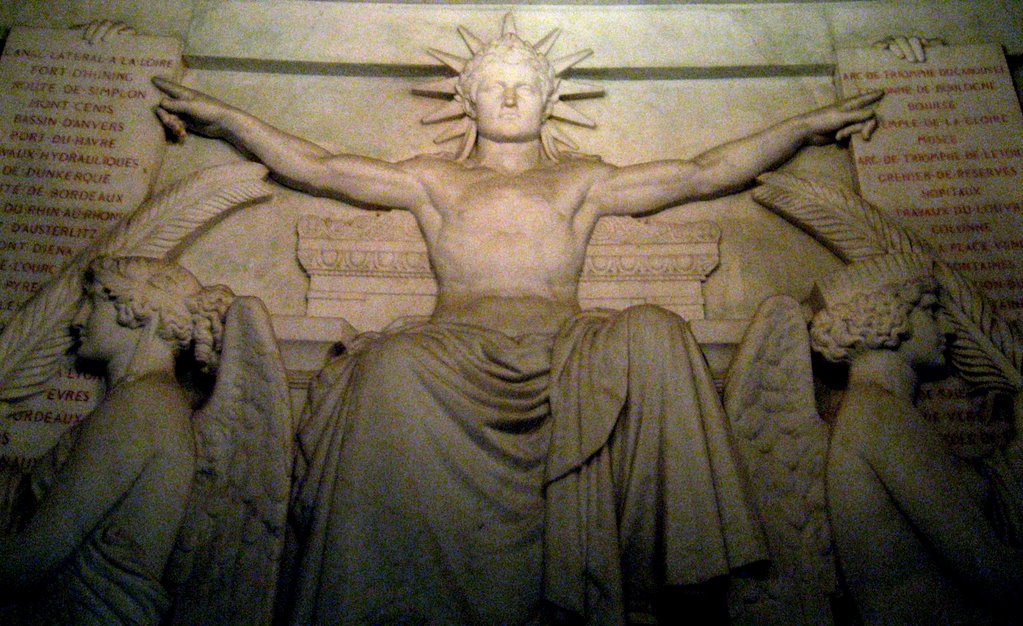
Series: I; II; III. Ten points for guessing who is depicted in this relief.
A new series by Andrew Errington
 I: The Shalomite position
In a number of recent posts (1, 2, 3) on Ben Myers’ superb Faith and Theology, Kim Fabricius has argued clearly and forcefully that Christians ought to be pacifists, or what he has recently called Shalomites. The reasoning for this position should be read in Kim’s original stimulating posts; but briefly, his argument runs along the following lines.
Christian ethics flow from our understanding of who God is; and we know who God is above all through the cross. There we see God not ruling with a rod of iron, but humbling himself unto death. Therefore, nonviolence is essential to Christian discipleship, because, “it is the very heart of our understanding of God.” (Stanley Hauerwas, quoted in Why I am a Shalomite). As Kim himself puts it: “You see I am a Shalomite – and I believe that at least all Christians and, in principle, all people should be Shalomites… because of something I know about Jesus’ (William Willimon) and because of something Jesus knows about God: namely, that God is a God of Shalom, that (to adapt what St John says about God and light and darkness) God is non-violent and in him there is no violence at all.” (Why I am a Shalomite).
Thus, “[T]he Christian pacifist argument turns on the nature of the triune God; and the normative criterion of the nature of the triune God is the Christ event… If there is violence in this God – in this Jesus – the case for pacifism falls.” (Propositions on peace and war: a postscript).
God cannot be other than who he is in Jesus Christ. Since there is no violence in Jesus, there is no violence in God. Old Testament references to a violent deity must therefore be viewed in a new light, and cannot be made to prop up an ethic which lacks the essential ingredient: a Christological basis. In the light of the nonviolence of God in Jesus, Christians are compelled to be nonviolent themselves.
But is it true to say that there is no violence in God? Does the pacifist position innevitably end up with a Jesus who dies but is not then exalted? This is where we are headed.
Andrew is an old uni friend of mine. He will continue this series over the coming days in between whatever else I manage to post while preparing for my final exam. As mentioned earlier, I remain fascinatedly undecided on these issues. Ten points for the city in which this statue can be found. Series: I; II; III.
For those who've been away recently, or don't get out (into the blogosphere) much, this post by Kim Fabricius over at Ben Myers's Faith and Theology has got many blogs talking (see here for a string of links). Josh of Theologoumenon offers this important quote from Miroslav Volf.
On this issue I remain unhappily undecided, blown about by every wind...
 "...But on the other hand, all this must inevitably mean that the man who thus hopes will never be able to reconcile himself with the laws and constraints of this earth, neither with the inevitability of death nor with the evil that constantly bears further evil. The raising of Christ is not merely a consolation to him in a life that is full of distress and doomed to die, but it is also God’s contradiction of suffering and death, of humiliation and offence, and of the wickedness of evil. Hope finds in Christ not only a consolation in suffering, but also the protest of the divine promise against suffering. If Paul calls death the ‘last enemy’ (I Cor. 15.26), then the opposite is also true: that the risen Christ, and with him the resurrection hope, must be declared to be the enemy of death and of a world that puts up with death. Faith takes up this contradiction and thus becomes itself a contradiction to the world of death. That is why faith, wherever it develops into hope, causes not rest but unrest, not patience but impatience. It does not calm the unquiet heart, but is itself this unquiet heart in man. Those who hope in Christ can no longer put up with reality as it is, but begin to suffer under it, to contradict it. Peace with God means conflict with the world, for the goad of the promised future stabs inexorably into the flesh of every unfulfilled present. If we had before our eyes only what we see, then we should cheerfully or reluctantly reconcile ourselves with things as they happen to be. That we do not reconcile ourselves, that there is no pleasant harmony between us and reality, is due to our unquenchable hope. This hope keeps man unreconciled, until the great day of the fulfillment of all the promises of God. It keeps him in statu viatoris, in that unresolved openness to world questions which has its origin in the promise of God in the resurrection of Christ and can therefore be resolved only when the same God fulfils his promise. This hope makes the Christian Church a constant disturbance in human society, seeking as the latter does to stabilize itself into a ‘continuing city’. It makes the Church the source of continual new impulses towards the realization of righteousness, freedom and humanity here in the light of the promised future that is to come. This Church is committed to ‘answer for the hope’ that is in it (I Peter 3.15). It is called in question ‘on account of the hope and resurrection of the dead’ (Acts 23.6). Wherever that happens, Christianity embraces its true nature and becomes a witness of the future of Christ...."
- Jürgen Moltmann, Theology of Hope, 7.
The full introduction to this important book can be found online here. The next (and almost last) post in my heaven series will pick up on these ideas.The end is a free gift for humanity Prologue: from garden to garden city
The Bible ends with a vision of a city: a glorious picture of human relationships and interdependence, of action and rest, of productive peace between difference, of 'healing for the nations'. A huge city filled with life. This is not a city that relies upon exploiting the surrounding countryside, pushing the land to produce more than it is able to sustain: this city exports life-giving fruit twelve months a year. This is not a city that needs to huddle together for fear of the extremes of nature, nor one threatened by invasion. It is not fractured with internal division, nor oppressed by monotonal uniformity.
Is this the original utopia? No, because this end is 'of grace' - not that grace comes to an end, but that this end is the result of God's free gift. Just as Jesus was 'of Nazareth' and Saul was 'of Tarsus', so this end is 'of grace'. This city is not built with human hands, is not a realised utopian vision of human progress. It comes down from heaven, signifying the divine origin of its establishment and the source of its life.
There is another famous city at the other end of the Bible: Babel. In it human hubris reaches for the heights. Its skyscraping was not for maximising office space, but for forging a link between earth and the heavens from the human side upwards. Ever since, urban development has been an ambivalent achievement: drawing people together, increasing possibilities, maximising human creative and productive potential; yet also dislocating communities, atomising individuals, disintegrating ecosystems. The cities of the world are at once humanity's greatest achievements and our most painful failures.
John's vision of the end is all about grace. It is achieved not by human effort but is a gift from the riches of divine love. It does not come with the achievements of the powerful, nor will it be hindered by the failures of the weak. It is an environment for humans, and for a large and complex human society. For it is the fulfilment of the central thread and hope of the biblical narrative: the divine promise 'I will be with you.' The city is a picture of the final result of God's action: not that we depart to live with him, but that he comes to dwell with us, in our kind of space, though one that he himself has supplied.
This is the start of the end of grace. There is more to come...
Ten points for picking the location from which this pic was taken.
Series: I; II; III; IV.
'With the raising of Jesus all has not yet been done.'
- Jürgen Moltmann, Theology of Hope, 163.
And this has further implications:'Faith, whenever it develops into hope, causes not rest but unrest, not patience but impatience. It does not calm the unquiet heart, but is itself this unquiet heart in man. Those who hope in Christ can no longer put up with reality as it is, but begin to suffer under it, to contradict it. Peace with God means conflict with the world, for the goad of the promised future stabs inexorably into the flesh of every unfulfilled present.’
- Theology of Hope, 7.
Of course, Barth the anti-Fascist was never aiming at quietism with his earlier quote. Which is truer to the biblical witness and to an otherwise hope-less world, Barth or Moltmann? Jesus resurrection as the end, or as the announcement of the end?

 Posts
All Comments
Posts
All Comments

All photos and text by Byron Smith, unless noted otherwise.
Nothing New Under the Sun blog by Byron Smith is licensed under a Creative Commons Attribution-NonCommercial-NoDerivs 3.0 Unported License. Site feed
 Fave on Technorati Blogs that link here


