Showing posts with label John Calvin. Show all posts

Friday, March 12, 2010

Calvin the Greenie

"The earth was given to man, with this condition, that he should occupy himself in its cultivation... The custody of the garden was given in charge to Adam, to show that we possess the things which God has committed to our hands, on the condition that, being content with the frugal and moderate use of them, we should take care of what shall remain. Let him who possesses a field, so partake of its yearly fruits, that he may not suffer the ground to be injured by his negligence, but let him endeavor to hand it down to posterity as he received it, or even better cultivated. Let him so feed on its fruits, that he neither dissipates it by luxury, nor permits it to be marred or ruined by neglect. Moreover, that this economy, and this diligence, with respect to those good things which God has given us to enjoy, may flourish among us; let everyone regard himself as the steward of God in all things which he possesses. Then he will neither conduct himself dissolutely, nor corrupt by abuse those things which God requires to be preserved."

- John Calvin on Genesis 2.15 in Commentary on Genesis (1554).

The earth was given to us. And, at the same time, we were given to the earth, to till it and keep it.

A recent study found that one quarter of the earth's arable land has been degraded through soil erosion, salinisation, desertification or nutrient exhaustion.

Tuesday, March 04, 2008

Calvin on loving the unlovely

"We are not to look to what men in themselves deserve, but to attend to the image of God, which exists in all, and to which we owe all honour and love. […] Therefore, whatever man you meet who needs your aid, you have no reason to refuse to help him. […] Say he is contemptible and worthless, but the Lord shows him to be one to whom he had deigned to give the beauty of his image. […] Say that he is unworthy of your least exertion on his account; but the image of God, by which he is recommended to you, is worthy of yourself and all your exertions. But if he not only merits no good, but has provoked you by injury and mischief, still this is no good reason why you should not embrace him in love, and visit him with offices of love. […] We are not to reflect on the wickedness of men, but look to the image of God in them, an image which, covering and obliterating their faults, should by its beauty and dignity allure us to love and embrace them."

– John Calvin, Institutes of the Christian Religion III.vii.6.

This is a very interesting point Calvin makes: that the basis for loving my neighbour is not lost through my neighbour's unworthiness, or even active hostility towards me. I am to see in my neighbour the gift of God - that God has seen fit to make even my broken and destructive neighbour a means by which others might see something of the divine life.

Of course, none of this makes sense until we learn to see Christ as God's image, into whose likeness we are drawn by the Spirit. The ever-open possibility that my neighbour might conform more closely to Christ's grace and truth keeps open the door to treating her graciously and truthfully. None are beyond the transforming power of the Spirit of Christ. All are vulnerable to grace. I love, then, in order that my neighbour might become more fully herself by becoming more like Christ.

Thursday, August 30, 2007

Books

Books have the same enemies as people: fire, humidity, animals, weather, and their own content.

- Paul Valery (1871 - 1945)

Read any good books recently? Two have captured my interest of late. The first is The Wound of Knowledge: Christian Spirituality from the New Testament to Saint John of the Cross by Rowan Williams. Williams is a senstive reader of and an excellent guide to a variety of patristic and medieval thinkers. It's been a refreshing tour of some Christian tradition too often ignored in Protestant circles. It can be easy to get the impression sometimes that after Paul, the next great thinker was Luther or Calvin (with perhaps a passing reference to Augustine or Athanasius). Speaking of Augustine, Williams' chapter on the bishop of Hippo was a real highlight.

The second book is a piece of popular history called Tamberlane: Sword of Islam, Conqueror of the World, a portrait of a Turkic-Mongol warlord in the late 14thC (and early 15thC) variously known as Timur/Temur/Tamberlaine/Tamerlane, who conquered central Asia from the borders of China and northern India to Turkey and Egypt. Along the way, he killed somewhere in the region of 15 million people and probably inadvertently saved Europe from becoming part of the Ottoman empire.

Wednesday, October 11, 2006

Top 14 Christian thinkers?

Have your say...
Who are the top fourteen most influential Christian thinkers* of all time? Excluding Old Testament figures, yet including Jesus (who I'm assuming will go in #1 position) and Paul and co., who would make the cut?

Why fourteen? Why not? Actually, a friend asked me my opinion for a project she's currently working on. I won't include her list, but off the top of my head I suggested (roughly in order of importance, rather than chronological order):
1. Jesus the Christ
2. Paul/Saul of Tarsus
3. John the evangelist
4. Augustine of Hippo
5. Thomas Aquinas
6. Martin Luther
7. Karl Barth
8. John Calvin
9. G. W. F. Hegel
10. Friedrich Schleiermacher
11. Immanuel Kant
12. Athanasius of Alexandria
13. Jonathan Edwards
14. John Wesley
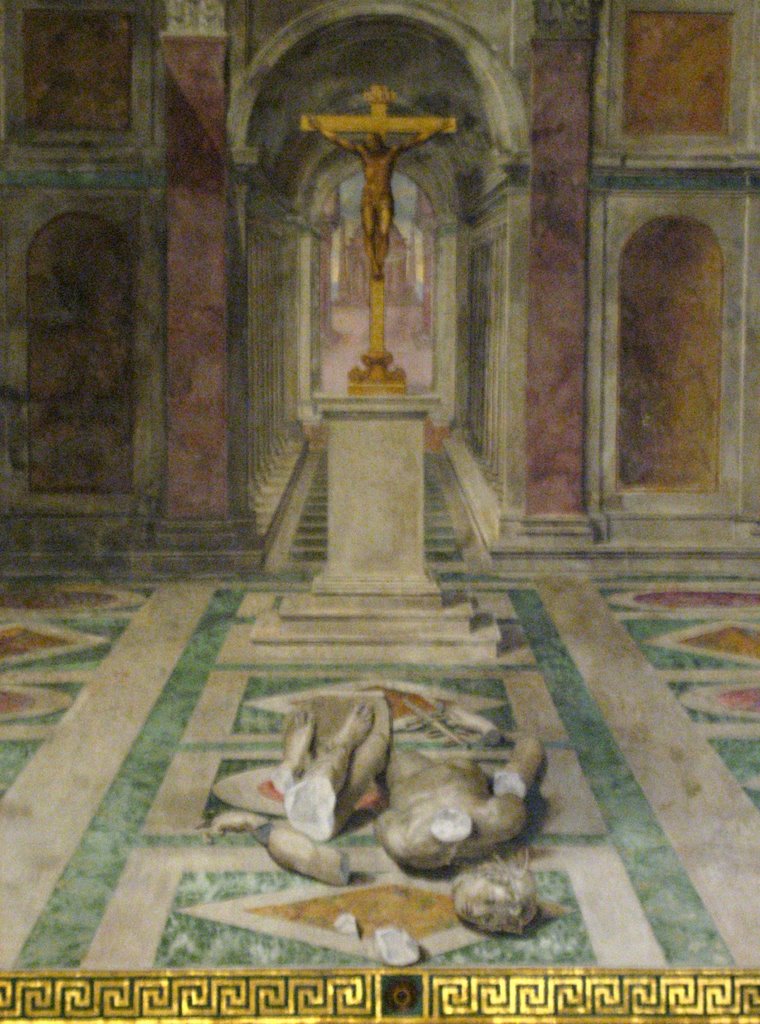
*UPDATE: A clarification: the larger project is to select the 50 most influential religious figures in history, and 14 spaces have been allocated to the Christian movement. Thus, this is not just about thinkers (despite my title and opening), nor does it exclude Jesus, who was not (by definition) a Christian. Apologies for any confusion. Ten points for the location of the picture. Bonus points for knowing/guessing how you have to be positioned to see it.

Monday, June 26, 2006

Rahner the Calvinist? Or Calvin: the good Catholic

'Christ and his salvation are not simply one of two possibilities offering themselves to man's free choice; they are the deed of God which bursts open and redeems the false choice of man by overtaking it. In Christ God not only gives the possibility of salvation, which in that case would still have to be effected by man himself, but the actual salvation itself, however much this includes also the right decision of human freedom which is itself a gift from God. Where sin already existed, grace came in superabundance.'

- Karl Rahner, Theological Investigations V, 124