Showing posts with label Acts. Show all posts

Thursday, September 09, 2010

On blessing enemies and burning books

I recently mentioned the plans of a small church in Florida to commemorate the attacks of 11th September 2001 by burning a Qur'an, in order to send a warning to radical Islam: "If you attack us, if you attack us, we will attack you." This is the heart of the rationale offered by Pastor Terry Jones, who plans to carry out this act on Saturday's anniversary.

In my previous post I mentioned the words of Christ in Luke 6 about loving enemies as one obvious response to this proposal. Loving enemies means the only retaliation we can condone is repaying cursing with blessing, hatred with love, and violence with vulnerable peacemaking. God retaliated against the death of his son by raising him to new life, and by commissioning messengers with the gospel of forgiveness and peace in his name. Burning a book is indeed a powerful form of communication, but the message that is intended by this action is a perversion of the gospel of Christ.

Indeed, there is a deeper and even more worrying assumption behind this action, which is brought to light by asking after the identity of the "we" in Pastor Jones' quote above. Who is it who will bring repay attack for attack? The obvious candidate is the US military acting on behalf of the US government. As well as ignoring the teaching of our Lord, this pastor seems to have confused the church of Jesus Christ with his nation and its military.

Sam Norton has suggested that the popular reaction to this story has been misguided, on the basis that the offensiveness of burning a Qu'ran, or the potential harm it might bring to US soldiers are not properly Christian reasons. It is not the place of the church to ensure the safety of soldiers occupying a foreign country, nor is the giving of offence itself a problem. On these points, he is correct. He goes on to suggest that the burning could be seen as an act of protest or resistance against idolatry. I am not opposed to symbolic actions that expose the hollowness and violence of idolatry. But I don't think this action does that. Not only does Jones' explanation fail to conform to anything like the Christian gospel, but the very act of burning a book - not least the sacred text of a minority community in his society - does not speak of fearlessness, hope or joy. It is a punitive action that attempts to silence speech and intimidate a group already the focus of hostility and suspicion.

As one of Sam's commentators (revsimmy) points out, "In the only New Testament example of book-burning (Acts 19:19) at Ephesus these were books being burned by people who were renouncing their former beliefs and practices (not the case in Pastor Jones' case). Later on in Ephesus, when the silversmiths stir up a riot against Paul, the town clerk is able to claim, with apparent credibility, that Paul and his companions have never spoken against their temple or blasphemed their goddess." This too is an important point. Whatever we make of the book-burning in Acts chapter 19, it was undertaken voluntarily by those who had formerly practiced idolatry as a symbolic, costly and effective break with their old lives. The action planned by Terry Jones for this Saturday, by contrast, is more akin to the destruction of Buddhist statues by the Taliban. The overthrow of idolatry is not through the weapons of this world (whether explosives or cigarette lighters, outrage or censorship), but through preaching, purity and prayer.

The first idolatry that needs to be addressed in this story is not the attitude of Muslims to the Qu'ran, but of Christians to militarism and nationalism. The good news is that liberation from such empty idols is possible in Christ.

UPDATE: It seems that Pastor Jones may have decided to cancel the burning. Or put it on hold. Or something. He seems like quite a confused man.

A typically good reflection on the whole matter from Andrew Cameron in the Social Issues Briefing. He asks "what would St Paul do?" and his answer is that prior to the Damascus Road, Saul of Tarsus would have joined in and led the burning. After meeting Christ, not so much.

Tuesday, January 26, 2010

Baptism: dunk, dip, douse or dribble?

Baptism by the Book (of Common Prayer)
Our daughter was baptised on Sunday morning with little fuss and great joy. Praise God!

Although the service used a more contemporary liturgical pattern, I took the opportunity to re-read the baptism services in the 1662 Book of Common Prayer. I was struck by a number of things. First, as always, the saturation of Scripture throughout the service. The most obvious difference between traditional and contemporary Anglican liturgical services is not language, but length. And much of what has been cut is the reading of and reference to Scripture. For example, it really adds something to a service of infant baptism to read the passage in Mark 10.13-16 where Jesus tells his disciples (who are acting as overzealous bodyguards) to "let the little children come unto me".

Another more surprising element came in the rubric (the instructions accompanying the words to be said) at the point of baptism. But to show why it was surprising, first a little personal background.

Growing up in a Baptist church, I had only ever witnessed full immersion baptisms (dunking), where the candidate is plunged entirely under the surface of the water and then brought up again (for the hardcore, this can be done thrice: once for the Father, once for the Son, and once for good measure the Holy Spirit). This was how I was baptised just short of my sixteenth birthday. For me, immersion has always made good sense of the apostle Paul's discussion of baptism in Romans 6.3-4, where he speaks of our baptism as our having been "buried with Christ". Thus, full immersion baptism symbolises the burial of the old life and the resurrection to the new life that is experienced when a person is united with Christ by faith.

More recently, and in a tradition that embraces the baptism of infants, I have become familiar with two other methods of baptising: sprinkling (dribble) and pouring (dousing). The former can look to the sacrificial practice in the Old Testament temple (as recorded in the Pentateuch and referenced in the New Testament) and especially to the divine promise of a future cleansing through sprinkling with clean water recorded in Ezekiel 36.25. The latter may look to the frequent New Testament language of the Holy Spirit being poured out upon believers, an event associated with baptism.

As long as it was done in the name of the Father, and of the Son and of the Holy Spirit and using water, all three methods (dunking, dribbling and dousing) were accepted by the early church, though there seems to have been a preference for immersion.

Yet contemporary Anglican practice (insofar as I've seen or heard about it) only ever sprinkles or pours water on infants. Given this, I'd asked our minister to at least splash around as much water as possible, pouring rather than sprinkling. He agreed, saying that the water also symbolises God's love, so the more the merrier.

Therefore, it was with some interest that I noticed that in the 1662 service for "The Ministration of Publick Baptism of Infants" the actual baptising is described like this:

Then the Priest shall take the Child into his hands, and shall say to the Godfathers and Godmothers,
Name this Child. And then naming it after them (if they shall certify him that the Child may well endure it) he shall dip it in the Water discreetly and warily, saying,
I baptize thee in the Name of the Father, and of the Son, and of the Holy Ghost. Amen.

But if they certify that the Child is weak, it shall suffice to pour Water upon it, saying the foresaid words,

I baptize thee in the Name of the Father, and of the Son, and of the Holy Ghost. Amen. Notice that pouring is a concession for weak babies; the normal practice is for the child to be dipped. Is this immersion (done discretely and warily)? Or immersion without putting the head under? Is anyone familiar with this practice?

I checked, and the same instruction is found in all the early English Prayer Books (and the Scottish one too). Unfortunately, I was too late to ask for this to be incorporated into the service, but I think it should happen more often. If you are having a child baptised, make sure you take along the BCP and ask your priest for a dipping!

Tuesday, October 07, 2008

Scepticism and hedonism

"...just as scepticism overcomes itself by bringing the standpoint of doubting into doubt, so does hedonism overcome itself in that the redonistic reflection looks at itself and questions whether we really feel our best when we are concerned with nothing besides feeling good. The answer to this question is no."

- Robert Spaemann, Happiness and Benevolence (trans. Jeremiah Alberg, S.J.; University of Notre Dame, 2000 [1989]), 32.

Spaemann is a fan of both scepticism and hedonism. He is not out to win a quick knock-down victory through this self-refutation point. He wants both of them in a more sophisticated, self-critical form. Just before this, he has approvingly quoted Hegel's comment that true philosophy is "fully accomplished scepticism". Later (p. 39), he goes on to praise Epicurus for thinking through the consequences of friendship to their end, even at the expense of hedonism:
"The full enjoyment of friendship only comes to the one who is not fixated on the enjoyment. And Epicurus draws out the consequences without reservation. The saying that giving is more blessed than receiving, which we know from the Gospel, is found also in Epicurus. One could understand it in such a way that one must, in order to enjoy life, engage oneself to a certain degree, but always in such a way that the costs-benefits balance. Epicurus goes farther: 'Under certain circumstances the wise one will also die for a friend.' For, only under this condition is the friendship authentic. And only when it is authentic do we have from it what one can have from friendship, its full 'enjoyment'. The wise one chooses, according to Epicurus, the way of living which holds the greatest enjoyment. The dialectic of hedonism, its self-negation, cannot be more clearly articulated. The saying, 'The one who keeps his life will lose it' is valid for every selfish system."

Friday, August 01, 2008

Running from the past: Breakfast with Jesus VII

An Easter sermon from John 21: part VII
In the presence of the gracious and risen Jesus, Simon Peter is able to recognise himself as betrayer and to acknowledge the past that he can’t escape. Jesus’ forgiveness takes the form of an invitation, a summons, to re-enter the life of loving service that he had fallen from. Not to just go back as if it never happened, but to learn from that past and grow into the ongoing purposes of God for his future.

“Simon has to recognise himself as betrayer: that is part of the past that makes him who he is. If he is to be called again, if he can again become a true apostle, the ‘Peter’ that he is in the purpose of Jesus rather than the Simon who runs back into the cosy obscurity of ‘ordinary’ life, his failure must be assimilated, lived through again and brought to good and not to destructive issue. [...] Simon is still, in the eyes of God, Peter. What he has to learn is that his betrayal does not make God betray, so that his calling as Peter, as rock of the apostolic faith, is still there, waiting to be lived out.”

- Rowan Williams, Resurrection, 28-29.

Jesus won’t let him return to the anaesthetised pain of being a failed apostle; instead, he calls him to move forward, to say “yes, I failed, but in God’s creative grace, that very failure can become something the start of something beautiful and worthwhile.”
“Peter’s fellowship with the Lord is not over, not ruined, it still exists and is alive because Jesus invites him to explore it further. […] To know that Jesus still invites is to know that he accepts, forgives, bears and absorbs the hurt done.”

- Rowan Williams, Resurrection, 30.

Peter’s personal story of initial hope and promise, followed by betrayal and emptiness, is to have a further chapter: a new and deeper calling as forgiven apostle; as a rock that has been broken and re-made. He is now able to be not simply Simon the failure nor Peter the unshakable apostle, but Simon Peter, the preacher of our second reading in Acts, the preacher of a forgiveness and divine love that takes us where we are and uses us and all of our history, if we will only bring it all before the loving scrutiny of Jesus. He will still make mistakes, even serious ones (you can read about one of them in Galatians 2), but the risen Jesus makes it possible for us to face failure.
Series: I; II: III; IV; V; VI; VII; VIII; IX.

Thursday, December 06, 2007

Wright on heaven on earth

[The book of] Acts, which of course begins with the story of the Ascension, never once speaks in the way [...our] whole tradition [...] so easily does. At no point in the whole book does anyone ever speak, or even sound as though they’re going to speak, of those who follow Jesus following him to heaven. Nobody says, ‘well, he’s gone on before and we’ll go and join him’. And for a very good reason. When the New Testament speaks of God’s kingdom it never, ever, refers to heaven pure and simple. It always refers to God’s kingdom coming on earth as in heaven, as Jesus himself taught us to pray. We have slipped into the easygoing language of ‘the kingdom of heaven’ in the sense of God’s kingdom being ‘heaven’, but the early church never spoke like that. The point about heaven is that heaven is the control room for earth. Heaven is the CEO’s office from which earth is run – or it’s supposed to be, which is why we’re told to pray for that to become a reality. And the point of the Ascension, paradoxically in terms of the ways in which generations of western Christians have seen it, is that this is the moment when that prayer is gloriously answered.

- N. T. Wright, 'On earth as in heaven', sermon preached 20th May 2007.

I have posted an sixteen-part series on this necessary corrective to our thinking, singing and expectation about heaven and hope. Wright's sermon is a very interesting brief exploration of "what the kingdom of God looks like when it’s on the road, arriving on earth as in heaven."
Eight points for correctly naming the city.

Wednesday, November 21, 2007

Williams on Teresa on the perfect lover

Perfect love is simply the imitation of the love of Christ; but, although Teresa can say this, and suggest that perfect love is concerned about giving, not receiving, it would be wrong to read her as claiming that the perfect lover is a self-sufficient, quasi-divine subject, loving out of the abundance of an inner fullness. Teresa's perfect lover is someone aware, first and foremost, of being causelessly loved by God: like it or not, the lover is primarily and inescapably a receiver of love. [...] We are free to give love, not because we need no love, but because (as in Christ's relation to God the Father) we are already recipients of an eternal love, and any need we have is met in advance. [...] It is pious nonsense to say that, if we know the love of God for us, we no longer need human relations of the creative kind Teresa is trying to describe; on the contrary, to pass beyond the hungry and selfish needs of 'normal' love we need to be in love with God's friends, who will give us not what we think we want, a greedy love that mirrors our own, but what we most deeply need in order to be human as God would have us be.

- Rowan Williams, Teresa of Avila (Continuum: 1991), 108.

To give is indeed more blessed than to receive (Acts 20.35), but it is still blessed to receive. And Teresa points out that as creatures reception is the more fundamental reality for us. We need to receive God's gift before we can give. In fact, we need to receive love from one another too. It is not possible to imitate Christ alone.

Wednesday, September 05, 2007

O'Donovan on wakefulness I: Waking

Waking
Last night I went to hear Oliver O'Donovan give the first of three lectures on Morally Awake? Admiration and resolution in the light of Christian faith.

This first lecture was entitled Waking and he took as his starting point the eighteenth century Scottish philosopher David Hume's famous paragraph questioning the route from 'is' to 'ought': how do we engage in successful moral reasoning such that our descriptions of the world (what 'is')and ourselves lead us to practical outcomes (what we 'ought' to do)?

In every system of morality, which I have hitherto met with, I have always remarked, that the author proceeds for some time in the ordinary ways of reasoning, and establishes the being of a God, or makes observations concerning human affairs; when all of a sudden I am surprized to find, that instead of the usual copulations of propositions, is, and is not, I meet with no proposition that is not connected with an ought, or an ought not. This change is imperceptible; but is however, of the last consequence. For as this ought, or ought not, expresses some new relation or affirmation, 'tis necessary that it should be observed and explained; and at the same time that a reason should be given; for what seems altogether inconceivable, how this new relation can be a deduction from others, which are entirely different from it.

- David Hume, A Treatise of Human Nature, book III, part I, section I.

This, he argued, was not an attempt to articulate what later became known as the fact/value distinction (between bare public facts and private selections of values), but was the first attempt to discuss the difference between the good and the right. What is good is something real about the world that we appreciate or admire; what is right is what we do as a result. We admire the good and resolve to do the right (hence the subtitle of the series; lecture 2 will be on Admiring and lecture 3 on Resolving).

Yet in order to trace a path from the good to the right, it is necessary to employ various metaphors or images: construction, insight, weighing up, making choices (O'Donovan, in keeping with his consistent anti-voluntarist agenda, was very critical of this last option). Although we may usually and casually switch images as suits the moment, at points, the metaphor we use is crucial. O'Donovan suggested that a key scriptural metaphor in this regard is wakefulness. Although in the Old Testament, the image is often used of God waking up and taking action, in the New, it is assumed that God is awake, he has acted. And so Jesus and the apostles frequently encourage believers to watch out or be alert (e.g. Matthew 24:42-43; Mark 13:37; 14:37-38; Luke 12:15, 38; 17:3; 21:36; Acts 20:28; Galatians 6:1; Philippians 3:1-3; 1 Timothy 4:16; 2 John 1:8). Although in Ephesians 5.14 waking is used of conversion, usually the image speaks of staying awake. We can't presume to be awake; we must be attentive to staying attentive.

And this attention is oriented in three directions: the world, the self and time.

First, we must be awake to the world, to the contextual framework that surrounds our existence, which precedes (and presumably postdates) our existence. It is possible to drift through the world inattentively, thinking it is a screen for my projections, and so fail to notice, or notice in only a fragmentary and fleeting manner. How we describe objects in our experience is itself part of moral deliberation: is a foetus a human being or a collection of tissue? To attend to the world responsibly means to avoid imposing our desires, assuming that how we want things to be is actually the way they are. This attention is not easy or straightforward. But failure to attend to how things are, to 'mistake' one thing for another (I thought you were an economic unit; little did I know that you were a human being with dignity and worth) is not innocent. Such inattention is culpable, and according to Augustine, is the basic human sin (the basic angelic sin is pride). Thus, the line between moral and theoretical reason does not lie between prescriptive versus descriptive language. To describe is already a moral act.

Second, we must be awake to ourselves. Although experimental disciplines practice a form of self-abnegation, this only makes sense within a larger self-awareness, a desire to avoid having myself as observer interfere with the object under observation. Attention is active, we need to look. And so to be aware of oneself as attentive is to be aware of oneself as active, as a force in the world, to find oneself as an agent in the world with distinct, albeit limited, responsibility. The failure to attend to ourselves as actors is the sin of sloth, the temptation to withdraw from the agentive self. This may arise from despair, or simply from a carelessness in which we sense ourselves as the suffer of the impositions of others: "Look what you made me do!"

Third, we must be aware of time, as well as the world and the self. I act now. I can reflect on the past and I can imagine the future, but I can only deliberate on the present. Of course memory and foresight are morally significant, but only as they impinge on the present. Moral thinking does not mean making predictions about the future; the moralist has no business with crystal balls. Even the Son doesn't know the day or the hour of that absolute future when the kingdom will come in fullness.

These three orientations help diagnose typical failures in moral deliberation. Attention to the world without attention to the self leads to the observational mode, in which ethics is replaced with social science. Attention to my own powers of agency without attention to the world leads to the technological imperative in which the ends serve the means. Attention to the self and to the world without attention to time leads to idealism, missing the good deeds for this time and place.

This trifold structure can also be related to a more familiar one. Love renews our consciousness of the world; faith renews our knowledge of the self; hope renews our awareness of time and possibility.

In question time O'Donovan was asked about the relationship between wakefulness and the past, prayer, conversion, decision-making, secular moral reasoning and sin. Perhaps the most interesting discussion was about decision-making. Often we understand moral deliberation as if we have an apple in one hand and a pear in the other and it's a toss up as to which we might bite into. Not so. According to O'Donovan, moral deliberation is a process of refining and clarifying in which we realise we have no other choice. The 'decision' is simply to recognise the outstanding candidate, not tossing a coin between two equal options.

The lectures will be are generously available for download in a few weeks now from the New College website.
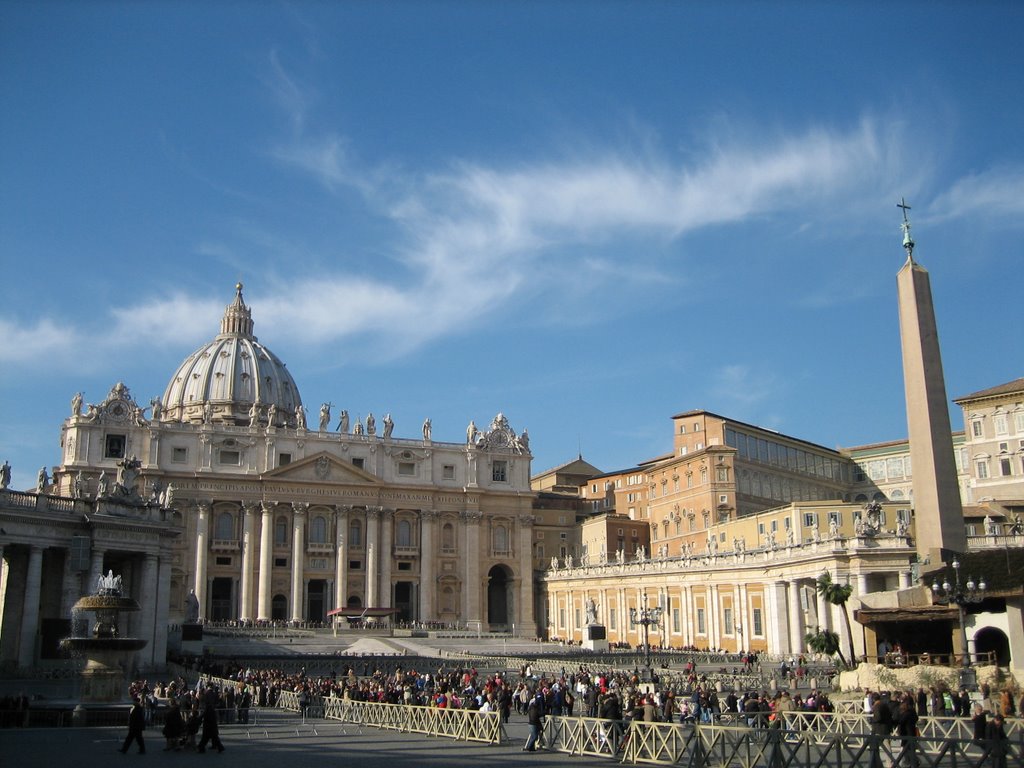
Eight points for guessing the European city in the pic.
Series: I; IIa; IIb; IIIa; IIIb.

Wednesday, August 08, 2007

On prayer

Prayer begins in silence. This is because we do not know God unless he speaks first. There can only be a conversation because he has taken the initiative. Left to ourselves, we invent gods of our own wishes and fears, but the good news is that God has spoken to us in his Son. We are not left in the dark, but can respond to his gracious invitation to relationship with him as our heavenly Father. If he had not reached out to us in our need, then we would be ignorant of both the true nature and depth of our need and the identity of the one whom we might call upon to help.

Of course, sometimes our needs are so pressing that all we can do is cry that most basic of prayers: ‘Save me, Lord!’ And the Scriptures promise that ‘Everyone who calls on the name of the Lord will be saved’ (Joel 2.32; Acts 2.21; Romans 10.13). Yet it is not just any lord to whom we fly in our distress, but to the God and Father of Jesus. As we come to know him, we also grow in our understanding of ourselves and the depth of our dependence upon him.

Our prayers are profoundly shaped by our conception of God. If God is a cosmic Santa Claus, we will bring our shopping list. If he is a harsh and distant judge, then our pleas will be fearful, brief and infrequent. And so to grow in prayer, it is important to remember again the good news about Jesus and allow our prayers to be moulded by God as he truly is.

First, God is the creator to whom we owe our existence and all we have. Every good thing comes from him, and so it is right that our prayers be filled with adoration. And not just when things are good. The Psalms are filled with examples of David and others continuing to praise God in the midst of danger and suffering (Psalms 5, 73, 77, 86 and many others).

When we face our own strife and failure it is usually partially self-caused and partially the result of circumstances outside our control. To the extent that we are at fault for our own pain, it is God whom we have ultimately offended and so it is also right that we confess our errors in our prayers: whether large or small, public or private, in word or deed – or even through not doing what we ought to have done. At this point, knowing the heart of God to whom we confess makes all the difference. This is the one who is ‘merciful and gracious, slow to anger, and abounding in steadfast love and faithfulness’ (Exodus 34.6), the one whose Son lived, died and rose to secure our forgiveness.

Not only has God given us life and all the good things we enjoy, but in Jesus he has also brought new life to all of us living in the shadow of death. This includes both release from guilt and the gift of the Spirit to set us free from the compulsion to do evil. In Christ, we are adopted as God’s children and let in on God’s plan to set everything right through Christ. We have so much for which to give thanks in our prayers and so it is no surprise that Paul tells the Thessalonians to ‘Rejoice always, pray without ceasing, give thanks in all circumstances; for this is the will of God in Christ Jesus for you.’ (1 Thessalonians 5.16-18)

Yet we know that everything is not yet right. Jesus has risen from the dead and we follow his path with the help of the Spirit, but death still interrupts, sins still entangle. Paul told the Christians in Rome that the whole world groans for the day when what was begun at Easter for Jesus is finished for all creation (Romans 8.18-23). And we also groan, yearning for the day when Jesus will return to bring life and peace once and for all to his dying and war-torn world. Such prayers might consist of ‘sighs too deep for words’ (Romans 8.26-27) or they might simply cry ‘Come, Lord Jesus!’ (Revelation 22.20)

And so that leaves us today, cleansed from our past, eagerly waiting for the future, and living each day relying on God for all our needs. Consequently, we ask for daily bread from the one who fed Israel in the wilderness and who gives good things abundantly even to those who ignore him (Matthew 5.45). We need not be embarrassed about asking from one who loves to give. But neither ought we fear asking: ‘Take delight in the LORD, and he will give you the desires of your heart.’ (Psalm 37.4) If our delight is in God, the desires of our heart will be shaped to be his desires and so he will satisfy them with more than we can ask or imagine.

There is power in prayer, but it is not ours; it is God’s. Prayer is not a magic formula giving us access to a secret and mysterious force. Prayer is an admission of our impotence and need, and of God’s generosity and strength. The more we know him as we hear and obey the good news about Jesus, the more our prayers will be filled with adoration, confession, thanksgiving, groaning and requests.

And the more we will pray.
Twelve points for the first to correctly name the location of the each photo.

Monday, January 29, 2007

Worse than death? V

You have died

Whom have I in heaven but you?
   And there is nothing on earth I desire other than you.
My flesh and my heart may fail,
   but God is the strength of my heart and my portion forever.

- Psalm 73.25-26

Death is the last (though not greatest) enemy of humanity and God. The Christian, however, has already died: for you have died, and your life is hidden with Christ in God. When Christ who is your life is revealed, then you also will be revealed with him in glory (Colossians 3.3-4). The worst is over: one has died for all; therefore all have died (2 Corinthians 5.14). Notice that the logic is not that Jesus died for us so that we might not die (strict substitution), but that in him, we have already died. He is our representative. What he did is for us, applies to us, is true for us, indeed is true for 'all': he tasted death for everyone (Hebrews 2.9).

But what does it mean that we have died, since we're still breathing? Is this a legal fiction? A pious way of speaking of the end of an old selfish way of life? Or something else? To understand ourselves and our own story aright, it is necessary for this to be situated correctly within God's story as its proper context. And in particular, we need to hear our story being told as part of the story of Christ. Our life is hid with his. The true meaning of our lives will be revealed when he is. The true and full meaning of our death is likewise hidden with Christ. However, since the resurrected Christ is both present and absent, having been seen by many, yet now not seen for a little while, our knowledge of this meaning is also somewhat ambiguous. We are neither in the dark, nor yet confronted irrefutably face to face with it. So while we can say something of what it means to be somehow already dead, we mightn't be able to express it all.

I take it that at the very least, to be already dead with Christ is to be free from fear of the worst, since the worst has already happened to Christ, and already happened to us in Christ. This worst wasn't death itself, but was being abandoned by God, being godforsaken. Whatever we are to make of Jesus' heartwrenching and mysterious cry from the cross - my God, my God, why have you forsaken me?* - that this one was the one that God subsequently raised means that even the experience of godforsakenness is now transformed. No matter how bad things get for the Christian, Christ has been there first and remains with us, as Immanuel, through it now. Whatever our situation, the worst is already over. Christ has suffered the hell of godforsakenness for us.
*Volumes can and have been written on this cry, a quote from Psalm 22. I will not add to those volumes at this point.

Although Christians still suffer an end to life, and many even have horrible and painful experiences as they do so, nonetheless, there is a difference between all these experiences and Jesus' death on the cross. Every Christian passes their final breath under the pattern and so the promise of Christ's experience: vindication from out of shame, new life from out of death.
‘I saw the Lord always before me,
   for he is at my right hand so that I will not be shaken;
therefore my heart was glad, and my tongue rejoiced;
   moreover my flesh will live in hope.
For you will not abandon my soul to Hades,
   or let your Holy One experience corruption.
You have made known to me the ways of life;
   you will make me full of gladness with your presence.’

- Acts 2.25-28 (Psalm 16.8-11; LXX 15.8-11)
H/T Cyberpastor, who suggested this passage here.

Series: I, II, III, IV, V, VI.

Monday, August 21, 2006

The end of grace II

The Trinitarian foundations of an eschatology of grace.
After a pause, I return to my theme of grace in the end. I began with some thoughts on the end as a free gift for humanity. Of course, despite - or actually, because of - their eschatological theme, these thoughts are intended as reflections upon the way, not as pronouncements from the end.

What is grace? Not a thing, but a reason, a motivation, a desire. Or perhaps, the lack of a reason. That the end is all of grace means that it is brought about by the free act of God. Divine freedom is not conditioned or constrained by anything outside the love of Father : Son : Spirit.

So perhaps better than grace as lack of reason, is grace as superabundance of reason, but reasons located within the Trinitarian life. A free gift does not arise from fear. God's grace is not driven, a chasing after. God's acts towards us are free because of the overflowing joyful love of the Father for the Son, Son for Spirit, Spirit for Father - and back again: 'You are my Son, the beloved; in you I am well pleased.' The Father's affirmation of the Son as he begins his task of restoring and renewing the world is thus the basis for Christian hope. At the same point, the Spirit rests upon the Christ in bodily form as a dove as an indication of the unity of the Trinity in this task, bound together not by the world's need, but in common love, fellowship, koinonia. The Father's work undertaken by Christ in the Spirit is therefore gracious, arising from the very identity of God, not through an external constraint or debt owed to his creatures.

And the corollary is that the Son delights to do his Father's work:

At that same hour Jesus rejoiced in the Holy Spirit and said, 'I thank you, Father, Lord of heaven and earth, because you have hidden these things from the wise and the intelligent and revealed them to infants: yes, Father, for such was your gracious will. All things have been handed over to me by my Father; and no one knows who the Son is except the Father; or who the Father is except the Son and anyone to whom the Son chooses to reveal him.'

- Luke 10.21-22

The closed circle of divine knowledge in which only the Father knows the Son and the Son the Father is the basis for all human knowledge of God. Who Jesus is and what he does are closed to those who don't know the Father. Who God is and what he does is closed to those who don't know the Son. It is only by an initiative from the divine side, from inside the circle, that we can know anything at all. This is why our hope is based on divine grace. Without the final startling exception (and anyone to whom the Son chooses to reveal him) we would remain ignorant of God and his promises.

Since it was not our goodness or need or failure to disqualify ourselves that resulted in God's action, we need have no fear that humanity can thwart God's intentions. Indeed, the very point at which the powers of humanity against God were at their strongest was the very point at which God achieved the centre of his purpose (Acts 2.23): what we intended for evil, God nonetheless used for good (cf. Gen 50.20).

God's love for the world, the love that resulted in his sending his Son so that whoever believes may have the life of God's coming age (John 3.16), is not based on the worth of the world, but on the faithfulness and joy found within the fulness of Father : Son : Spirit. And that love is never exhausted.

Grace is not over yet. There is more to come...
Eight points for the first to link to another shot of this cross.
Series: I; II; III; IV.

Sunday, July 02, 2006

Words, words, words: or, why be catholic?

I know it's going to make me sound all emergent and everything, but I was thinking again today about how important it is to occasionally keep claiming good words like 'catholic', 'orthodox', 'liberal', 'pentecostal', 'baptist' (even 'evangelical'!). They are too easily Capitalised and turned from a useful adjective into a proper name of a movement.

Having preached today on Acts 19.1-7* (actually from 18.18-19.10, but 19.1-7 is the juicy bit that everyone wants to talk about), my application was twofold: (a) don't follow John the Baptist; (b) instead: be baptist, pentecostal and catholic. Seemed to generate a few conversations afterwards. Perhaps not so many as my suggestion that we call John the Baptist, 'Jack the dipper'. Oh well, you can't win them all.
* A quick straw poll: does anyone include this passage in their list of top ten Bible favs?

Saturday, May 27, 2006

Placing oneself: Barneys and grief

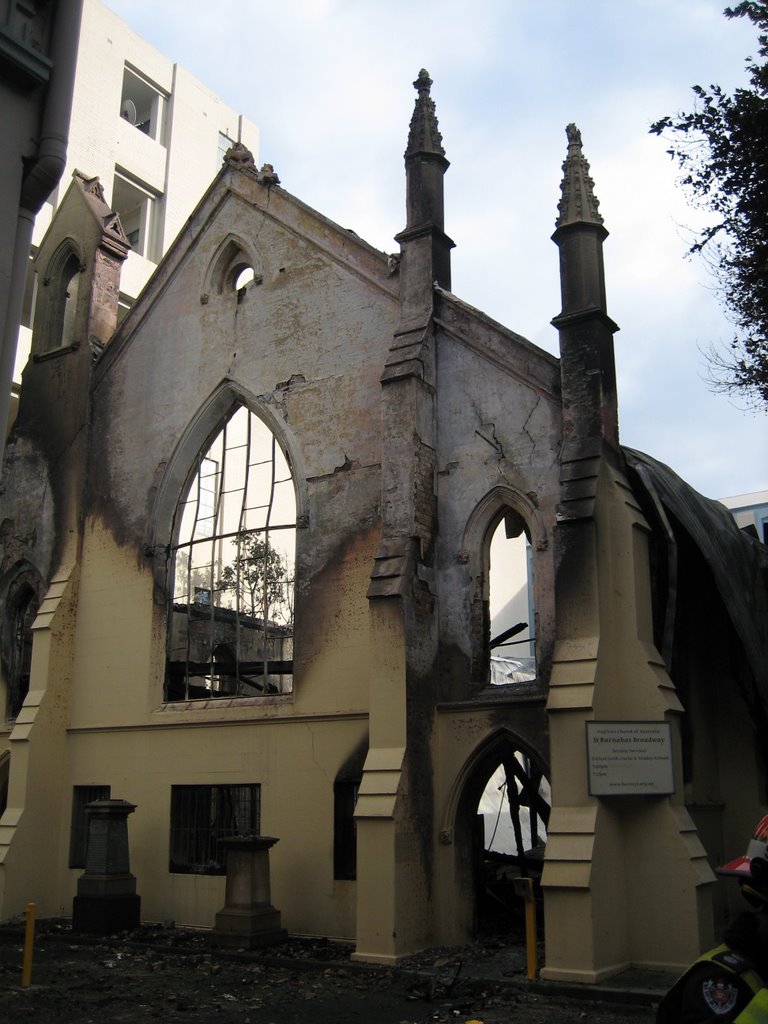
As previously mentioned (and here and here), the building in which my church (St Barnabas Anglican, Broadway, or 'Barneys') meets burned down recently.

As promised (and requested), some further thoughts on the matter:
I noticed in the days following the fire that there seemed to be two kinds of reaction, even where they were often mixed in individuals. On the one hand, some wanted to clearly say it was 'business as usual', the building was just a tool that is irrelevant to the 'real' work that Barneys does, that God was not any different, nor was our fellowship. On the other hand, some people wanted to grieve and acknowledge the grief of others at having lost something analogous to a 'family home'. So which is it to be? Or both?

How can we affirm the goodness and power of God in a world where things fall apart and burn down? We could deny the goodness of the falling-apart and flammable things. But that would be to deny that God was their creator, that "The LORD is good to all, and his compassion is over all that he has made" (Ps 145.9). If his compassion extends as far as his creation, how can he be good when the things he has made are subject to frustration and decay (Rom 8.23)?

We could include death inside his goodness, such that closure is a blessing that makes for beauty and poignancy, a way of multiplying good things by having one pass away to make room for another, a way of giving temporary things a extra specialness (like how Maccas special deals are special because this might be your one chance to get them. If they were part of the regular meal, then they would lose this glow). Or for the more refined, the apocryphal story of Michaelangelo's snowman: there is an extra beauty for the fact that it was but is no more. There is a melancholia and nostalgia that allows it to grow in the memory and imagination. Or consider the sunset: part of whose beauty is that now, just now, just here, is this particular configuration of cloud and colour; it will never be quite the same again as this moment. (Thought: is a blog an attempt to freeze and preserve what is wonderful about intelligent conversation, to make it always accessible? Just as a photo of a sunset is trying to pin down the butterfly of ephemerality). While there is indeed a bittersweetness to nostalgia based on transience, death remains 'the last enemy' (1 Cor 15.26).

A third alternative is to acknowledge the goodness of created things that leaves the tug in our hearts when they pass away, but to relegate this to 'mere creation': good but going. We are not to set our mind on such passing earthly things, but on the eternal. Earth is good, but heaven trumps earth. This is better than the first option, in that it can leave room for legitimate grief at earthly loss, and needn't imply a closure to creation. Indeed, it can become quite a useful stance when combined with C. S. Lewis' frequently stressed point that the best is not the enemy of the good. It is possible to keep first things first (trust in God, the location of Christian fellowship in Christ not buildings), without needing to deny secondary truths (how many great memories will always be associated with particular environmental contexts, and hence a sense of loss at destruction of that context). But I'm still not convinced that this is where our pilgrimage towards affirming creation ends.

The one who made the world, who dwelt with Israel in wilderness tabernacle and Zion temple even while filling heaven and earth, who abhorred not the virgin's womb, who took on human flesh (and not just temporarily, but who remains human in his present mediation: 1 Tim 2.5), whose ultimate goal is not the disentangling of heaven and earth, but their marriage (Revelation 21-22: notice that the new Jerusalem comes down to earth; God makes his dwelling amongst humans, not vice versa), this one will bring about 'the restoration of all things' (Matt 19.28; Acts 3.21), will make all things new (Rev 21.5), will resurrect the dead. Resurrection comes after death; unless a grain of wheat falls into the ground and dies, it remains a single seed. There will also be discontinuity, the resurrection of Jesus wasn't breathing life into a corpse, but transformation. It was not rewinding the sunset.

More can and must (at some point) be said here, but for now, notice that this God isn't afraid to get his hands dirty, in his freedom to bind himself to a contingent and limited creation, not to salvage what was good out of it into himself, but to dwell in it (and for it to dwell in him). He calls us not out of creation, but into it. His kingdom is indeed not 'from' the world (John 18.36) in its basis, methods and goals, but it is 'of' the world, in the sense that Jesus is the king of the Jews - and the Greeks and the whole world, as Israel's Messiah always was to be. And as we are thrown back into the world, we grow into the world, and it grows into us. As we do, creation is 'humanised'; this is indeed part of the mystery of our thanks-filled 'dominion' and 'filling' (Gen 1.28), which is also a 'serving' (Gen 2.15). Not a replacement of non-human by human, so that we squeeze all other life off the planet and die ourselves in regret, but a growing into, an integration. We become not less bodily as we grow in spirituality, but become more in tune with God's Spirit who breathes life into all things. This present life is not a secondary good that awaits its obsolescence in an apocalyptic inferno, but is a sign and anticipation of life of the aeon to come.

This, despite being by far my longest post, remains a summary and introduction to many more thoughts which I'll continue to explore in other avenues. Nonetheless, I think we can go beyond mere instrumentalism in considering the goodness of a building that we have grown into and which in turn has grown into us. The things of this world grow strangely glorious, not dim, in the light of the presence of God and in the hope of the resurrection. Christian response to loss is not a Stoicism that denies the importance of physical things, but genuine grief - with hope.
More posts on Barneys and the fire: I; II; III; IV; V; VI.
Ten points for being able to name the artist who painted the second image. And fifteen more if you can say where it is presently hung.