Showing posts with label age to come. Show all posts

Thursday, January 24, 2008

Jesus and climate change XIII

The renewal of all things
The renewed creation will be the full realisation and perfection of the present order, as well as its transformation into something even more wonderful. The writers of the Bible struggle to describe it, in language limited by present experience. Nonetheless, they paint a picture of a place where we will be completely at home, with recognisable physical bodies, where we will know one another, will love and be loved, where we will be at rest and yet will have fruitful things to do in serving God, where life will abound without the threat of extinction and decay. We sometimes get a fleeting taste of this now, but then it will be the steady settled reality.

Many people have a mistaken idea of disembodied spirits going to heaven at death. This is not the hope presented in the Bible and is a sub-Christian idea. The Christian hope is actually for heaven to come to earth, that is, for the reality of God’s gracious and gentle rule to become as established and evident on earth as it is in heaven. This is not going to heaven when you die. This is heaven coming to earth at some point in God’s glorious future.

And nor is this a return to a garden paradise like the one we read about in the opening chapters of the Bible. The Bible’s final picture of our ultimate destiny is not a garden, but a garden city. The city is a place of creativity and technology, yet also of human community and relational intensity. The human task of ordering, blessing and caring for the earth finds its consummation in a flourishing human community in which all living things flourish. In the images offered us in Revelation, we are told of this harmonious city that "the glory and honour of the nations will be brought into it" (Revelation 21.26). This seems to imply that nothing that is good will be entirely lost, that God will honour what is honourable in human creativity and endeavour. Part of humanity's destiny (and so task) is to enrich the good things in the world. This is not, on the one hand, to leave them untouched as though our mere presence pollutes, yet on the other, nor is it to dismiss created things as irrelevant, distracting or corrupting.

And so the Christian hope that God will renovate the created order is not a license to trash the world in the meantime. In fact, the opposite is true: because God will redeem his entire groaning creation, how we treat it now ought to reflect its importance. Because the earth will one day be filled with God’s glory (Numbers 14.21, Habakkuk 2.14, Psalm 72.19), we ought to glorify him today in how we care for it.
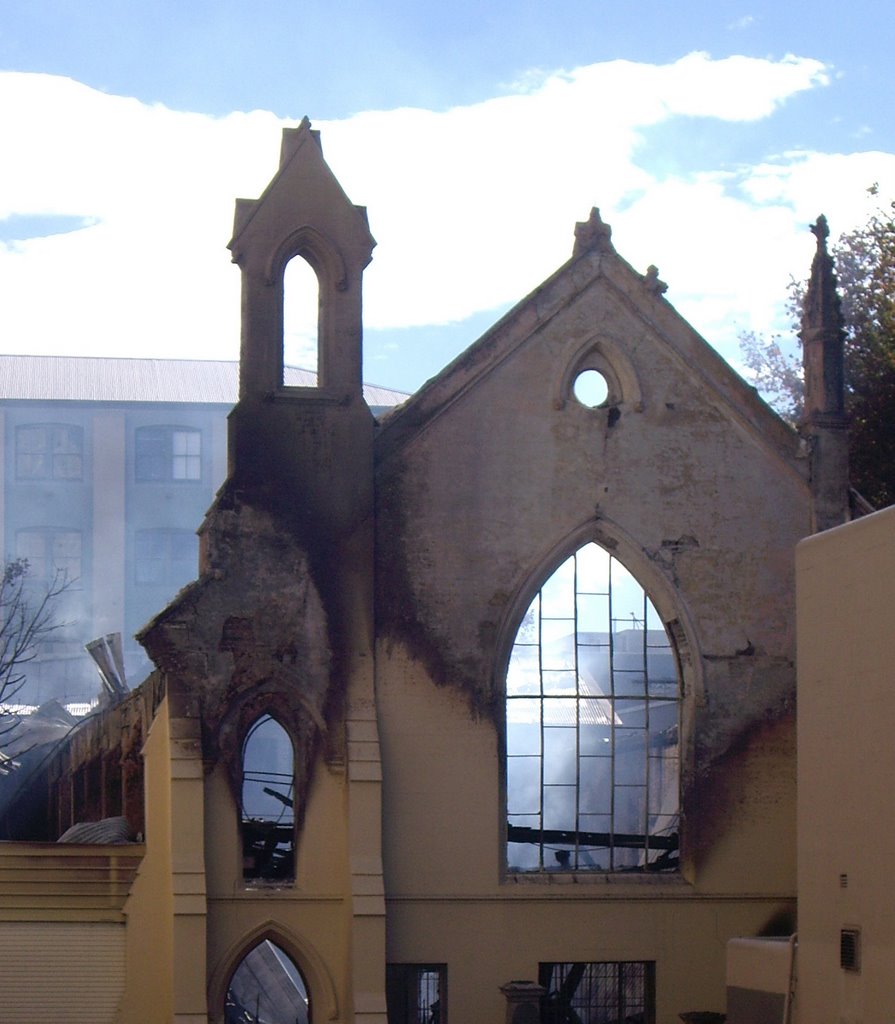
Twelve points to the first person to guess the Sydney building in the picture.
Series: I; II; III; IV; V; VI; VII; VIII; IX; IX(b); X; XI; XII; XIII; XIV; XV.

Tuesday, May 22, 2007

Would Jesus vote green? XII

Fear (cont)
But of all the responses we’ve looked at, while sorrow is probably the one I can most straightforwardly endorse, fear is the one that the Christian message affirms least.

Of all the commands in the Bible, by far the most frequent is ‘fear not’. It is often thought that hatred is the opposite of love. Not so. The greatest barrier to love is fear. The Apostle John tells us that ‘perfect love drives out fear’ (1 John 4.18).

And how, according to Jesus, is it possible to fear not?

Because God loves his world. God passionately, deeply, unswervingly, sacrificially loves his world. He will not abandon it. He has shown a pledge of his commitment to his good world by raising Jesus bodily from the dead. This is the start of his clean-up job. It is his pledge, his down-payment, guaranteeing that he will finish the job, that he will likewise raise all those who belong to Jesus, that he will liberate the groaning creation from its bondage to decay (Rom 8.19-22).

No matter how bad we get, God can heal and restore. Even if we destroy ourselves, which would be very sad, God can raise the dead. This is not an excuse, a safety-net freeing us from responsibility. Precisely the opposite. God loves his world and will restore it, but he will destroy those who destroy the earth (Revelation 11.18). Those who persist squandering God’s good gifts, ungratefully hoarding all they can lay their hands on, apathetically or cynically ignoring the plight of their neighbour, despoiling the world God made, in short, those who persist in rejecting life as Jesus shows us it was meant to be lived, they will eventually succeed in cutting themselves off from life as it should be. By rejecting Jesus, you reject the one who brings life and so choose death.

But those who weep over the cracked world, who admit they are part of the problem, who realise that Jesus paid the ransom to set them free from guilt, who renounce their selfish or self-righteous lifestyle, who yearn for the liberation of creation, who follow Jesus in loving all life, these ones are liberated from fear, and find themselves free to live a life of faith, hope and love. If you trust the God who made a good world, and so have a sure hope that he will complete the job that he began by raising Jesus from the dead, then you are freed from fear and are able to begin the delightful privilege of learning to love your neighbour and the whole community of creation.
Eight points for guessing the country. Series: I; II; III; IV; V; VI; VII; VIII; IX; X; XI; XII; XIII.

Saturday, December 09, 2006

MLK and the apple tree

Even if I knew that tomorrow the world would go to pieces, I would still plant my apple tree. - Martin Luther King, Jr.

This quote illustrates a hope in God in the face of disaster that I find quite inspirational. Every small enacted hope requires faith in the God who raises the dead and calls into being the things that are not (Romans 4.17). Such a faith neither desperately clutches at the present out of fear of change and loss, nor does it need to reject the present as irrelevant in the light of impending catastrophe. The good gifts of today can be celebrated without idolatrous hoarding or thankless world-denial. Although Stoic thought (and some forms of Eastern philosophy) would counsel us to minimise our desires to avoid the pain when (as is almost inevitable) they are frustrated, Christian hope is free to love deeply, to mourn keenly, to yearn fearlessly.

Tuesday, November 07, 2006

Heaven: not the end of the World XV

Series summary
[Photo by Adrian Smith]
This series began by raising the question: "what does heaven have to do with the Christian hope?" Although many Christians think of going to heaven when you die, I suggested this is to significantly misunderstand the scriptural witness. 'Heaven' most frequently simply means that part of God's creation located physically above us; this is then often extended to refer symbolically to the location of God, and then to be a kind of reverential shorthand for 'God'. In this last sense, 'heaven' (i.e. God) is the origin or agent of our hope, but 'heaven' (as other or extra-worldly location) is not our destination. This, I suggested, might be what Paul meant when he called Christians citizens of heaven. The final chapters of the Bible picture heaven coming to earth, that is, God coming to live with us, rather than vice versa. For this to happen, the entire created order needs some drastic renovation. In particular, our physical bodies will be raised from the dead and transformed. This image (resurrection) - while not the only one - is, I think, the most important because this is what happened to Jesus. By it, we can understand 'new heavens and new earth' as new in quality, not in number. This means that we are left eagerly waiting for this future, groaning for and with a world in which everything falls apart. We are aliens in such a world, not because we belong elsewhere, but because we belong to its future. In that future, perhaps it will be through and in a raised body/renewed creation that we will see God, as Augustine once suggested.

What does this matter? What difference does it make? Why should we care? There is still more to come...
Series: I; II; IIa; III; IV; V; VI; VII; VIII; IX; X; XI; XII; XIII; XIV; XV; XVI.
Ten points for the first to link to the other post on this blog with a photo by the same artist as this one.

Wednesday, November 01, 2006

Heaven: not the end of the World XIV

Seeing GodAugustine concludes his massive City of God with a discussion of those wonderful biblical promises that we will see God: 'Blessed are the pure in heart, for they shall see God.' Although our knowledge of God is presently like looking through a dim mirror,* in the resurrection it will have the clarity and certainty of knowing 'face to face'. But how can we see God? God is invisible. Could it be that we will 'see' God in the same way that we can 'see' that two and two are four? Perhaps, but Augustine doesn't think this is adequate, especially since last time God showed himself, he looked more like a Galilean peasant than a mathematical equation.
*First century mirrors were polished metal, and thus only gave a dim and somewhat hazy image.

That God raised Jesus from the dead means that God thinks bodies are important. He made a good world, and Jesus resurrection is the firstfruits of its redemption. It is not simply a disembodied soul that God is interested in, but our full corporeal and corporate life. Indeed, Augustine links these two - having a body means being part of a body. When the physical body of Christ rose, it was also a sign that the community known as the body of Christ is also to be redeemed. Salvation is personal, but not individualistic. We are saved into and for a community. Our destiny is social.

What does this have to do with seeing God? Here's how Augustine links them:

It may well be, then – indeed, this is entirely credible – that, in the world to come, we shall see the bodily forms of the new heaven and the new earth in such a way as to perceive God with total clarity and distinctness, everywhere present and governing all things, both material and spiritual. In this life, we understand the invisible things of God by the things which are made, and we see Him darkly and in part, as in a glass, and by faith rather than by perceiving corporeal appearance with our bodily eyes. In the life to come, however, it may be that we shall see Him by means of the bodies which we shall then wear, and wherever we shall turn our eyes. In this life, after all, as soon as we become aware of the men among whom we live, we do not merely believe that they are alive and displaying vital motion: we see it, beyond any doubt, by means of our bodies, though we are not able to see their life without their bodies. By the same token, in the world to come, wherever we shall look with the spiritual eyes of our bodies, we shall then, by means of our bodies, behold the incorporeal God ruling all things.

- Augustine, City of God 22.29.

Augustine thinks that as we look around ourselves, and particularly as we look at our redeemed community centred around the risen Christ, that through all and in all and over all we will truly see God.

Perhaps this is how we might understand Paul's comment in 1 Corinthians 15 when he says that after the resurrection, God will be all in all. I realise, as did Augustine, that this is a suggestion of how things might be, and not necessarily the only way of understanding these promises. However, to me, it draws together so many threads and makes good sense of the God who thought it was not good for the man to be alone, who speaks of his salvation as being like a city, and whose son died and rose in a body so that the body of Christ might live.
Series: I; II; IIa; III; IV; V; VI; VII; VIII; IX; X; XI; XII; XIII; XIV; XV; XVI.
Ten points for guessing the artist in the above pic.

Monday, October 16, 2006

Heaven: not the end of the world XII

Spirituality as groaning
I have been arguing that going to heaven (either at death or at the end) is an inadequate way of expressing the Christian hope for the resurrection of the dead. Christ's resurrection was the first fruits, the model and ground and proof of a coming universal restoration, a renewal of all things. Having made a good universe (summed up in the phrase 'heaven(s) and earth'), God doesn't intend to abandon it. Perhaps the lengthiest expression of this theme is found in what is rightly the most famous chapter of the New Testament:

I consider that the sufferings of this present time are not worth comparing with the glory about to be revealed to us. For the creation waits with eager longing for the revealing of the children of God; for the creation was subjected to futility, not of its own will but by the will of the one who subjected it, in hope that the creation itself will be set free from its bondage to decay and will obtain the freedom of the glory of the children of God. We know that the whole creation has been groaning in labour pains until now; and not only the creation, but we ourselves, who have the first fruits of the Spirit, groan inwardly while we wait for adoption, the redemption of our bodies. For in hope we were saved. Now hope that is seen is not hope. For who hopes for what is seen? But if we hope for what we do not see, we wait for it with patience.

Likewise the Spirit helps us in our weakness; for we do not know how to pray as we ought, but that very Spirit intercedes with sighs too deep for words. And God, who searches the heart, knows what is the mind of the Spirit, because the Spirit intercedes for the saints according to the will of God.
- Romans 8.18-27
Paul personifies the created order as a woman in labour pains, frustrated by bondage to decay, yearning and waiting and groaning - in pain, but hopeful. Each of the rich images he uses here could be explored at much greater length, but I'd like to briefly pick up the idea of groaning.

This groaning, an expression of 'eager longing', is the only activity available to the prisoner, to the woman bearing a child. The primary focus is on the imminent future, and the knowledge of the difference between now and then ironically serves to make the present pain simultaneously trivial and much worse.

Trivial, because in comparison to the glorious anticipated state, the sufferings of the 'now' pale into insignificance. When the child arrives, the sweat and tears have all been worth it (or so I am told...). At the first breath of freedom, the years in chains fade into a bad dream.

And yet - not yet. The night, though far gone, is not yet over. And so the inescapable failings of the present are exacerbated by the knowledge that they will not last. One must not become accustomed to them, to explain them as just the way things are. There is a possibility, a promise, of something different. Moltmann puts it like this:
[F]aith, wherever it develops into hope, causes not rest but unrest, not patience but impatience. It does not calm the unquiet heart, but is itself this unquiet heart in man. Those who hope in Christ can no longer put up with reality as it is, but begin to suffer under it, to contradict it. Peace with God means conflict with the world, for the goad of the promised future stabs inexorably into the flesh of every unfulfilled present. (more...)

- Jürgen Moltmann, Theology of Hope, 7.

And so it is not just creation that groans. We too, who have the first taste of freedom, in whom the Spirit has begun the miracle of making a heart of stone beat again, who with our first gasping breaths of new air cry "Abba, Father!", we too groan and yearn and cry and wait with eager longing for a world made new. Such groaning is part of spiritual maturity. The more we get a sense of the scope and sheer grace of God's intended liberation, the more fervently we strain against the present chains.

Indeed, this maturity is precisely spiritual, because the Spirit also groans with 'sighs too deep for words'. Our hope-filled discontentment is thus not only deeply in tune with the earth itself, it is also divine.
Series: I; II; IIa; III; IV; V; VI; VII; VIII; IX; X; XI; XII; XIII; XIV; XV; XVI.
For ten points, pick the city, which is the same as here and here.

Friday, October 13, 2006

Gregory of Nazianzus on hope

Gregory of Nazianzus (AD 329-389), the fourth-century bishop of Constantinople, preached at the funeral of his brother Caesarius. After considering various possibilities concerning his brother's present state, he bursts out with the real content of his hope:

‘Why am I faint-hearted in my hopes? Why do I behave like a mere creature of the day? I await the voice of the Archangel, the last trumpet, the transformation of the heavens, the transfigurations of the earth, the liberation of the elements, the renovation of the universe. Then I shall see Caesarius himself, no longer in exile, no longer laid upon a bier, no longer the object of mourning and pity, but brilliant, glorious, heavenly, such as in my dreams I have often beheld you, dearest and most loving of brothers, pictured thus by my desire, if not by the very truth.’

- Gregory of Nazianzus, Oration, 7.

Tuesday, October 10, 2006

Heaven: not the end of the world XI

The end of the world: replacement or renewal?
At the start of this series, I was asked about 2 Peter 3 (and 1 Corinthians 15.35ff., which I think I've now said something about, even if discussion continues). Here is Peter's wonderful vision of the end:

But the day of the Lord will come like a thief, and then the heavens will pass away with a roar, and the heavenly bodies will be burned up and dissolved, and the earth and the works that are done on it will be exposed. Since all these things are thus to be dissolved, what sort of people ought you to be in lives of holiness and godliness, waiting for and hastening the coming of the day of God, because of which the heavens will be set on fire and dissolved, and the heavenly bodies will melt as they burn! But according to his promise we are waiting for new heavens and a new earth in which righteousness dwells. - 2 Peter 3.10-13.
Two initial things to note: first, how positive the final image is - a world in which righteousness dwells, in which justice belongs. Our experiences of justice now remain partial, provisional and imperfectible, but this is a world set to rights. Second, Peter speaks of a new heavens and a new earth, that is, of a whole new created order, not simply of 'heaven'.

However, doesn't Peter’s vision differ from my earlier claims? If 'the heavens and earth that now exist have been stored up for fire' (v.7) and 'the heavens will pass away' and 'the heavenly bodies will be burned up and dissolved' and 'the heavens will be set on fire and dissolved, and the heavenly bodies will melt as they burn' and 'we are waiting for new heavens and a new earth,' doesn't this mean the end of the world in a 'goodbye earth' kind of way? If the universe gets thrown in the garbage bin, how can we still speak of renewal or liberation? Isn't this replacement?

Perhaps. Or perhaps not. Peter's language, like that of Revelation, is apocalyptic in tone. While this term is sometimes used as a synonym for 'catastrophic', it can refer technically to a genre in which major world events are invested with their full theological meaning through using 'earthshattering' language. These dramatic metaphors and pictures emphasise the significance of the events being spoken of, rather than necessarily giving a literal prediction. The second half of Daniel, most of Revelation, and numerous extra-canonical books from around the time of the New Testament give us plenty of examples.

Even if we take these images more straightforwardly, notice that the passage still doesn’t quite claim that the universe will be destroyed. Some translations do say that the earth will be 'burned up' in verse 10, but there is some confusion over this verb* and it is probably better rendered 'exposed' (as above) or 'laid bare'. It is an image of judgement, rather than destruction; there will be nowhere to hide. The eradication of the heavens is not a prediction that outer space or the earth's atmosphere will kick the bucket while the planet itself survives, but is part of the image of exposure. The 'curtain' of the heavens is ripped back so that the earth and all the works done on it are utterly disclosed to divine judgement. You can run but you can't hide.
*See discussion in comments.

Third, immediately prior to this passage in 2 Peter 3.5-7, Peter uses the deluge (Genesis 6-9) as an pattern of what to expect. Back then, he says, the world 'perished' in the flood (v.6). However we read the flood account, the world was not literally annihilated; it 'perished' in that the old order of things passed away and a new beginning was made.

Thus, I take it that while Peter certainly emphasises the remarkable discontinuity between now and then (in order to highlight the importance of the future divine judgement and its implications for our present behaviour - a topic for a future series), the decisive event is nonetheless a renewal and transformation of this world, not simply its destruction and replacement. Our paradigm: Jesus' own resurrection.
Series: I; II; IIa; III; IV; V; VI; VII; VIII; IX; X; XI; XII; XIII; XIV; XV; XVI.
Thanks to Erro for many of the thoughts and references for this post. I'll be very impressed if anyone can pick artist, title or location of this painting. Ten points each.

Thursday, September 28, 2006

Heaven: not the end of the world VIII

New heavens and new earth
First mentioned in Isaiah 65 and 66, the phrase "new heaven(s) and new earth" also crops up in 2 Peter 3 (see coming post) and Revelation 21 (see previous post), and seems to suggest that the old heavens and earth are made obsolete and replaced with a new model. This approach, while affirming the importance (at least notionally) of a new earth as well as heaven (i.e. a new universe, since "heaven and earth" is a biblical idiom for "everything"), fails to read these promises christologically. It is only in Jesus that we know anything at all about the future (see here for this important metholodological principle, based on the idea of Jesus' resurrection as the first fruits of what is come).

God the recycler
The one piece of this new heavens and earth that has been (briefly) revealed demonstrates something remarkable about the new model: the old car hasn't been thrown on a scrapheap, it's been recycled. Jesus' resurrection body is the one access we have to the future, and the tomb was empty. That is, God didn't simply throw out Jesus' old body (the beta version?) and give him an upgrade. It was the same body.

But it was not simply the same. Jesus' body was not returned back to how it was. It was radically new; if we listen to the stories of the Easter appearances in the Gospels, he wasn't always recognised. We can call it renewed, but such a tune up and revamp that it makes as much sense to just say 'new'. The resurrected Jesus was totally stunning when revealed in his glory (perhaps there is also a foretaste of this in his transfiguration?). He is still Jesus (witnessed by the scars), but death no longer has dominion over him.

So too with us, and with creation. New bodies, new world: not through the annihilation or replacement of the old, but through resurrection, through liberation from bondage to decay. Paul uses the image of a seed germinating (taken originally from Jesus), capturing both the continuity and discontinuity of the event: the seed becomes the plant - it is the same seed yet no longer merely a seed.

I wonder whether this approach mightn't throw some light on Jesus' words about heaven and earth passing away.* The present order of things - ruled by death and in bondage to decay - will indeed pass away, but only through its being made new by the one who makes all things new.
*Alternatively, the saying could be a hyperbolic expression of how trustworthy his words are: less a promise/warning ("they will pass away") than a hypothetical ("even if they did, my message still holds").
Series: I; II; IIa; III; IV; V; VI; VII; VIII; IX; X; XI; XII; XIII; XIV; XV; XVI. Five points for the city in the picture. I also discussed the novelty and continuity of the (re)new(ed) creation here
.

Monday, September 11, 2006

Heaven: don't worry it's not the end of the world

A heavenly new series
...Clouds, harps, angels, souls in bliss, white light, rugby...

What is heaven? Who lives there? What does it have to do with Christian hope? As I've hinted at briefly in previous posts, I don't think that "going to heaven when you die" is an accurate summary of what the Bible teaches us to hope for. This series will aim to untangle some threads commonly confused in modern Christianity in order to recover one often neglected aspect of the gospel, the radically subversive hope for the resurrection of the dead and the life of the world to come.
Series: I; II; IIa; III; IV; V; VI; VII; VIII; IX; X; XI; XII; XIII; XIV; XV; XVI.
Ten points for naming the country in this pic.

Friday, August 11, 2006

The end of grace I

The end is a free gift for humanityPrologue: from garden to garden city
The Bible ends with a vision of a city: a glorious picture of human relationships and interdependence, of action and rest, of productive peace between difference, of 'healing for the nations'. A huge city filled with life. This is not a city that relies upon exploiting the surrounding countryside, pushing the land to produce more than it is able to sustain: this city exports life-giving fruit twelve months a year. This is not a city that needs to huddle together for fear of the extremes of nature, nor one threatened by invasion. It is not fractured with internal division, nor oppressed by monotonal uniformity.

Is this the original utopia? No, because this end is 'of grace' - not that grace comes to an end, but that this end is the result of God's free gift. Just as Jesus was 'of Nazareth' and Saul was 'of Tarsus', so this end is 'of grace'. This city is not built with human hands, is not a realised utopian vision of human progress. It comes down from heaven, signifying the divine origin of its establishment and the source of its life.

There is another famous city at the other end of the Bible: Babel. In it human hubris reaches for the heights. Its skyscraping was not for maximising office space, but for forging a link between earth and the heavens from the human side upwards. Ever since, urban development has been an ambivalent achievement: drawing people together, increasing possibilities, maximising human creative and productive potential; yet also dislocating communities, atomising individuals, disintegrating ecosystems. The cities of the world are at once humanity's greatest achievements and our most painful failures.

John's vision of the end is all about grace. It is achieved not by human effort but is a gift from the riches of divine love. It does not come with the achievements of the powerful, nor will it be hindered by the failures of the weak. It is an environment for humans, and for a large and complex human society. For it is the fulfilment of the central thread and hope of the biblical narrative: the divine promise 'I will be with you.' The city is a picture of the final result of God's action: not that we depart to live with him, but that he comes to dwell with us, in our kind of space, though one that he himself has supplied.

This is the start of the end of grace. There is more to come...
Ten points for picking the location from which this pic was taken.
Series: I; II; III; IV.

Monday, August 07, 2006

Secular authorities

How are Christians to think of 'secular' authorities?
In a comment from a recent post about political authorities, Matheson asked: what does it mean for our attitude towards participation (which Drew encourages us to take up responsibly) that these are merely secular authorities, in the sense that they are of this "age"?

This, of course, was a leading question.

Secular is derived from the Latin secularis, which is from seculum, meaning 'age or generation'. It was a term used by the medieval church to denote what belonged to the sphere of the 'world', or at least of the world of this age, as opposed to what pertained to the age to come. Thus, by calling political authorities 'secular', this was not primarily a way of designating a 'separation between church and state' (though this idea is thoroughly rooted in Christian conceptions of authority, despite its frequent misunderstanding and abuse in much contemporary debate).* Instead, such authorities are secular because their authority is temporally limited. Their existence will continue prior to the eschatological victory of Christ in which he will 'destroy every ruler and every authority and power' before handing the kingdom over to God the Father (1 Corinthians 15.24). Thus the primary Christian stance towards secular political authorities is freedom, knowing that they are passing away, that their authority is limited and temporary. The primary political duty of the church is to bear witness to the coming rule of Christ, reminding governments that their role has a use by date and that they are not to pretend otherwise by setting themselves up as absolute authorities. Within this freedom, the Christian is liberated for joyful obedience to these provisional structures while awaiting the resurrection of the dead and with it, the destruction of the ultimate resort of every tyrant: death.
* See Oliver O'Donovan The Desire of the Nations (and presumably also The Ways of Judgment) for this argument. Indeed this post is a brief summary of one thread in his thought, as Matheson was well aware when he made the comment.Since Matheson's comment sparked this post, I thought his smiling face should end it. Five points for the first to name the thing behind Matheson. Ten points for the institution in the first shot that is being turned into a mere silhouette by the rising Son. (Yes, groan all you like; I know you're sitting there wishing you'd said it first. And yes, I know the sun is actually setting - poetic licence).

Sunday, June 25, 2006

Rahner on mystery

"[...] precisely the believer actively engaged in theology knows better than anyone else that every theological statement is only truly and authentically such at that point at which man [sic] willingly suffers it to extend beyond his [sic] comprehension into the silent mystery of God..."

- K. Rahner, 'Reflections on Metholodology in Theology',
Theological Investigations XI, 103.

Rahner goes to claim that the mystery of God remains - indeed, is perfected - in the eschaton. The beatific vision is not the cessation of mystery, but the point where we finally grasp the blessedness of it.
"Now we see as in mirror, dimly, but then we will see face to face. Now I know only in part; then I will know fully, even as I have been fully known.' (1 Corinthians 13.12)
What is the relationship between our present knowledge of God and our hoped for knowledge? Do we desire mystery to depart in vision? Is mystery a negative thing, an aspect of our present fallen imperfections, or does it relate to our very createdness? Even if the latter is also as true as the former (i.e. if both are true: that God is still experienced, at least in some sense, as hidden due to both our sin and our finitude), will this particular creaturely limitation be overcome? Do we want it to?

Friday, June 16, 2006

Theodicy & eschatology V

I have been claiming that any theodicy worth the name must abandon three common features of most 'answers to the problem of evil':
(a) the belief that explanation is solution. We need more than a conceptual reshuffling of divine attributes. Any solution to evil must not be simply re-interpretation, but transformation.
(b) the belief that we are the ones to solve the problem. The answer to the problem of evil is found in God's decisive action through and in Jesus.
(c) the belief that the solution must be completed now. Either as an a-temporal (or at least synchronic) account of God's present providential rule, or as an over-realised eschatology in which there is nothing more to happen other than the unveiling of what is already the case.

Instead, any specifically Christian theodicy must be evangelical and eschatological. Evangelical: it must be focused on the good news of what God has done in Christ. And eschatological: it must leave room for more to come, for the ultimate solution to still be in the future.

I have already discussed the evangelical necessity. Jesus on the cross defeats evil through refusing to fight fire with fire, and the cycle of violence is buried with him. The resurrection is a demonstration that God will not abandon his perishing creation. Easter is a promise, a first down payment, of God’s intention to remove evil, root and branch, from his entire world, to hand it over to eternal destruction, to ultimate and irreversible exclusion. The gospel, the story of Jesus' life, death and resurrection, is God's solution to the problem of evil. In short, the gospel is theodicy. (To borrow a phrase from my good friend Matheson).

But we find ourselves in the midst of the gospel narrative, not yet at its ultimate conclusion. There is more to come. My contention from the start has been that only an eschatological theodicy will do. As long as evil continues to have the dominant hand, any attempt to account for its presence and influence is mere reinterpretation. As Marx famously said, philosophers have hitherto interpreted the world, the point is to change it. Or rather, the point is that God will change it. That change began with Jesus’ death and resurrection; there is now one piece of the world that is an evil-free zone, namely, Jesus’ resurrected body. Death no longer has dominion over him (Romans 6.16).

But it does over us. Jesus has been given all authority in heaven and on earth (Matthew 28.18), including authority over the evil forces and powers and multinational corporations and corrupt governments and globalisation and the capitalist system and disease and decay and death. But we do not yet see all things in subjection to him (Hebrews 2.8).

There is more to come: the resurrection of the dead, the final triumph over the last enemy. This is not to add something to the achievement of Jesus or replace it with something else, because it is Jesus’ own future that we are looking forward to. But Jesus’ final victory over death – that great last enemy of God and humanity (1 Corinthians 15:20-28) – is not simply the unveiling of what is already the case. For Jesus’ resurrection is only the first fruits (1 Corinthians 15:20), and while he is the firstborn (Rev 1:5), the harvest, the great family, is not yet here. ‘The Christ event cannot then itself be understood as fulfilling all promises, so that after this event there remains only the sequel of its being unveiled for all to see.’* Therefore, the believer’s present experience of an unredeemed groaning world is not to be downplayed as mere appearance awaiting the exposure of its hidden redemption.

* Jürgen Moltmann, Theology of Hope, 214.

Series: I; II; III; IV; V; VI.

Saturday, June 10, 2006

A whole new world

[Photo by Adrian Smith]
What will be new about the new heavens and earth? Where is the discontinuity? What will not last?

The short answer is: death. The long answer is death and mourning and crying and pain, the bonds of futility: in sum, the old order of things. It will be a new world order for a renewed world. No longer will God be absent, no longer will mortality loom and pronounce doom. What is hidden will be revealed. Injustice and half justice will be banished; things will be right.

But of course, all I am doing here is quoting the Bible. What does it mean?

Theologically, the problem with this world is neither physicality nor transience, nor temporality, nor humanity per se. It is evil, and its partner, death: the chaotic destruction and convoluting of life, of God's good world. Where did it come from? See my coming post on the origin of evil (and here). What is it like? See my coming post on the nature of evil. What is God doing about it? The gospel: the life, death and resurrection of his Son. Why is it still around? Because the gospel continues: the cross and resurrection were promise as well as achievement; there is a chapter yet to come in which the resurrection is applied to the entire world. What is its destiny? Exclusion from the new world. Whatever we make of the images of eternal destruction, they are complemented by images of exclusion: there is no symmetry between the new creation and what is not in it.

However, this raises the question of whether good things will be excluded. I have often stressed the continuity between creation and its redemption through the language of release (as in Rom 8) or of renewal. But is it true that no good thing will be lost? That not a hair of creation's head will perish?

Now, of course, one piece of scriptural witness I haven't yet mentioned is marriage. Specifically, 'in the resurrection they neither marry nor are given in marriage, but are like angels in heaven.' (Matt 22.30) Is this a good part of this creation that misses out on renewal? No: though like everything else, it must 'die' in order to be raised/transformed. Marriage will remain: the new Jerusalem is 'prepared as a bride adorned for her husband'. The wedding feast of the Lamb and his Church affirms, liberates and restores marriage. What does this mean for those presently married? I am not entirely sure; but the good gift of marriage is not excluded.

Have I here undermined all my previous confidence in continuity? If marriage can be so transformed as to possibly mean the end of all present human marriages (remember, our vows are until parted by death), is anything really 'safe'? Of course not, if by safe we want to retain them as they are. But absolutely, they are secure in the transformative power of God to become truly themselves. The risen Jesus was not at first recognised by even his closest followers. But it was truly him.

Towards the end of The Great Divorce (and despite other problems I have with this text), Lewis captures this dynamic with a beautiful image. One man's lust, a sneering whispering slimy lizard on his shoulder, is killed so that he can 'go on to the Mountains' (an image of new life). As it dies, it becomes an enormous stallion that then carries him on his journey. The narrator reflects upon this with his guide (the Teacher, who is meant to have a Scottish accent. Don't ask):

‘Do ye understand all this, my Son?’ said the Teacher.
I don’t know about all, Sir,’ said I. ‘Am I right in thinking the Lizard really turned into the Horse?’
‘Aye. But it was killed first. Ye’ll not forget that part of the story?’
‘I’ll try not to, Sir. But does it mean that everything – everything – that is in us can go on to the Mountains?’
‘Nothing, not even the best and noblest, can go on as it now is. Nothing, not even what is lowest and most bestial, will not be raised again if it submits to death.’

- C. S. Lewis, The Great Divorce, 95.

Friday, June 02, 2006

Will Newtown be in Heaven?

I heard a great issues paper today from Evan McFarlane called 'Will Newtown be in Heaven?'* His answer, roughly speaking, was 'of course not - because heaven is not the eschatological goal. But Newtown will (in some form) be radically renewed in the eschaton, along with the rest of God's creation.'

This conclusion, though familiar to some, is for many others still something of a shock. The belief in 'heaven when you die' as the Christian hope runs deep and dies hard. I was leading a Bible study discussion recently on the Christian hope based on 1 Corinthians 15 and the idea of something awaiting us other than flight to an otherworldly bliss seemed novel to the entire group (hi guys if you're reading this!). I was asked what I called my newfangled theological position. I could think of no other name than 'the resurrection of the dead and the life of the world to come'.

The worst culprits on this matter are generally our songs. One of my favourites has this clanger:
When from the dust of death I arise
To claim my home beyond the skies...

Simply substituting beneath for beyond would be sufficient. At least this song has a resurrection (from the dust of death I arise), which puts it streets ahead of so many others in which death is simply the doorway to a heavenly bliss beyond.
* Newtown is a suburb of Sydney and was the location for the delivery of Evan's paper.

Tuesday, May 30, 2006

Evil: divine instrument or enemy?

Over here, Mandy has started a long conversation (mainly involving students from Moore College in Sydney and Oak Hill College in London) about limited atonement.

For me it has again raised the place and role of evil in God's economy.

God wants things that don't happen. This is either because his plans are opposed by evil forces and human rebellion, or because he wants other things more (or both?). Yet God uses human evil to bring about his good plans (Gen 50.20; Acts 2.23). However, I guess one thing I'm wondering is: does all evil fall into this category? Will all evil one day be seen as the dark threads in God's glorious tapestry? Is all evil to be understood as God's instrument? Or is it his enemy? This is a false either-or, I know. But as a matter of emphasis: is it his instrument, which he will eventually throw away (or keep locked in the cupboard, or 'outside' in outer darkness), or is it his enemy, which in his powerful grace he sometimes judo flips to fall where he wants?
UPDATE: I have since written a six part series that attempts to address some of these issues. It starts here.
Fifteen points if you can name the English cathedral which boasts this lovely sculpture out the front.

Saturday, May 27, 2006

Placing oneself: Barneys and grief

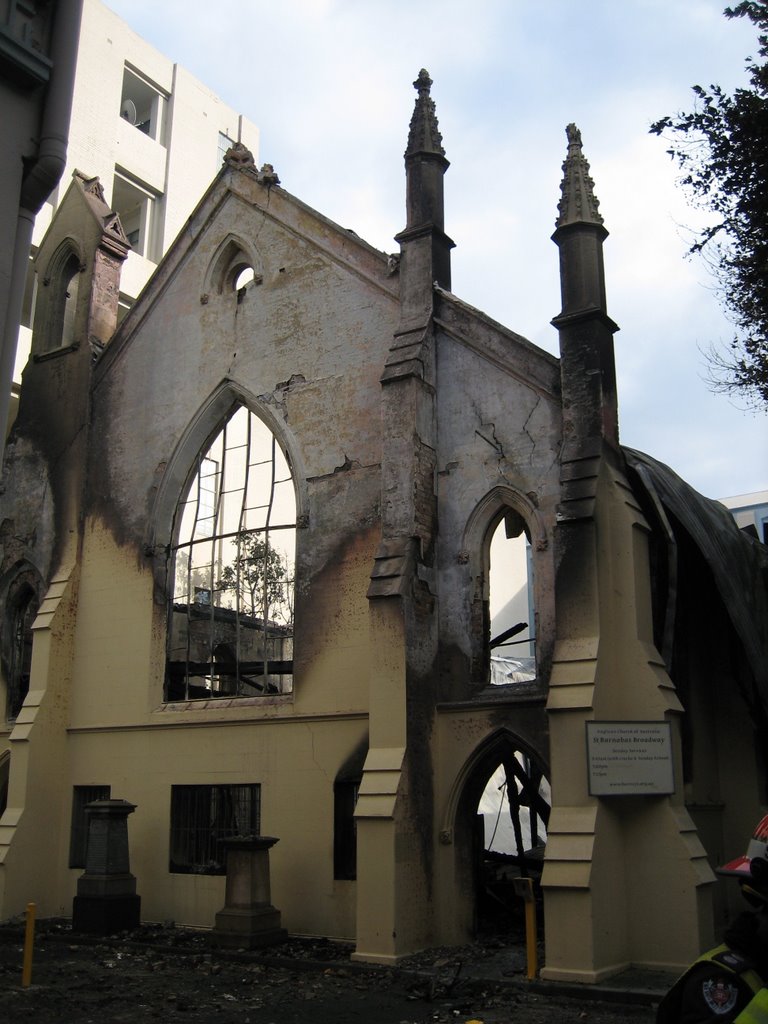
As previously mentioned (and here and here), the building in which my church (St Barnabas Anglican, Broadway, or 'Barneys') meets burned down recently.

As promised (and requested), some further thoughts on the matter:
I noticed in the days following the fire that there seemed to be two kinds of reaction, even where they were often mixed in individuals. On the one hand, some wanted to clearly say it was 'business as usual', the building was just a tool that is irrelevant to the 'real' work that Barneys does, that God was not any different, nor was our fellowship. On the other hand, some people wanted to grieve and acknowledge the grief of others at having lost something analogous to a 'family home'. So which is it to be? Or both?

How can we affirm the goodness and power of God in a world where things fall apart and burn down? We could deny the goodness of the falling-apart and flammable things. But that would be to deny that God was their creator, that "The LORD is good to all, and his compassion is over all that he has made" (Ps 145.9). If his compassion extends as far as his creation, how can he be good when the things he has made are subject to frustration and decay (Rom 8.23)?

We could include death inside his goodness, such that closure is a blessing that makes for beauty and poignancy, a way of multiplying good things by having one pass away to make room for another, a way of giving temporary things a extra specialness (like how Maccas special deals are special because this might be your one chance to get them. If they were part of the regular meal, then they would lose this glow). Or for the more refined, the apocryphal story of Michaelangelo's snowman: there is an extra beauty for the fact that it was but is no more. There is a melancholia and nostalgia that allows it to grow in the memory and imagination. Or consider the sunset: part of whose beauty is that now, just now, just here, is this particular configuration of cloud and colour; it will never be quite the same again as this moment. (Thought: is a blog an attempt to freeze and preserve what is wonderful about intelligent conversation, to make it always accessible? Just as a photo of a sunset is trying to pin down the butterfly of ephemerality). While there is indeed a bittersweetness to nostalgia based on transience, death remains 'the last enemy' (1 Cor 15.26).

A third alternative is to acknowledge the goodness of created things that leaves the tug in our hearts when they pass away, but to relegate this to 'mere creation': good but going. We are not to set our mind on such passing earthly things, but on the eternal. Earth is good, but heaven trumps earth. This is better than the first option, in that it can leave room for legitimate grief at earthly loss, and needn't imply a closure to creation. Indeed, it can become quite a useful stance when combined with C. S. Lewis' frequently stressed point that the best is not the enemy of the good. It is possible to keep first things first (trust in God, the location of Christian fellowship in Christ not buildings), without needing to deny secondary truths (how many great memories will always be associated with particular environmental contexts, and hence a sense of loss at destruction of that context). But I'm still not convinced that this is where our pilgrimage towards affirming creation ends.

The one who made the world, who dwelt with Israel in wilderness tabernacle and Zion temple even while filling heaven and earth, who abhorred not the virgin's womb, who took on human flesh (and not just temporarily, but who remains human in his present mediation: 1 Tim 2.5), whose ultimate goal is not the disentangling of heaven and earth, but their marriage (Revelation 21-22: notice that the new Jerusalem comes down to earth; God makes his dwelling amongst humans, not vice versa), this one will bring about 'the restoration of all things' (Matt 19.28; Acts 3.21), will make all things new (Rev 21.5), will resurrect the dead. Resurrection comes after death; unless a grain of wheat falls into the ground and dies, it remains a single seed. There will also be discontinuity, the resurrection of Jesus wasn't breathing life into a corpse, but transformation. It was not rewinding the sunset.

More can and must (at some point) be said here, but for now, notice that this God isn't afraid to get his hands dirty, in his freedom to bind himself to a contingent and limited creation, not to salvage what was good out of it into himself, but to dwell in it (and for it to dwell in him). He calls us not out of creation, but into it. His kingdom is indeed not 'from' the world (John 18.36) in its basis, methods and goals, but it is 'of' the world, in the sense that Jesus is the king of the Jews - and the Greeks and the whole world, as Israel's Messiah always was to be. And as we are thrown back into the world, we grow into the world, and it grows into us. As we do, creation is 'humanised'; this is indeed part of the mystery of our thanks-filled 'dominion' and 'filling' (Gen 1.28), which is also a 'serving' (Gen 2.15). Not a replacement of non-human by human, so that we squeeze all other life off the planet and die ourselves in regret, but a growing into, an integration. We become not less bodily as we grow in spirituality, but become more in tune with God's Spirit who breathes life into all things. This present life is not a secondary good that awaits its obsolescence in an apocalyptic inferno, but is a sign and anticipation of life of the aeon to come.

This, despite being by far my longest post, remains a summary and introduction to many more thoughts which I'll continue to explore in other avenues. Nonetheless, I think we can go beyond mere instrumentalism in considering the goodness of a building that we have grown into and which in turn has grown into us. The things of this world grow strangely glorious, not dim, in the light of the presence of God and in the hope of the resurrection. Christian response to loss is not a Stoicism that denies the importance of physical things, but genuine grief - with hope.
More posts on Barneys and the fire: I; II; III; IV; V; VI.
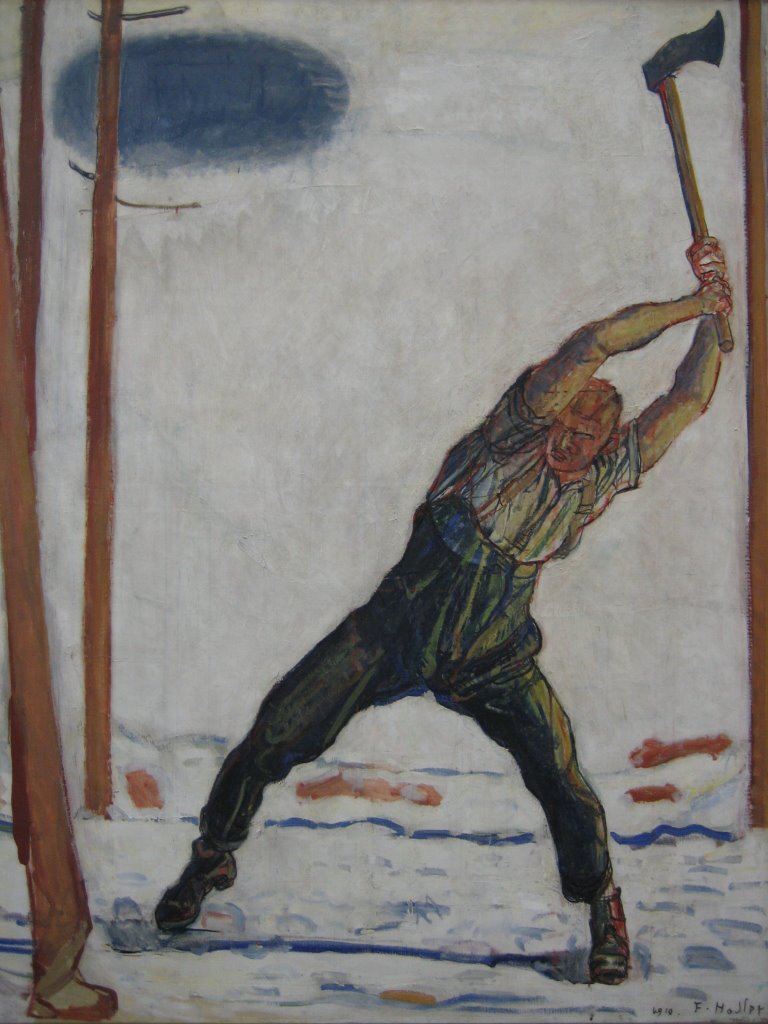
Ten points for being able to name the artist who painted the second image. And fifteen more if you can say where it is presently hung.

Wednesday, May 17, 2006

Barneys Old and New

For those who mightn't be Sydneysiders or SMH readers, the 148 year old building in which my church meets burned down last week.

Earlier, I posed the question about whether buildings mightn't have a place in the eschaton; indeed, what is the place of all human achievement and action when God makes all things new? Can we leave our mark?

When we consider our only source of knowledge about the new world, the risen Jesus, we find that upon him, the actions of humanity had indeed left their mark. His risen body was scarred with human attempts to end him. Interestingly, Mel Gibson's Passion gestured (however briefly) to a risen Christ with holey hands, yet the scourging was gone. Why the nails but not the whip? How could the Emmaus pair have missed a flaggelated man?

But I digress - it is quite a gap from Emmaus to the smoking ruin of Barneys. Not only was it marks of human violence which remained on the risen Christ (rather than human achievement considered in any positive sense), but also, well, Barneys was a collection of stone, glass and wood (not to mention lead, if we're to believe the SMH). Do non-human places and structures have any destiny beyond moth and rust?
More posts on Barneys and the fire: I; II; III; IV; V; VI.

Tuesday, May 16, 2006

Barneys barn burns

So, the news is getting cold, the ash washed away, the walls still in doubt, the plans have begun to sprout from every amateur architect in town. But what is the end for Barneys? Or at least the building we knew by that name? Do our buildings have a place in the end? Will the God who makes all things new, do a backyard blitz on this much-loved plain-faced eminantly-combustable collection of memories and dreams? Will bricks and mortar inherit the kingdom?

Sure, sounds a little odd, but just what is the place of human actions, achievements and anticipations of God's coming age? Surely there is more to be said here than 'rain-shelter' or even 'ministry-partner'? Our hope is not for the transcendence of the physical, the passing away of the transient, the eternal trumping the quotidian, but the resurrection of the dead.
More posts on Barneys and the fire: I; II; III; IV; V; VI.
Eight points for each piece of evidence (apart from the people) in this picture that demonstrates which Barneys service it was taken at.
Photo by JKS.