Showing posts with label 1 Peter. Show all posts

Thursday, August 25, 2011

Economics and ethics: does everything have a price?

Fox News is not usually considered to be a great source of ethical insight. So when a friend sent me an article titled almost everything we're taught is wrong, I was dubious. The piece argues that child labour, price gouging, ticket scalping, selling kidneys and blackmail are all deemed morally reprehensibly and illegal in many countries, but when we consider them from an economic point of view, we see that each ought to be considered socially beneficial.

Child labour in poorer nations contributes to the economy and keeps children from prostitution. Price gouging during an emergency reduces hoarding and gives an incentive to distant vendors to supply what is missing, even if this means travelling long distances. Ticket scalping provides a service that adds value, namely, allowing those prepared to pay extra to avoid the time they would have spent waiting in a queue. Making the sale of kidneys legal would save lives by increasing the supply. And if blackmail were legal, then there would be more reason for people to behave; in asking for money to not exercise free speech, the blackmailer is engaging in a form of "private law enforcement" by putting a price on not gossiping.

Each of these arguments needs to be addressed on its merits. Child labour: I agree that simply banning it is insufficient, but any ethical analysis worth its salt is not going to be content with mere legislation. The same argument could well be used against the abolition of slavery: what are the slaves going to do once they are freed? It is worth looking more broadly at what forces have created an economic situation in which the alternative to child labour is child prostitution.

Price gouging doesn't mean prices rising when there is shortage, but dramatic and extortionate price rises during a crisis. Should prices rise in an emergency? Yes, but not too much for essentials, since access to the means to stay alive ought not be contingent upon wealth. Far better for essentials to be rationed.

The argument for ticket scalpers I actually have some degree of sympathy for, though where ticket sales are online, then there is no waiting in line.

The sale of bodily tissues is problematic for multiple reasons. First, it commodifies one of the sites that ought to be most resistant to the logic of the market, one's own body. Second, if people are able to sell irreplaceable bodily organs, then why not their freedom? Thus there is a economic justification for slavery here. Third, if there is a legal price for kidneys, then the price is going to be high and this is almost inevitably going to mean that a black market will develop, incentivising criminal and coercive surgery. The antipathy to the sale of human tissue actually arises partly from Edinburgh history, where in the eighteenth century there was a black market in fresh cadavers for the famous medical school, and it lead to a very famous case of serial murder, which, incidentally, occurred just a few metres from where I sleep.

Blackmail has the same problem; making it legal would incentivise further and worse criminal behaviour. We only need to look at what happened to News of the World (and probably other UK tabloids) when gossip became commodified to see the dangers of encouraging breaches of privacy for profit.

The fundamental failure of the article appears in its opening lines. Economics is not a substitute for ethics. Any society that treats them as commensurate is inviting the thoroughgoing colonisation of all human relationships by market forces and the logic of commercial transactions. Christians of all people have the most reason to be suspicious of this, since we are taught that the love of money is a root of all kinds of evil (1 Timothy 6.10) and that our lives are ransomed not with silver or gold, but the precious blood of Christ (1 Peter 1.18). Not everything can be translated into a single numerical language.

Thursday, March 10, 2011

Lent: What is the reward of fasting?

"Beware of practising your piety before others in order to be seen by them; for then you have no reward from your Father in heaven. [...] And whenever you fast, do not look dismal, like the hypocrites, for they disfigure their faces so as to show others that they are fasting. Truly I tell you, they have received their reward. But when you fast, put oil on your head and wash your face, so that your fasting may be seen not by others but by your Father who is in secret; and your Father who sees in secret will reward you."

- Matthew 6.1, 16-18 (NRSV).

Does fasting earn spiritual brownie points? Does every meal skipped now give us an extra helping at the messianic feast of the age to come? I don't think that this is Jesus' point here. He is warning against those whose acts of piety (he mentions charitable giving, prayer and fasting) are done in order to be seen by others. Jesus has no problem with good deeds that are visible to others. Indeed, just a few verses earlier, he taught his listeners to "let your light shine before others, so that they may see your good works and give glory to your Father in heaven" (Matthew 5.16, NRSV). The issue here is not the visibility of the works, but their purpose. Ostentatious display somehow undermines the point of such deeds, which suggests that their point has to do with our hearts, with our motives and desires (a conclusion also suggested a few verses later in 6.19-21, where Jesus speaks of what it is that our hearts treasure). We give, pray and fast in order to allow our hearts to be shaped by such disciplines. These activities are done for the healing of our desires not the enhancement of our reputation. At least part of the reward of fasting, then, is to discover that our treasure is indeed heavenly and so free from the vicissitudes of material possessions or social reputation.

"Heaven" in Matthew's Gospel is not code for eschatological promise (as it is often misused in much Christian discourse), but is either a reference to God's dwelling place (5.34, 14.19 and all occurrences of "Father in heaven"), or a synecdoche for God himself (3.17, 16.1, 18.18, 21.25 and all occurrences of "kingdom of heaven"). In other words, when Jesus speaks of storing up treasure in heaven, he is not first and foremost talking about the future (unlike, say 1 Peter 1.4, though even there the hope is that it will be revealed, not that we will go to heaven to be with it). Instead, storing up treasure in heaven means cherishing God, seeking first his kingdom and his righteousness. It means a transformation of our desires so that we are not seeking our own glory but delighting in God's. And this is why any attempt to gain credit before others through acts of piety destroys the very purpose of those acts, since it distracts us from the chance to have our desires realigned towards God and his purposes.

Therefore, perhaps the "reward" of fasting (or prayer or giving) that Jesus refers to in Matthew 6 is not that we somehow earn a better future, but that our desires take another step on the path to healing, that we are slowly liberated from our crippling self-obsession. This is no mercenary bonus, unrelated to the activity that wins it. It is the appropriate outcome of the very activities that seek to draw us out of the echo chamber of own hearts. Our reward might well be that we become a little more capable of love.
I have tried head off one potential misunderstanding of this post at the pass.

Monday, February 21, 2011

Why I'm not going to heaven

Heaven's above!
Yuri Gagarin, the first human to orbit the earth, is reputed to have said upon his return, "I looked and looked but I didn’t see God". God is not in heaven; we have now been there.

This anecdote may make us smile. Heaven is indeed well-known as the dwelling-place of God, yet when Christians pray to "our Father in heaven" we do not mean that God is literally to be glimpsed by cosmonauts up above the ionosphere in the heavens. The Scriptures do frequently speak of "the heavens" in this literal sense of what you see when you look up on a clear night. But the term gains extra layers of meaning as we follow the biblical story from the creation of the heavens and the earth in Genesis 1-2 through to the marriage of heaven and earth in Revelation 21-22. Heaven comes to mean a reality far deeper, richer and more overarching than merely the sky.

For many Christians, "heaven" has come to serve as a shorthand for everything we hope for, for the ultimate goal of our salvation, for the blissful land of rest at the end of our journey. We populate this realm with images from cartoons and movies, in which white robed figures with haloes play harps on clouds, or perhaps play rugby against the angels. Even where the content is left more vague, much Christian piety assumes that going to heaven when we die is the content of Christian hope. This theme is found in many of our songs, mentioned at many funerals, serves as a focal point in evangelism, and is frequently discussed in wistful or anguished conversations late at night.

Heaven: the origin, not the goal, of our salvation
However, a closer reading of the biblical narrative would suggest that such conceptions are significantly wide of the mark. The good news of Jesus certainly does hold out a stunning hope in the face of death and for a dying world. But it is not that we will go to heaven. It is that heaven will come to us. It is not that we will pass into a higher realm at death, but that, one day, God will transform this world so that his will is done on earth as it is in heaven. It is not that there is life after death for an immortal soul, but that at some point after our death, God will raise us bodily as he did for Jesus. Although there are a few passing references to the fact that those who have died in Christ are not lost, but are now with him, this is never held out as the primary content of our hope.

This is worth pausing over. We are indeed "citizens of heaven", but this doesn’t mean we hope to end up there. Instead, it is from heaven that we await a Saviour who will raise us to have glorious bodies like his (Philippians 3.20-21). Our inheritance is indeed in heaven, but that is because Jesus is our hope, and he is hidden until the day our living (i.e. resurrection) hope is realised (1 Peter 1.3; see also Colossians 1.5). We seek to enter “the kingdom of heaven”, but this is Matthew’s way of speaking of what is elsewhere called "the kingdom of God"; "heaven" here is simply a reverent way of referring to God without directly mentioning him (see also Luke 15:18). We could go on and on, but nowhere does the New Testament teach that going to heaven when we die is the focus of Christian hope.

The truly Christian hope, based on the experience of Jesus, is for resurrection, not merely an otherworldly existence after death. Resurrection is a powerful act of God to vindicate and transform our lowly bodies to be like Jesus’ glorious body, for us to be raised as he was raised, not simply back from the dead into mortal bodies to die again, but raised in glory and freedom.

"Your will be done on earth"
And it doesn’t end with our bodies. Our hope is for God to say "yes and amen" to the creation that he declared good, very good. It is for the earth to be filled with the glory of God as the waters cover the sea, for death to be swallowed up in victorious new life, for God’s will to be done on earth as it is in heaven. In short, our hope is not to escape this place and these bodies and go elsewhere, it is for God to heal and bring new life to his broken creation, conquering death and decay forever.

Thus, Christian hope is not for redemption from the world, but for the redemption of the world. Jesus’ resurrection therefore has implications not just our bodies, but also for the entire created order of which they are a part. In Romans 8 Paul pictures the created order as a woman giving birth, waiting and straining for a future joy, despite pain and distress at the moment. Switching metaphors, he says that creation is like a prisoner, in bondage to decay. So while everything currently falls apart, God has something surprising planned: a gaol-break! And creation is yearning, groaning for that day. And so, says Paul, are all those who have gotten their first taste of God’s future in the Holy Spirit. We too groan and yearn for that day when our bodies will be redeemed, that is, raised into glorious freedom.

Matter matters
That heaven is not the end of the world has all kinds of implications. Here, briefly, are four.

God has not abandoned his good creation.
The God who has the power to call things which are not into existence is the same God who raises the dead (Romans 4.17). Therefore, redemption is not fundamentally opposed to creation and the created order, but vindicates it. And that means that the church is not the opposite of the world, but an imperfect foretaste of the world’s true future.

God says "yes" to life.
His "no" of judgement is only to be understood within an overarching "yes" to Christ, to humanity, to his world, to life. He opposes that which opposes the flourishing of his creation. God is unashamedly positive about all that is good in the world: he says "yes" to love, to laughter, to sharing, to sex, to food, to fun, to music, to matter. It is because he loves the world that he will not put up with its present disfigurements.

Humanity as humanity matters.
Jesus was raised, and remains, a human (1 Timothy 2.5). We await resurrection as humans. Nothing that is truly human will ultimately perish (though all must be transformed). This makes human endeavour and relationships noble, even while they remain tragically flawed. Christians remain humans, with much still in common with our neighbours. Secular work in God’s good world is not to be despised or treated merely instrumentally. Neither is art, or education, or healthcare, or agriculture, or science. There is much about these activities that will not endure, and much that requires reform; yet these tasks all participate as part of what it is to be a human creature.

What we do with our bodies and the planet matters.
Not because we can create the kingdom of God or sculpt our resurrection bodies now, but because God cares for them. Bodies and the broader environment in which they find their place are good gifts, worth caring for. Just as our obedience will never be complete in this age, yet we keep thanking, trusting and loving God, so our care for creation is presently an imperfectible, yet unavoidable, responsibility and privilege. We must therefore also reject any dualism that opposes ‘spiritual’ to 'physical' concerns. To be truly spiritual is to be enlivened, empowered, cleansed and directed by the Holy Spirit of life, who is the midwife our birth (Job 33:4) and our rebirth (Titus 3.5), and the midwife of the world’s birth (Genesis 1.2) and rebirth (Romans 8.22-23). To be a friend of God is to be a friend of creation, of humanity, of life - the kind of friend that hates what is evil, clings to what is good, that is not overcome by evil, but overcomes evil with good (Romans 12.9, 21).
This article was originally published in Salt magazine with the title "Heaven: It's not the end of the world" in Autumn 2009 and then online by WebSalt. Long time readers (or those who browse the sidebar) may recognise that it is a condensed version of my sixteen part series on heaven from the early days of this blog in 2006. I thought I would repost it here (with permission from the Salt editor) in order to provide a more accessible and convenient form of the argument in a single post. Those looking for a little more detail are referred to the full series.

Friday, July 30, 2010

Hospitality makes you feel at home

"Be hospitable to one another without complaining." - 1 Peter 4.9.
Mi casa es su casa. Being hospitable is a core Christian practice.* Sharing a home, whether for a meal for a night or for longer is a way of using our blessings to bless others. But something that has struck me over the last few years is that the blessing runs both ways. I don't simply mean that you might receive hospitality in return (that is never the goal), or even that you might have a good conversation or make a new friend, though these are frequently true. Instead, my wife and I have discovered that one of the blessings of sharing our place is that the very act of sharing makes us feel more at home. Put another way, a place only becomes our home when we share it with others.

I heard a statistic a few years ago that I now can't source, but I think was a newspaper report of a study done in Australia. It had been found that the average Australian only has six people into their home each year (including family). Are you missing out on receiving blessings by not sharing more?

That said, this instruction in 1 Peter assumes that complaining is commonly associated with the offering of hospitality. Opening your home takes time, effort and sometimes involves some extra costs. It will not always feel like a blessing. Indeed, frequently, it is not something from which you will gain any immediate reward at all.
[Jesus] said also to the one who had invited him, "When you give a luncheon or a dinner, do not invite your friends or your brothers or your relatives or rich neighbours, in case they may invite you in return, and you would be repaid. But when you give a banquet, invite the poor, the crippled, the lame, and the blind. And you will be blessed, because they cannot repay you, for you will be repaid at the resurrection of the righteous." - Luke 14.12-14.
*It is probably worth drawing a distinction between hospitality and entertaining. The former is sharing your home life with others (including strangers!); the latter is aiming to impress friends or contacts with a life that is not really yours. Being hospitable doesn't necessarily mean cooking a multi-course gourmet meal or offering a five star hotel bed. And while taking people out to dinner can be a lovely thing to do, I'm not sure that it counts as hospitality.

Having written this post, I've just discovered that Jeremy has written an even better post about hospitality, so let me invite you over to his place for a rich meal of thoughts.

Thursday, February 11, 2010

Hope in 2010

Is it possible to hope today?

Rev Dr Michael Spence is the current Vice-Chancellor and Principal of my alma mater, the University of Sydney and he is also an ordained Anglican priest working in a voluntary capacity at St Mary's Anglican Church, Waverley (the church in which Jessica was baptised and in which we were married). He recently participated in a panel event hosted by ABC Radio National as part of the Sydney Festival titled Hope 2010: Crisis, Catharsis, Renewal. Dr Spence's contribution is worth listening to as someone in high office giving an account of the hope that is in him. To give you a taste, here are some quotes:

"Love - self-giving, self-sacrificial, unsentimental, others-oriented love - is at the centre of reality."

"Acceptance is the opposite of hope. [...] Hope claims the right to look for and struggle for a world in which all those enemies of love - hate and all its children - are defeated."

"Resurrection is possible. There can be real victory over the enemies of love, both in our own lives and more generally."

"There are just as many pathological reasons for belief as for unbelief."
The fact that he made it from ontological difference to Babe in two sentences was particularly impressive.
H/T Matt.

Tuesday, March 11, 2008

"In my Father's house": some reflections on John 14

...We look for the resurrection of the dead, and the life of the world to come.

- Nicene Creed

A while ago, I posted a series on why I think that the Christian hope has very little to do with going to heaven when you die. During that series I argued that resurrection on a renewed earth is a more scriptural understanding than an individual post-mortem departure to another place, despite what many of our hymns say. I also looked at various passages often (mis)used to prop up such a platonic view, showing how each either directly teaches or can naturally be understood to be affirming a resurrection hope: Philippians 3.20-21 ("our citizenship is in heaven"); 1 Peter 2.11 (being aliens and strangers); 1 Peter 1.3-5 (a heavenly hope); Matthew (the kingdom of heaven); 2 Peter 3 (a new heavens and new earth).

However, there was one commonly cited passage I didn't address:
Do not let your hearts be troubled. Trust in God; trust also in me. In my Father's house are many rooms; if it were not so, I would have told you. I am going there to prepare a place for you. And if I go and prepare a place for you, I will come back and take you to be with me that you also may be where I am. You know the way to the place where I am going.                      - John 14.1-4
A heaven-as-destination-of-Christian-hope reading of this passage is probably so familiar that I barely need to sketch it out. Jesus is about to go back to being with his Father in heaven ("my Father's house"), where he is preparing rooms for the disciples (taking almost two millennia and counting to do so) such that one day when he comes back, he will take all believers to be with him. And the way into this heavenly mansion is Jesus himself ("I am the way, the truth and the life", two verses later). Notice, however, that even if this reading correctly identifies "my Father's house" with heaven, this is still not "heaven when you die" - it is heaven at Jesus' return.

N. T. Wright, vocal critic of "heaven when you die" eschatology (and owner of numerous large birds), has suggested a reading of this passage in The Resurrection of the Son of God (2003) that tried to emphasize the rooms (or "dwelling-places") were an image of a "temporary resting-place, a way-station where a traveller would be refreshed during a journey" (p. 446). He pointed out that "my Father's house" is a common way of referring to the Temple (John 2.16-17; cf. Luke 2.49; Matthew 21.13; Mark 2.26). Putting this together with some parallels in Jewish apocalyptic writing that speak of "the chambers where the souls are kept against the day of eventual resurrection", he concludes:
"The 'dwelling-places' of this passage are thus best understood as safe places where those who have died may lodge and rest, like pilgrims in the Temple, not so much in the course of an onward pilgrimage within the life of a disembodied 'heaven', but while awaiting the resurrection which is still to come." (p. 446)
Thus, for Wright this passage becomes a reassurance about the intermediate state. God is able to accommodate all those awaiting resurrection. He will not turn any away; those who have died in Christ are not lost.

In his very brief treatment of the same passage in John for Everyone (2004), he seems to have changed his mind. Rather than being about an intermediate state, he now thinks Jesus is referring to our ultimate hope, not going to heaven, but the renewal of all creation to become the dwelling place of God. After again making the point about "my Father's house" as the Temple, he goes on to explain:
"The point about the Temple, within the life of the people of Israel, was that it was the place where heaven and earth met. Now Jesus hints at a new city, a new world, a new 'house'. Heaven and earth will meet again when God renews the whole world. At that time there will be room for everyone." (p. 58)
So where does God dwell? Where is his "house"? Although the idea of God dwelling in heaven is a common scriptural image, I think Wright is correct to point to John 2.16-17 as an important earlier reference to God's house. However, even the equation of God's house with the Temple in Jerusalem is problematised in that very passage, which declares that Jesus, in speaking of the Temple, was speaking of his own body (2.19-21). The temple, or house, of God is an image of God's dwelling place. In one sense, God dwells in heaven. In another sense, he dwells in Christ. In a third sense, he will dwell in the new heavens and earth. And yet in John 14 there is a fourth location, a fourth sense of God's dwelling place:
Jesus replied, "Anyone who loves me will obey my teaching. My Father will love them, and we will come to them and make our home with them."

- John 14.23

More to come on this...
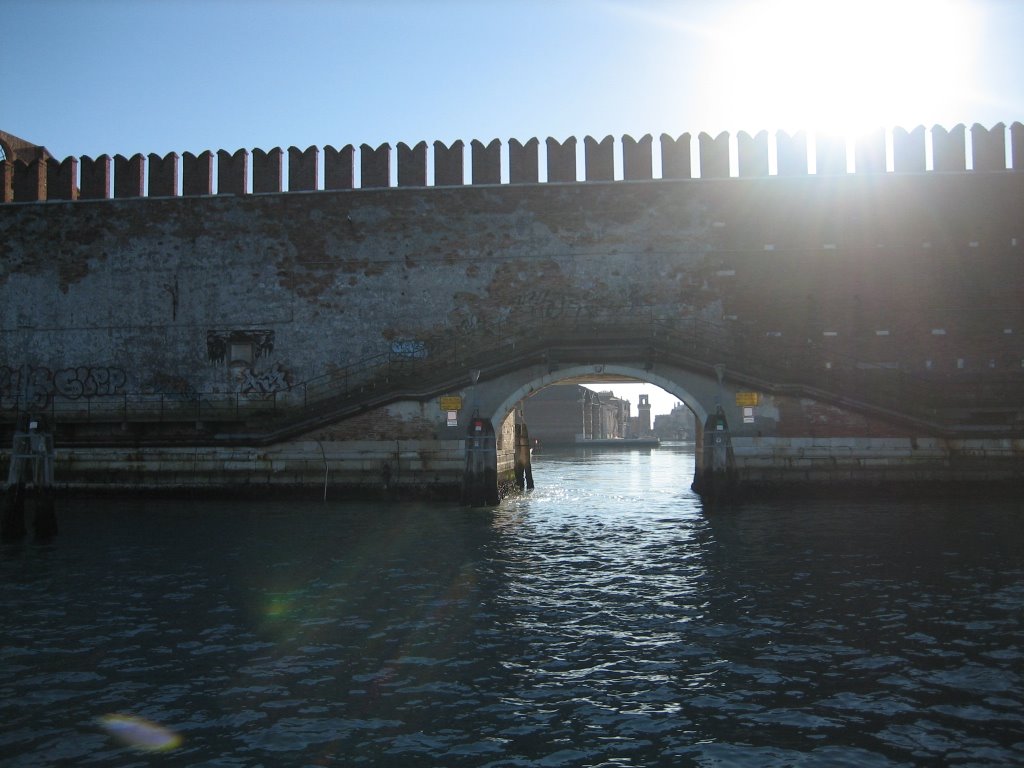
Twenty points for correctly naming the building. Ten for the city. Five for the country. No more than one set of points per person.

Sunday, December 23, 2007

Mary's melody: a revolutionary hope VII

Jesus' revolution starts now, but is not yet complete. We're a little like sleeper cells, waiting for the day the world is turned upside-down and living quietly subversive lives now. For instance, this meal we are about to share is not based on income, or status, or friendship. Such sharing is a subversive act in a world dominated by economics.

Jesus said, Blessed are the poor, for theirs is the kingdom of God (Luke 6.20). Mary’s song teaches us that God opposes the proud but gives grace to the humble. Once we realise our poverty, when we give away everything that we think is ours, once we share all the good things we don’t and can’t ever own, when we are poor, then God will open our eyes to see that we have everything in his kingdom. When we loosen our grip and let our treasures slip from our hands, then we will discover that it is only with open and empty hands that we can receive. Once we realise our helplessness, when we stop being impressed by our own abilities, or stop being envious of those around us, once we are weak, then God will give us strength to pick up our cross every day. Once we realise our finitude, our frailty, our emptiness, then God can begin to fill us with unspeakable beauty, undying love, untamable hope.
Series: I; II; III; IV; V; VI; VII.

Monday, September 17, 2007

Moving on from Howard?

The Hon John Howard MP has spent eleven years as Prime Minister of Australia as leader of the Liberal/National Coalition. In the 2004 federal election, Howard's Coalition won by almost six points in a two-party preferred vote over the ALP. But now, with about six or eight weeks until the election (the date has not yet been set), he trails opposition leader Kevin Rudd by somewhere between fourteen and eighteen points, according to the latest polls. Some polls even predict he could lose his own electorate of Bennelong. With over twelve million people eligible to vote out of Australia's population twenty-one million, that's well over a million people who have changed their preference since 2004.

If you are one of them,* I'm curious: what has been decisive in your change of mind?
*That is, you voted for Howard's Coalition in 2004 (or placed them ahead of the ALP in your House of Representatives (lower house) vote), but if the election were held today, would give your lower house preference to Rudd's ALP. I'm happy for others (who have not changed their mind) to comment, but I'd really like to hear from those who have. You may comment anonymously if you like. However, please observe 1 Peter 2.17.

NB In case you haven't heard, there are new laws regulating enrollment deadlines. If you are over 18 and an Australian citizen, it is compulsory to vote. If you have changed address since the last election, you need to change your enrollment. There is now less time to do either of these than previously and if you don't, you will miss out and may be fined. You can enrol or change your details at the Australian Electoral Commission.
Image of John Howard at the recent APEC conference from Epoch Times.

Wednesday, March 28, 2007

Democracy in action

Pilate then called together the chief priests, the leaders, and the people, and said to them, "You brought me this man as one who was perverting the people; and here I have examined him in your presence and have not found this man guilty of any of your charges against him. Neither has Herod, for he sent him back to us. Indeed, he has done nothing to deserve death. I will therefore have him flogged and release him."

Then they all shouted out together, "Away with this fellow! Release Barabbas for us!" (This was a man who had been put in prison for an insurrection that had taken place in the city, and for murder.) Pilate, wanting to release Jesus, addressed them again; but they kept shouting, "Crucify, crucify him!" A third time he said to them, "Why, what evil has he done? I have found in him no ground for the sentence of death; I will therefore have him flogged and then release him." But they kept urgently demanding with loud shouts that he should be crucified; and their voices prevailed. So Pilate gave his verdict that their demand should be granted. He released the man they asked for, the one who had been put in prison for insurrection and murder, and he handed Jesus over as they wished.

- Luke 23.13-25

It struck me tonight that this is one version of democracy in action. The many declare their will and it is implemented by the appointed authorities, despite personally disagreeing with the decision.

It is, however, an unmitigated disaster. The mob's irrational hatred* drowns out the one voice of reason and a gross injustice is perpetrated.

Not that the alternatives to democracy fare much better on this dark day. The entire chapter can be read as an unmasking of the beastliness of human authorities (cf. Daniel 7: obviously not a randomly selected passage, given the number of times Jesus refers or alludes to it while in Jerusalem). There is far more to say about a biblical attitude towards authority than Romans 13 and 1 Peter 2 (i.e. "obey!").
*The problem of why the crowd suddenly turn upon Jesus may be solved if it is assumed that this group is largely co-extensive with "the assembly of the elders of the people" (22.66; cf. 23.1). Although this group may have grown a little (justifying the inclusion of "the people" in the list of verse 13), it may well have still be largely those who had tried Jesus the night before. Notice in verse 14 that Pilate can say to the crowd that "you brought me this man", implying a high degree of continuity between the assembly and this group before Pilate. Also notice that the multitudes who had been praising Jesus a week earlier as he rode into Jerusalem were not Jerusalemites, but a rent-a-crowd of disciples (i.e. they had already been travelling with Jesus). Therefore, there is no need to explain a sudden change of mind on the part of the Jerusalem populace.
Ten points for correctly identifying this building and fifteen for briefly explaining its connection to the history of democracy.

Wednesday, October 25, 2006

Heaven: not the end of the World XIII

Aliens and strangers
Augustine writes movingly of the civitas Dei peregrina, the pilgrim City of God. By this, he refers to that society of people scattered among the nations on earth who love God more than self, who glory in him, rather than seeking their own glory, who confess Christ and yearn for home, finding themselves homeless wanderers in this world. Indeed, the Latin term peregrina, often translated 'pilgrim' might perhaps be better rendered 'resident alien' or 'sojourner'. It is a word closer to the experience of Tom Hanks in The Terminal than the merry pilgrim-cum-tourists of Chaucer's Canterbury Tales.

To confess Christ is to put yourself on the wrong side of those powers that crucified him, and so to find oneself misunderstood as a rebel. Misunderstood, because just as Christ was a prophet calling the nation back to its true identity, calling humanity back to its Creator, so those who take up their cross and follow him are doing so out of faithfulness to that Creator and thus in solidarity with the groaning creation.

And like the creation, those with the Spirit - the firstfruits of the future presence of God - yearn for the redemption of our bodies, for a transformed world where death is no more, where Christ's gracious kingdom is unopposed, where the riches of God's kindness are poured out with unspeakable joy. We long for the day when the oppressor is no more and the earth is inherited by the meek.

Because of this, we can never feel at home in a world where the rich devour the poor, where unborn strangers are turned back at the borders of life, where Christ is crowned with thorns and anointed with spittle. We are aliens, citizens of the civitas Dei peregrina.

But this is not because our home is elsewhere. It is elsewhen.

And so I wonder whether when Christians are called 'aliens and strangers', this is less like the Jewish exiles in Babylon, who pined for Zion and could not sing for grief, and more like Abraham. Abraham and his immediate descendents are repeatedly called 'aliens' and 'strangers' (Gen 17.8; 21.23, 34; 23.4; 26.3; 28.4; 37.1), though they are already living in the land that God had promised them. Though strangers, the land belongs to them by promise.

For all things are yours, whether Paul or Apollos or Cephas or the world or life or death or the present or the future--all belong to you, and you belong to Christ, and Christ belongs to God.

- 1 Corinthians 3.21-23

Series: I; II; IIa; III; IV; V; VI; VII; VIII; IX; X; XI; XII; XIII; XIV; XV; XVI.
Ten points for guessing the country in the above pic.

Monday, October 09, 2006

Heaven: not the end of the world X

Images of the future
Of course, resurrection is not the only way the New Testament speaks of our future life. Sometimes it is pictured as a banquet (Matt 8.11, 22.2; 25.10; Rev. 19.9) or described as an ‘inheritance’ (Matt. 25.34; Rom. 8.17; 1 Pet. 1.4). However, I personally take these images more metaphorically than resurrection, because once again, I think that it is only in Jesus and the Spirit that we get a picture of the future. Thus his resurrection (and the Christian experience of present inner 'resurrection'/renewal by the Spirit) is our primary access to the future: we will be like him. Of course, our knowledge of Jesus' resurrection (and even of our own inner experience) is incomplete - the risen Jesus did not fit any previous paradigms and the new Christians reached for the language of 'resurrection', while acknowledging also radical transformation. And so even our most concrete knowledge of the future is more evocative than exhaustive.
Series: I; II; IIa; III; IV; V; VI; VII; VIII; IX; X; XI; XII; XIII; XIV; XV; XVI.
For ten points, pick the city (this one really does require random guessing - no shame in being wrong).

Wednesday, September 20, 2006

Heaven: not the end of the world V

Heavenly salvation: origin, not destination (1 Peter 1.3-5)
I mentioned at the end of the last post that Christian hope is indeed heavenly, because it is from heaven that we await salvation. This helps understand the language of 1 Peter 1.3-5:

Praise be to the God and Father of our Lord Jesus Christ! In his great mercy he has given us new birth into a living hope through the resurrection of Jesus Christ from the dead, and into an inheritance that can never perish, spoil or fade— kept in heaven for you, who through faith are shielded by God's power until the coming of the salvation that is ready to be revealed in the last time.
I suspect that many readers, upon hearing that their inheritance is "kept in heaven", imagine that the content of that inheritence is itself "heaven", a post-mortem paradise of some kind. However, this misses the main point of this passage. The living hope is precisely that: alive. Life is not simply the mode, but the content of the hope: the new birth is to be the start of new life. And this new birth is into resurrection life. The same kind of resurrection (indeed, strictly speak, the same resurrection) as Jesus. It is his resurrection that is both the ground and illustration of our lively, vivacious, vital, living breathing hope.

Thus, this hope is "kept in heaven" in a similar way to the new car your parents might give you for your birthday is kept in the garage for you. Not so that you can go into the garage to enjoy existence there, but so that the real hope - fully mobile vehicular life - is secure until the day that it is ready to be revealed. Or, to borrow an illustration, like the beer is kept in the fridge for you. The hope isn't to chill out long term, but to have the hope adequately stored and prepared. So too here, the purpose of its being in heaven, is that it is with God, indeed, our hope is God himself (that's why it's in heaven), and so there is no fear of its being flat or warm: it can never perish, spoil or fade. The paintjob won't get scratched by the neighbour and it won't get lifted by the local joyriders. Our future is secured by God's power; indeed, we ourselves are divinely shielded until the time is ripe. Not that bad things can't happen to us: on the contrary, they can and will. What is shielded is our future resurrection, it is securely held by the one whose power raised Jesus from the dead. No one can snatch us out of his hand.
Series: I; II; IIa; III; IV; V; VI; VII; VIII; IX; X; XI; XII; XIII; XIV; XV; XVI. Ten points for the city in this pic.

Wednesday, August 23, 2006

The end of grace III

The graciously delayed end
I've been posting recently on grace and eschatology, or rather, grace in eschatology, or perhaps, eschatology as grace.

God takes his time with us. He is patient with us, not wanting anyone to perish, but everyone to come to repentence. At least from our perspective, there seems to be a chronic postponement or delay in God's decision to call a halt to the ongoing catastrophe of life ruled by death. However, this pause is actually itself motivated by grace. Strangely, while the end will be the culmination of God's free action to defeat evil and reclaim his world, that he doesn't make it happen now is also a gift. The temporal 'gap' between rebellion and its consequences might make rebels bold. The causal 'gap' (or at least inadequacy of correspondence) between those who perpetrate destruction and those who suffer as a result might lead to the prosperity of the wicked and the pain of the (relatively) innocent. But God's patience is motivated by his desire for human repentence. While the victim cries for justice, God commits their cause temporarily to fallible and provisional human courts - courts which not only often fail, but always must fail to provide the infinite justice that grief demands. This too is gracious: avoiding the destruction of society in a mounting storm of reprisals, a multiplying echo-chamber of vengeance. Abel's blood cries from the ground, but God graciously marks Cain to prevent human attempts at pre-empting final justice.

Final judgement delayed speaks of mercy; the guilty may turn aside from their fatal path and live. Provisional human judgements upon wrongdoing are a partial and often bitter gift. But the open question of the when of divine justice grates those who have received injustices. Mercifully pausing for the sake of the guilty, graciously providing for the continuance of human society despite grievances that threaten to tear it decisively apart, God reminds us that the victim is not the only party in need. The wrongdoer is threatened by internal disintegration, social recrimination, and divine wrath. Their plight is dire indeed, and without the merciful space afforded by divine delay and the limits set upon human retribution, the self-destructive logic of their acts would itself bring about a catastrophic end.

Yet where is God's grace for the victims? How long will they have to wait for their day of vindication? Sorrowful concern for the sinner comes after righteous indignation for the sinned against. What gift does God have for them? How is the gospel good news for the poor and oppressed? The blood of Abel still cries, as does the shed blood of all the martyrs, innocents and wronged: 'how long, O Lord?'

But there is a better word than the blood of Abel. The cry of those faithfully leaving room for God's vengeance is not forgotten. But it is not answered on its own terms either. The sprinkled blood of Christ is a better word than the victim's cry for vengeance. God's justice involves not simple and immediate retribution, but a gracious sacrifice made on behalf of wrongdoers. For God's desire is that none should perish. He asks the victims to relinquish their demands, or at least to let them be transformed in the light of divine wisdom. He asks for trust: that his dealing with wrongdoers will satisfy the wronged.

Does he then go easy on the perpetrator while asking the victim to lower her expectations? Must she exchange her thirst for retribution and accept God's reforming work in the criminal instead? A partial answer is that the wrongdoer does not avoid death through repentence, but accepts co-crucifixion with Christ. But this is not the full answer. God's eschatological justice has arrived and been executed upon Calvary, but it remains hidden - as Christ is hidden. In Christ, God has begun graciously satisfying both victim and offender.

But grace is not over yet. There is more yet to come...
Series: I; II; III; IV.