Showing posts with label apocalyptic. Show all posts

Wednesday, August 17, 2011

The end is nigh? Apocalyptic thought and our present distress

Apparently, the apocalypse has already come and gone. Did you miss it?

The relation of apocalyptic thought to our present and likely future distress is an interesting and complex question, not easily answered in a few sentences. I've recently been reading a book edited by Stefan Skrimshire titled Future Ethics: Climate Change and Apocalyptic Imagination, which I mentioned back here. As is usual in an edited collection of essays, quality and relevance vary considerably, but the theme is an important one. How do our images of "the end" shape our understanding (or misunderstanding, as the case may be) of climate change?

For some activists, the pace and scale of anthropogenic climate change on our current trajectory represents an existential threat to the present order of the biosphere, including the human order of a globalised industrial civilisation of almost seven billion and rising. The language of apocalyptic is borrowed in order to try to gain some traction with policy-makers and the public. It matters not whether this borrowing represents a reflexive reliance on a thread of thought with its roots in religious discourse or the deliberate appropriation of concepts and tropes that still inhabit our imagination and so which will resonate widely. The goal is to induce an emancipatory shock, a recognition of our situation as extreme, a justification for emergency measures that disrupt the usual flow of commercial, political and social life with a radical reordering.

Some Christians, noting the borrowing of apocalyptic language by activists, are inclined to ignore the whole thing as another human attempt to claim control of even how the world is going to end. Instead, affirming that the end is in God's hands alone, they argue that any claims of humanity bringing about the end by our own efforts (even inadvertently) must be treated with extreme suspicion.

Personally, while it is difficult to get a good grip on the magnitude of the threat represented by climate change without recourse to some very strong language, I think that it is best to remain agnostic about the relationship between our preset distress and threats and the divine promises relating to ultimate realities. It may be that there is some link, but there is no particular reason in my opinion to think so. Even if our actions lead to the downfall of our way of life and the utter transformation of our society into something so different that in hindsight it is appropriate to speak of industrial civilisation having experienced a self-induced collapse, this need not be the end of the world. To use a line that is growing increasingly common, the end of the world as we know it is not necessarily the end of the world.

And where this cuts the mustard for me is that sometimes apocalyptic thought can become a lazy way out of ethical deliberation. Apocalyptic becomes lazy where it is in the service of a fatalism that assumes our destiny is doomed by the greater power of nature (whether acting blindly, under its own authority as a personified (and angry) mother earth, or as the instrument of God's inexorable judgement) or which conversely rejects the possibility of social self-destruction in principle. In each case, the future is seen as closed and human actions as ultimately irrelevant, in which case, let us eat and drink for tomorrow we die. It can also be lazy where it is used to create panic and a desperate acceptance of whatever medicine is closest to hand. This is a kind of non-emancipatory shock that stuns the hearer into passive acceptance of the salvific social, economic and/or political solution that swiftly follows the apocalyptic account.

Denying knowledge of the relationship between our time and time's telos keeps open the space for neighbourly care. It does this not by rendering apocalyptic inscrutably distant ("since we can't know when the end will come, then let us ignore the coming of the end altogether"), but constantly relevant. In Christian apocalyptic, the hidden meaning of history is revealed to be the stage of divine action, not in competition with human action, but as the previously unknown judge and liberator of human action. Since the day of divine judgement approaches like a thief in the night, unbidden and unobserved, the wise servant knows that her actions are made more weighty, not less. Instead of paralysing fear or enervating schadenfreude, she is liberated to conduct her faithful service in reverent hope of divine vindication. By such acts, she is not heroically securing the future; saving the world (or the present world order) is not her motive or modus operandi. Instead, she trusts that because the hour of her vindication approaches, she has time to prepare, to reflect with prudence on her ability to be a blessing in the limited time she has received. Waiting patiently, she need not dread the outcome of history, but is free to love her neighbour as an instantiation of her wholehearted love for the master with what strength and wisdom she has received. It may be that the immediate future holds suffering, even vast suffering, but not yet the end of all things. In which case, her actions undertaken in hope are not in vain; they are secured by the promise of the resurrection, and thus they are freed from the impossible burden of having to deliver her own life or the continued existence of her society.

And so, there is a sense in which the apocalypse has indeed already come, in the sense that apocalypse means "revelation", an unveiling of what was hidden. After Christ's coming, Christian believers now see the world and its future in a new light. No longer do the dark shadows of anticipated difficulties leave us blindly stumbling along in denial, distraction, desperation or despair. Once relieved of the responsibility to pursue survival above all else, we see the future as a stage on which faithful words and deeds may witness to the redemption of history through the cross and resurrection, and to the coming renewal of all things.

Saturday, April 23, 2011

Approaching the Cross II: Draining the cup

A three part sermon on Matthew's account of Gethsemane (Matthew 26.36.46).

I. The gathering storm
II. Draining the cup
III. Stay awake!
-----
Why is Jesus sorrowful and troubled? Why does he say his soul is "overwhelmed with sorrow to the point of death"? Extreme emotion is not alien to Jesus. He was no calm Stoic walking through life unaffected and unengaged. The Gospels record his anger, grief, delight, compassion, weariness, joy, sorrow and here, deep anguish. He shows us that being human doesn’t mean seeking to minimise or escape from our emotional life. But why is he so sad on this night? Is he scared of pain? Crucifixion was a horrendous procedure, designed to maximise the suffering of the victim, and made worse by the fact that Jesus had already predicted the desertion of his closest friends, even Peter, who had sworn to die for him. Being abandoned by his companions to a gruesome, extended death – is this what makes him so sad? It would be understandable if so, though certainly many others have faced death with more courage. Socrates drank his hemlock calmly, and many of the early Christian martyrs were said to been smiling or singing. Is Jesus weaker than they, to tremble at what he knows is coming?

A clue to what might be going on can be found in the combination of terms that appear in this passage that hint that we are dealing with more than just the impending death of an innocent man. When Jesus speaks to his father of “the cup” that he must drink, at one level this is a simple metaphor for having to face the particular experience he is about to undergo, but this language was also a common Jewish image found in Isaiah 51 and elsewhere depicting God’s anger as a cup of bitter wine that must be drained to its dregs. When we find this image in close proximity to talk of "the hour" having arrived and Jesus instructing his disciples to "stay awake" and pray in order to not come into the "time of trial", then this cluster of references all fit within a Jewish apocalyptic framework that pictures God’s decisive judgement upon human sin and wickedness, a powerful divine interruption into the normal course of events to bring evil to account. This night in this garden praying with friends was not like other nights. Not just because Jesus anticipates his own death just hours later, but also because he is anticipating that in the events about to unfold, nothing less is at stake than God’s definitive evaluation upon wayward humanity.

The cross of Jesus is not simply another tragic example of miscarried justice involving an oppressed minority, or of imperial brutality against perceived threats, or of religious violence against heretics. In short, his death doesn’t simply carry some of the various human meanings we attribute to such deaths. It has meaning for God. The meal of bread and wine spoke of a renewed covenant, of God acting again with a mighty hand and an outstretched arm to redeem those enslaved. But here, in the garden, the meaning of Jesus’ death is that it will be the point at which the world is judged and found wanting, where God’s own sorrow and anger at human pride and corruption is concentrated and expressed, where God says a resolute "no" to human violence and folly.

Jesus’ grief and anguish is because he himself will hear that "no", will suffer that judgement, will experience God’s rejection. This is the horrendous prospect of Gethsemane. This is why the man of sorrows is sorrowful. This is the bitter cup that Jesus would prefer not to taste. And yet, in obedience to his Father, he is willing to finish the last drop. "Not as I will, but as you will." In these words, Jesus fights and wins the battle to be obedient. He refuses the paths of violence self-assertion and self-justification as well as of retreat and hiding. And he entrusts himself to his Father.

Sunday, January 02, 2011

The vulnerable future of large cities

"We often think of future wars in apocalyptic terms - nuclear weapons slamming into city centres and such like. But our modern cities are so brittle that far less spectacular attacks could bring them to ruination. In this they are very different from the London that withstood the blitz. Today's cities rely upon highly sophisticated and easily disrupted technology to deliver water, goods, fuel and power to populations of ten million or more, in a just-in-time manner. Imagine a city like New York or London without a functioning electricity grid. People living in high-rise buildings would probably be trapped. With water pumps not working, both the removal of sewage and the supply of clean water would immediately become problems. Communications would be cut, traffic flows and rail services paralysed, and with no refrigeration food would quickly spoil. At night the streets would be plunged into darkness. Local generators might keep hospitals and other vital infrastructure going for a while, but within weeks the city would have to be abandoned. Where would the millions go? If the disruption were sufficiently prolonged it's fair to question whether the city would ever be reoccupied."

- Tim Flannery, Here on Earth: An argument for hope
(Melbourne: Text Publishing, 2010), 230.

Having rejected the apocalyptic image of the nuclear device detonating over a city centre, Flannery nonetheless indulges in an equally apocalyptic image of an immediate and irreversible cessation of an entire megacity's electrity grid lasting weeks or longer. While his point about the vulnerability of large modern cities with complex supply chains is probably quite valid, his example is far-fetched and insufficiently justified. What could cause such an event? As far as I am aware, no megacity is supplied by a single power station. No megacity grid has a single central and irreplaceable piece of infrastructure. No megacity with a major blackout would not have an army of hundreds or thousands of workers to attempt to fix such a problem as soon as it arises. Most high-rise buildings have fire stairs and emergency exits. Even the bleakest (non-nuclear) post-apocalyptic future would see the ruins of the great cities as vast depositories of resources. Medieval huts were built amongst (and from) the ruins of ancient Rome.

Flannery's illustration itself illustrates a lack of imagination in contemplating a more difficult future. Very large cities already face a range of problems in which they struggle under the weight of their own complexity and this is highly likely to increase in the bumpy decades ahead. No city prior to the widespread exploitation of fossil fuels supported a population much above a million. The fate of megacities in a world of increasingly expensive energy is unclear. However, the kind of scenario that Flannery paints is a lazy shorthand for the incredibly complex series of questions faced by political authorities, communities and individuals as our largest infrastructure investments - our cities - become increasingly problematic. The staggering sunk cost that cities represent means that decline or abandonment will likely be piecemeal rather than sudden.

Sunk costs of existing infrastructure also provide a very high incentive to make things work. For instance, in a future where just-in-time agribusiness-to-supermarket supply chains become less reliable and so threaten food security, I doubt it would take long for suburban lawns to be converted to gardens.

Even great catastrophes such as that experienced by New Orleans in 2005 do not suddenly wipe a city clear of inhabitants. It may well be the case that the population never recovers to pre-Katrina levels as the cost of building levees will rise faster than sea levels, making more and more of the city uninhabitable. And the precise conditions faced by each city are unique. Not every coastal city is as threatened as New Orleans by rising seas.

Whether it is wise to live in a very large city is a complex question. Yet such judgements are not aided by visions of the future based on simplistic assumptions or apocalyptic nightmares.

Friday, November 12, 2010

"Saving the planet": what on earth do you mean?

When people talk about "saving the planet", most are aware that this is a metaphor and that the structural integrity of the lump of rock and metal floating around the star we call Sol is in no particular danger from our actions.

However, beyond this, the reference of this phrase (and so by implication, the scale of the threats we face) often becomes murky, which is why I generally avoid it. However, for the sake of clarity, let me offer a rough sliding scale of threats that the "planet" might need saving from and how plausible I think such threats are based on the current trajectory of human actions.
1. Destruction of the planet itself. Well-nigh impossible.
2. Destruction of all terrestrial life. Very difficult.
3. Destruction of all human life. Difficult.
4. Destruction of our civiilisation and of the conditions under which large-scale human civilisation is possible. Possible.
5. Significant decline in human population and/or biological diversity. Fairly likely over the long term on our present path.
6. Downfall of/significant departure from the present mode of our society. Likely and probably imminent in the next few decades.
7. The ongoing catastrophe of history that we call progress. Presently underway.
This list has been expanded and revised from a comment I posted here. This phrase is also often associated with the even more common phrase "the end of the world", which has a similarly ambivalent list of possible referents. The end of the world as we know it doesn't necessarily mean the end of the world full stop.

Friday, November 05, 2010

Future Ethics: Climate Change and Apocalyptic Imagination

Future Ethics: Climate Change and Apocalyptic Imagination is a new(ish) collection of essays reflecting on climate change and perceptions of the future that seem right up my alley (I haven't read it yet). The foreword by Alastair McIntosh is available online. Here's a small taste:

"'How do we create the means to empathise with people we may never meet, in a future we may never inhabit?' The rich have never before done this for the poor. So why should they act for the far away and the mostly as-yet unborn, unless the water's already lapping at their own castle walls? In which case tipping point scenarios suggest it would be too late. What the 'rich' have to understand is that, this time, we're all in it together. Addictive consumerism is the cutting edge driver of climate change and we can run from such reality, but never run away - because we've only got one planet."

Saturday, October 30, 2010

The Age of Stupid

Today I went to a screening of The Age of Stupid, which was being shown as part of the Cineco Film Festival, a series of free ecological films showing around Edinburgh between September and November.


The Age of Stupid investigates the contradictions and myopia of our present age from the viewpoint of an archivist (Pete Postlethwaite) living in a remote Arctic refuge storing what could be salvaged of the world's cultural treasures, looking back from the year 2055 at decades of catastrophic climate change and using a glorified iPad to create a documentary warning for extraterrestrials. It doesn't sound like a format that will fly, and the film opens with apocalyptic images of London underwater, the Swiss Alps without snow, Las Vegas being covered by sand dunes and Sydney's CBD consumed in a towering inferno, further confirming my expectations that the film would consist largely of terrifying crystal ball gazing, showing an unfolding series of disasters that would lead to Postlethwaite's archivist on his lonely refuge. Instead, the 2055 viewpoint is a mere framing device to allow a pastiche of archival documentary and news footage from prior to 2009, along with original interviews following six or seven figures from around the world. The period between 2009 and 2055 is left largely blank and we are confronted directly with the stupidity of our own age.

The archivist narrator begins with this question:

"The amazing thing is we had a chance to avert this. The conditions we are experiencing now were actually caused by our behaviour in the period leading up to 2015. In other words, we could have saved ourselves. We could have saved ourselves, but we didn't. What state of mind were we in, to face extinction and simply shrug it off?"
And that is the focus of the film: the inability of our present society to join the dots between fighting climate change and wanting cheap flights, or hating wind farms. It is a moving and at times darkly amusing film, but the apocalyptic framing which grabs your attention also proves somewhat distracting, since the full devastating effects of climate change are left largely unstated. There is a brief discussion with Mark Lynas (author of the widely-read Six Degrees) and a couple of other hints (passing references to food riots, for instance), but the shape of the threat that could conceivably lead to the archivist's world is largely unspoken. Perhaps this was for the sake of time, or perhaps to avoid the charge of fear-mongering, though I think that a rational discussion of the genuine threats identified in the scientific literature is far more responsible (even if initially more terrifying) than a few apocalyptic images and a heavy dose of post-apocalyptic regret.

Once again, the film was stronger on the diagnosis of the problem than on offering plausible paths to how we might indeed "save ourselves", or (what might now be more realistic) offering healthy ways of salvaging what we can from a disaster that is now unavoidable, but whose effects can still be significantly reduced.

That said, I would still recommend the film as worth seeing. One particular highlight was the brief and clear explanation of contraction and convergence, which is a serious suggestion for how it is possible to slash global emissions while allowing developing nations to get out of stupid poverty. Of course, this means developing nations cutting their emissions even faster in order to leave some room for the global poor to meet their basic needs. This option is not politically viable, especially in the places where per capita emissions would need to fall the fastest (US, Australia, Canada and parts of the Middle East), but it is the most equitable of all the options on the table and has received support from a number of nations, including the UK.

Also coming up as part of the Cineco film festival are two more films that look very interesting. The first is called Our Daily Bread and consists almost purely of footage of contemporary industrial agricultural processes with commentary or soundtrack beyond environmental noises recorded with the footage, allowing the viewer to form her own opinions. It is screening at 6pm on the 12th November.

The second is called Dirt! and traces one of the major ecological challenges that doesn't receive much attention: the soil beneath our feet (and all too often, beneath our concrete too). In the last one hundred years, in different ways we have squandered about a third of all fertile topsoil on the planet. It is screening at 6pm on 17th November (Martin Hall, New College) and will include a panel discussion with local religious leaders. Here is the trailer.

Monday, September 13, 2010

Living in apocalyptic times: interview with Robert Jensen

Not Robert Jenson the theologian, but Robert Jensen the professor of Journalism, who is also a Christian. This whole interview is worth reading, but here are some highlights:
"Take a look at any measure of the fundamental health of the planetary ecosystem on which we are dependent: topsoil loss, chemical contamination of soil and water, species extinction and reduction in biodiversity, the state of the world’s oceans, unmanageable toxic waste problems, and climate change. Take a look at the data, and the news is bad on every front.

"And all of this is in the context of the dramatic decline coming in the highly concentrated energy available from oil and natural gas, and the increased climate disruption that will come if we keep burning the still-abundant coal reserves. There are no replacement fuels on the horizon that will allow a smooth transition. These ecological realities will play out in a world structured by a system of nation-states rooted in the grotesque inequality resulting from imperialism and capitalism, all of which is eroding what is left of our collective humanity. “Collapsing” seems like a reasonable description of the world.

"That doesn’t mean there’s a cataclysmic end point coming soon, but this is an apocalyptic moment. The word “apocalypse” does not mean “end.” It comes from a Greek word that means “uncovering” or “lifting the veil.” This is an apocalyptic moment because we need to lift the veil and have the courage to look at the world honestly. [...]

"Maybe it’s natural for people to want to believe that they have hit on the solution to a problem, but I believe that the problems are complex beyond our understanding, and it’s not only unlikely that there’s a single solution but there may be no solutions at all—if by “solution” we mean a way to continue human existence on the planet at its current level. We need experiments on every front that help us imagine new ways of being. [...]

"To borrow a phrase from a friend, I wake up every morning in a state of profound grief. We humans have been given a privileged place in a world that is beautiful beyond description, and we are destroying it and destroying each other. I cope with that by building temporary psychological damns and dikes to hold back that grief. But the emotion comes so powerfully from so many different directions that life feels like a process of constantly patching and moving and rebuilding those damns and dikes. Some of this is intensely personal, but for me the political work is a crucial part of that coping process. If I weren’t politically active, I would lose my mind. The only way I know how to cope is to use some of my energy in collective efforts to try to build something positive.

"At this point, there is no rational approach to the ecological crises that doesn’t start with this recognition: We are going to live in a low-energy world that is powered primarily by contemporary sunlight, not the ancient energy of fossil fuels. As a society we are not prepared, in terms of either physical infrastructure or cultural awareness, to deal with that. Anything that further delays coming to terms with this reality is a threat to life on the planet, not a solution. [...]

"Capitalism is the most wildly productive economic system in history, but the one thing it cannot produce is meaning. Even more troubling is the way, through its promotion of narcissism and mindless consumption, that capitalism undermines the larger culture’s ability to create real meaning. Virtually all of what is good in society—solidarity, compassion, creativity, ethics, joy—comes from outside capitalism, giving the illusion that capitalism is a civilized system. It’s a cliché, but important enough that we sing it over and over: Money can’t buy you love. Capitalism cannot create a healthy human community, and it undermines the aspect of human nature rooted in solidarity and love.

"The other obvious failure of capitalism is its contribution to the erosion of the health of the ecosystem. Humans have been drawing down the ecological capital of the planet since the invention of agriculture about 10,000 years ago, but that process has intensified dramatically in the capitalist/imperialist/industrial era. Our culture is filled with talk about the success of capitalism even though that system degrades our relationships and threatens our existence. That’s an odd definition of success."

- Robert Jensen, interview with Alex Doherty at the Oil Drum.

I know I've been posting some seriously dark material recently. I make no apologies for that. Unless we remove our heads from the sand and allow ourselves to be overwhelmed now, we will be overwhelmed soon enough when faced with critical decisions on short timeframes. An initial feeling of shock can be healthy, as are certain kinds of fear and anger, and the godly sorrow that leads to repentance.

Followers of Jesus Christ are to keep our eyes fixed on two things: our neighbour in peril and the crucified and risen Lord. Looking at one without the other means we simply are not paying attention. And looking at one will lead us to the other.

Wednesday, June 30, 2010

The end of the world as we know it?

"Talking in terms of "apocalypse" gets in the way of thinking clearly about the situation we're in. The end of the world as we know it is not the end of the world full stop. What we're facing is, very likely, the breakdown of many of the systems and ways of doing things that we (in countries like the UK or the USA) grew up taking for granted. But this is not going to play out with the speed of a Hollywood disaster movie or the finality of the Christian Day of Judgement."

- Dougald Hine, co-founder of the Dark Mountain Project.

My research interest is in the perception of the likely end of the world as we know it. This is a somewhat vague term, and ranges from Star Trek to Mad Max (or perhaps even The Road). The reality is likely to be somewhere in the middle of course. This whole discussion on the Dark Mountain website is a good example of a group of people reflecting upon this perception, though the range of expectations is quite diverse (some are considerably darker than others), as is the range of emotional responses to this perception.

Social discontinuities are nothing new. There have always been revolutions, wars and game-changing social transformations. My interest is whether there might not be something novel in our present situation and the kinds of perceptions and fears it generates. Articulating that novelty is something that I've been working on for some time and I will post more about this over the coming months.

Sunday, October 25, 2009

Thesis question articulation IX: Summary

Summary
Series begins back here.
The project is pointedly contemporary in its focus. The perception of inexorable threats to the future of industrial society as it is presently known is the dark background against which we will explore the possibility (and possibilities) of faithful Christian moral thought. However, the deeper issues are in one sense perennial. The fragility and temporariness of political and social orders may be closer to the surface at times, but it is never so distant as to be irrelevant.

Inhabiting the collective imagination of many Westerners are apocalyptic images drawn not least from the Bible and Hollywood. For those familiar with the alarming statistics concerning ecological damage to the health of the biosphere, it does not take much effort to picture a cascading series of systemic failures, increasingly widespread shortages in the material conditions required for daily life, a breakdown in civil order and rapid descent into violence and chaos. How can moral thought avoid being paralysed or oversimplified by such apocalyptic nightmares?

There is some similarity between my question and the one adopted by C. S. Lewis in his address “Learning in War Time”. Lewis was speaking to an incoming group of undergraduate students in Oxford about the possibility and importance of any kind of reflection in the bleak period following the outbreak of war with Germany in 1939. He noted the threats to the possibility of learning and articulated both philosophical and Christian reasons for both the necessity and possibility of learning even in war time. My question is both narrower (asking after only ecclesial moral attentiveness) and has what may be a less pressing, but even darker background.
This post is part of a series in which I am outlining my current research question. My present working title, which this series seeks to explain, is "Anxious about tomorrow": The possibility of Christian moral attentiveness in the predicament of societal unsustainability.
A. Societal unsustainability: part one; part two
B. Predicament: part one; part two
C. Moral attentiveness: part one; part two
D. Christian: part one
E. Possibility: part one
F. Summary: part one

Thursday, August 06, 2009

Two styles of Anglicanism: on not being in schism

I have generally steered fairly clear of recent global Anglican politics, and for those interested there has always been plenty of coverage on other blogs. However, I thought I might make a comment on a recent address by Rowan Williams, the Archbishop of Canterbury, titled "Communion, Covenant and our Anglican Future". In it, he outlines possible implications of pursuing a covenant model of Anglican communion, including the possibility that some churches will signup and others won't, resulting in two kinds of Anglican churches.

23. This has been called a "two-tier" model, or, more disparagingly, a first- and second-class structure. But perhaps we are faced with the possibility rather of a "two-track" model, two ways of witnessing to the Anglican heritage, one of which had decided that local autonomy had to be the prevailing value and so had in good faith declined a covenantal structure. [...]

24. It helps to be clear about these possible futures, however much we think them less than ideal, and to speak about them not in apocalyptic terms of schism and excommunication but plainly as what they are – two styles of being Anglican, whose mutual relation will certainly need working out but which would not exclude cooperation in mission and service of the kind now shared in the communion. It should not need to be said that a competitive hostility between the two would be one of the worst possible outcomes, and needs to be clearly repudiated. The ideal is that both "tracks" should be able to pursue what they believe God is calling them to be as church, with greater integrity and consistency. It is right to hope for and work for the best kinds of shared networks and institutions of common interest that could be maintained as between different visions of the Anglican heritage. And if the prospect of greater structural distance is unwelcome, we must look seriously at what might yet make it less likely.
This point is worth making and repeating. That we may well end up with two Anglican paths (at a formal level) doesn't mean we all hate each other, or that all possibilities of ongoing co-operation or mutual mission are now closed. It might be sad, but it is not the end of the world, nor even of that thing known as Anglicanism.

I've been thinking recently about the merits and pitfalls of avoiding unnecessarily apocalyptic modes of thought in other contexts and so this quote jumped out at me.

Part of living prior to final judgement is that we are to refrain from judging others (e.g. Luke 6.37). This does not mean we must never make any kind of humble preliminary evaluation about the lives and witness of those who claim to represent Christ, but it does mean that we hold back from doing so in ultimate ways, pronouncing condemnation upon others. If we embrace the goodness of God's action in Jesus, then false teaching that denies or undermines it will need to be gently corrected, but it quite possible to do this without turning everyone with whom we disagree into a diabolical and godless villain.

One implication of this is that I think it is best to avoid using military language and thought-patterns in how we understand the present Anglican crisis. If we want to speak in terms of fighting our enemies, the holy scriptures remind us that our true foes are not those Christians on the other side of this or that issue. Our enemies are spiritual: the spirits of disunity, factionalism, pride, impatience, fear and so on. The Anglicans with whom we disagree are brothers and sisters for whom Christ died and who may well have been blessed with some of the very weapons required to help us fight our own demons.
PS For those struggling to understand exactly what the Archbishop's address means, the Bishop of Durham has published a commentary. There are many other responses in various places, but I post this one because it is as much exegesis as analysis of the Archbishop's text.

Sunday, January 04, 2009

Moltmann on apocalypse

"Human beings were to blame for earlier catastrophes, but the catastrophes themselves were brought about by God the Judge; here, however, [in modern ecological and nuclear threats] human beings are guilty of actually bringing about the end itself. Earlier, people expected the end to come from God, and hope that from God the new beginning would come. But today we have to do with self-made apocalypses, for which human beings have to take responsibility, not God. Consequently these are End-times without hope. [...] Modern exterminism with the methods of mass annihilation therefore does not deserve the name of apocalypse. The 'exterminator' in the science-fiction horror films has nothing in common with the Son of man and judge of the biblical apocalypses. The one comes to cut down, the other to raise up. [...]

"The biblical apocalypses are not pessimistic scenarios of a global catastrophe which merely disseminate fear and terror so that human beings are paralysed by the corresponding belief in their doom. These apocalypses are messages of hope in danger, an encouragement to see the danger clearly and to resist it. They keep alive hope in the faithfulness of God: 'But when all these terrors of the End-time begin to take place, look up and raise your heads, because your redemption is drawing near.' [...]

"The apocalypses inculcate a realistic awareness of the dangers that threaten: 'Be afraid!' Anyone who is incapable of fear becomes blind, blind to catastrophe. But they also depict what can be seen if we 'look through the horizon', as the Indonesian word for hope puts it. 'He who endures to the end will be saved.'"

- Jürgen Moltmann, In the End - The Beginning, 49-51.

Can self-caused catastrophes also be seen as the judgement of God? In Romans 1, Paul speaks about God 'handing people over' to their destructive desires. Is this a way of saying that divine punishment sometimes (usually? for the moment?) takes the form of God stepping back and allowing us to experience the consequences of our own choices? Might not even this punishment then include mercy?

Father, save us from ourselves.

Thursday, March 06, 2008

Williams on our delusions of control and finality

"Human beings are perennially vulnerable to the temptation of arrogating divinity to themselves. It is a temptation manifest in the refusal to accept finitude, creatureliness and dependence – what Ernest Becker has called the 'causa sui project', the delusion that the world is my world, a world controllable by my will and judgement. But it is no less manifest in what we call the apocalyptic delusion, the belief that we can stop, reverse or cancel history, that we can assume the 'divine' prerogative of acting with decisive finality in the affairs of the world, that we can 'make an end'. Because our human history is marked by an ultimate severing of relations in death, and because death is something we can inflict (though not resist), it is not surprising that we nurture this delusion. It can be a source of relief: by the murder of another, by the obliteration of a race, by the consignment of someone to the isolation of prison or hospital, by the suffocation of my own memory, I can be free ('A little water clears us of this deed'). Or it can be a source of horror and despair: death ends all hope of reconciliation, it fixes in an everlasting rictus the hopeless grimace of failure in a relationship. We may stand appalled at our destructiveness, believing that we have indeed destroyed, annihilated, our possibilities.

"The resurrection as symbol declares precisely our incapacity for apocalyptic destruction – and equally declares that the 'divine prerogative' of destruction is in any case a fantasy. God’s act is faithful to his character as creator, and he will destroy no part of this world: his apocalyptic act is one of restoration, the opening of the book which contains all history."

- Rowan Williams, Easter: Interpreting the Easter Gospel, 17.

Williams makes at least two important points here. First, our desire to "wrap things up", achieving neatness and cohesion, can be a symptom of a refusal to be a creature, a misdirected protest against our own finitude. Not only is this futile, it is destructive. The attempt to achieve a 'final solution' to problems ought to make us shudder. Our projects remain provisional and ambiguous; they are open to correction, misunderstanding, clarification, reinterpretation, confusion and opposition. The attempt to leave an indelible and irrefutable stamp upon history is an inhumane megalomania - a warning against all utopian dreams.

Second, this desire for finality is often expressed in fantasies of destruction, obliteration, erasure. But God doesn't work like this. He is the creator of new things through the resurrection and transformation of the old. The "end of the world" of which Jesus' resurrection is a sneak preview is not really an end, but a new beginning in which all things are made fresh.
Both these points are in a similar vein to these two quotes from Moltmann.

Wednesday, January 30, 2008

Moltmann on the end of the world

"Some people think that the Bible has to do with the terrors of the apocalypse, and that the apocalypse is 'the end of the world'. The end, they believe, will see the divine 'final solution' of all the unsolved problems in personal life, in world history, and in the cosmos. Apocalyptic fantasy has always painted God's great final Judgement on the Last Day with flaming passion: the good people will go to heaven, the wicked will go to hell, and the world will be annihilated in a storm of fire. We are all familiar, too, with images of the final struggle between God and Satan, Christ and the Antichrist, Good and Evil in the valley of Armageddon - images which can be employed so usefully in political friend-enemy thinking.

"These images are apocalyptic, but are they also Christian? No, they are not; for Christian expectation of the future has nothing whatsoever to do with the end, whether it be the end of life, the end of history, or the end of the world. Christian expectation is about the beginning: the beginning of true life, the beginning of God's kingdom, and the beginning of the new creation of all things into their enduring form. The ancient wisdom of hope says: 'The last things are as the first.' So God's great promise in the last book of the Bible, the book of Revelation, is: 'Behold, I make all things new' (21.5). In the light of this ultimate horizon we read the Bible as the book of God's promises and the hopes of men and women - indeed the hopes of everything created; and from the remembrances of their future we find energies for the new beginning. [...] If the last is not the end but the new beginning, we have no need to stare fascinated at the end of life."

- Jürgen Moltmann, In the end - the beginning: the life of hope
(Fortress, 2004), ix-x.

I will be very interested to read the rest of this little book. Moltmann can be so inspiring, though sometimes his language is a little over the top. "Christian hope has nothing whatsoever to do with the end"? What about the end of death? The end of crying and mourning and pain? The end of endings?

Friday, January 19, 2007

The End of Suburbia IV

Peak Oil: denial (continued)
Way back in November, I was writing on Peak Oil (and here). You might think that my recent condition has distracted me from this issue. In one sense, yes, it has. But as I reflect upon it, I think there are many similarities between having cancer and facing the possibility of Peak Oil. In both cases, there is a limited resource (Oil, time) in which there is uncertainty over just how much might be left, the dead end possibilities of denial, blind optimistic 'faith' (which is really no faith at all), getting distracted from the main game, or despair.

Blind faith
In my previous post, I argued that blind faith in the market or God's protection were inadequate responses. Instead, Christians are liberated from fear and so can face the truth, whatever it might be found to be. The truth is not easy to find on this question. Competing experts telling us different things. Of course, it is possible that even the appearance of dispute can help one side or the other. Yet what to do in this case?

A distraction?
Some Christians might consider such things a distraction, from the real issue of preaching the gospel. In one sense, yes, it is quite possible for secondary concerns to make the church forget its raison d'etre: witnessing to Christ crucified, celebrating his resurrection and awaiting his return. However, it is not the case that 'secondary' concerns mightn't themselves become a cause of unfaithfulness when ignored: much of the church in Nazi Germany considered Hitler's Aryan clause to be a distracting non-gospel issue.

Despair
For those who start doing a little research and find the stats convincing, a fourth common response is despair. The future seems bleak and hopeless. Globalised civilisation, addicted to cheap oil, mightn't survive in anything like its present form, and what is left may be so unrecognisable that those who survive (which may only be a small percentage of the world's present population on some estimates) find themselves in a post-apocalyptic landscape desperately scrabbling for bare necessities in a post-industrial neo-tribalism. Even if such a worst-case scenario doesn't play out, there are enough variations holding out the prospect of major social upheaval and suffering to make any imaginative observer pause and consider other civilisations whose short-sighted greed ended in their own destruction.

Scarcity is not the problem
However, for the Christian, despair is not an option. Because despite appearances, scarcity is not the problem. Our first parents, faced with a whole garden of goodies, nonetheless came to believe that God had shortchanged them by denying them the fruit of the tree of the knowledge of good and evil (Gen 2-3). However this image is to be interpreted, the sting in the serpent's questions was the nagging fear that God was not generous, was not good, had not provided enough.

A theological 'solution'?
But of course, we, like them, live in a world with ample resources to provide for our needs. The problem is that we have artificially inflated our needs to include cheap transport, easy energy, comfort and inordinate and ever-expanding wealth. And so the primary theological 'solution' to Peak Oil is thankfulness, which is the key to contentment. Listen to the Apostle Paul: I have learned to be content with whatever I have. I know what it is to have little, and I know what it is to have plenty. In any and all circumstances I have learned the secret of being well-fed and of going hungry, of having plenty and of being in need. I can do all things through him who strengthens me. (Philippians 4.11b-13) And again: Of course, there is great gain in godliness combined with contentment; for we brought nothing into the world, so that we can take nothing out of it; but if we have food and clothing, we will be content with these. But those who want to be rich fall into temptation and are trapped by many senseless and harmful desires that plunge people into ruin and destruction. (1 Timothy 6.6-9)

There is much more to say about Peak Oil than this, but here is where I suspect a theological response ought to begin: with thanks for our creator God's abundant provision of a good world and an admission that our needs are more readily met than we often suspect. The problem is our selfishness, greed and shortsighted focus on ourselves to the detriment of the larger body - whether of the church, of humanity, or of the entire created order.
Series so far: I; II; III; IV.
Ten points for the town in which these ubiquitous little bikes dominate the streets.

Tuesday, October 10, 2006

Heaven: not the end of the world XI

The end of the world: replacement or renewal?
At the start of this series, I was asked about 2 Peter 3 (and 1 Corinthians 15.35ff., which I think I've now said something about, even if discussion continues). Here is Peter's wonderful vision of the end:

But the day of the Lord will come like a thief, and then the heavens will pass away with a roar, and the heavenly bodies will be burned up and dissolved, and the earth and the works that are done on it will be exposed. Since all these things are thus to be dissolved, what sort of people ought you to be in lives of holiness and godliness, waiting for and hastening the coming of the day of God, because of which the heavens will be set on fire and dissolved, and the heavenly bodies will melt as they burn! But according to his promise we are waiting for new heavens and a new earth in which righteousness dwells. - 2 Peter 3.10-13.
Two initial things to note: first, how positive the final image is - a world in which righteousness dwells, in which justice belongs. Our experiences of justice now remain partial, provisional and imperfectible, but this is a world set to rights. Second, Peter speaks of a new heavens and a new earth, that is, of a whole new created order, not simply of 'heaven'.

However, doesn't Peter’s vision differ from my earlier claims? If 'the heavens and earth that now exist have been stored up for fire' (v.7) and 'the heavens will pass away' and 'the heavenly bodies will be burned up and dissolved' and 'the heavens will be set on fire and dissolved, and the heavenly bodies will melt as they burn' and 'we are waiting for new heavens and a new earth,' doesn't this mean the end of the world in a 'goodbye earth' kind of way? If the universe gets thrown in the garbage bin, how can we still speak of renewal or liberation? Isn't this replacement?

Perhaps. Or perhaps not. Peter's language, like that of Revelation, is apocalyptic in tone. While this term is sometimes used as a synonym for 'catastrophic', it can refer technically to a genre in which major world events are invested with their full theological meaning through using 'earthshattering' language. These dramatic metaphors and pictures emphasise the significance of the events being spoken of, rather than necessarily giving a literal prediction. The second half of Daniel, most of Revelation, and numerous extra-canonical books from around the time of the New Testament give us plenty of examples.

Even if we take these images more straightforwardly, notice that the passage still doesn’t quite claim that the universe will be destroyed. Some translations do say that the earth will be 'burned up' in verse 10, but there is some confusion over this verb* and it is probably better rendered 'exposed' (as above) or 'laid bare'. It is an image of judgement, rather than destruction; there will be nowhere to hide. The eradication of the heavens is not a prediction that outer space or the earth's atmosphere will kick the bucket while the planet itself survives, but is part of the image of exposure. The 'curtain' of the heavens is ripped back so that the earth and all the works done on it are utterly disclosed to divine judgement. You can run but you can't hide.
*See discussion in comments.

Third, immediately prior to this passage in 2 Peter 3.5-7, Peter uses the deluge (Genesis 6-9) as an pattern of what to expect. Back then, he says, the world 'perished' in the flood (v.6). However we read the flood account, the world was not literally annihilated; it 'perished' in that the old order of things passed away and a new beginning was made.

Thus, I take it that while Peter certainly emphasises the remarkable discontinuity between now and then (in order to highlight the importance of the future divine judgement and its implications for our present behaviour - a topic for a future series), the decisive event is nonetheless a renewal and transformation of this world, not simply its destruction and replacement. Our paradigm: Jesus' own resurrection.
Series: I; II; IIa; III; IV; V; VI; VII; VIII; IX; X; XI; XII; XIII; XIV; XV; XVI.
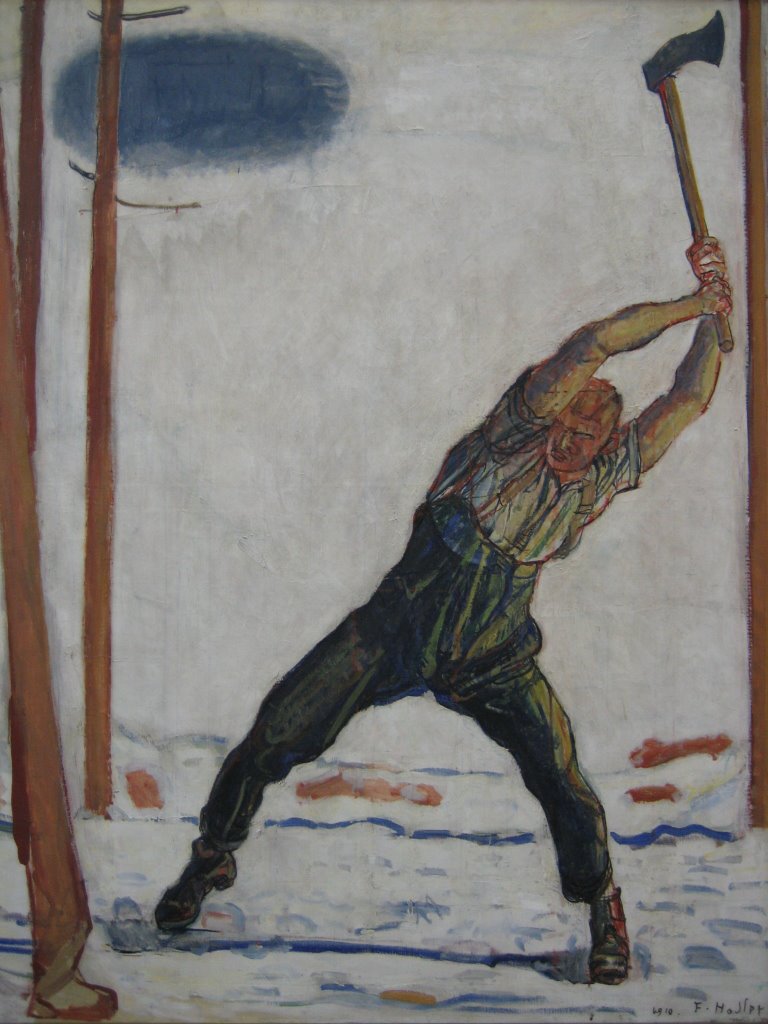
Thanks to Erro for many of the thoughts and references for this post. I'll be very impressed if anyone can pick artist, title or location of this painting. Ten points each.

Sunday, September 10, 2006

Exit Mundi

The end of the world is nigh! And this site catalogues and analyses over fifty ways it might happen. Some are quite amusing, some plain silly, some wildly speculative, some deadly serious. Some we don't have to worry about for another few billion years; some could be tomorrow.

Does trusting the one who raised Christ affect how we might think about such apocalyptic scenarios? Of course.

Does it guarantee that we don't need to think about blowing ourselves up (or consuming ourselves into a hothouse, or driving ourselves to destruction, or...) because God's in charge and wouldn't let it happen? Of course not.

Monday, July 17, 2006

No final solutions

But Christian eschatology has nothing to do with apocalyptic ‘final solutions’ of this kind, for its subject is not ‘the end’ at all. On the contrary, what it is about is the new creation of all things. Christian eschatology is the remembered hope of the raising of the crucified Christ, so it talks about beginning afresh in the deadly end.

Jürgen Moltmann, The Coming of God, Preface.

If you'd like the full quote, try here.
PS Ten points for the first to correctly locate this beautiful statue.
UPDATE: This post generated significant comments, and eventually, another post.

A brick flung at a gramophone

We have been taught to think of the world as something that 'progresses' or 'evolves'. Christian apocalyptic offers us no such hope. It does not even foretell (which would be more tolerable to our habits of thought) a gradual decay. It foretells a sudden violent end imposed from without: an extinguisher popped on to the candle, a brick flung at the gramophone, a curtain rung down on the play - 'Halt!'
- C. S. Lewis, 'The World's Last Night' in Fern-seed and Elephants, 72.

Wednesday, June 07, 2006

In the end: the beginning

Moltmann on "the end"
In the end is the beginning: Eschatology is generally held to be the doctrine of ‘the Last Things’, or of ‘the end of all things’. To think this is to think in good apocalyptic terms, but it is not understanding eschatology in the Christian sense. To think apocalyptically means thinking things through to their end: the ambiguities of history must sometime become unambiguous; the time of transience must sometime pass away; the unanswerable questions of existence must sometimes cease. The question about the end bursts out of the torment of history and the intolerableness of historical existence. To echo a German proverb: better a terrifying end than this endless terror.

Eschatology seems to search for the ‘final solution’ of all the insoluble problems, as Isaiah Berlin indignantly remarked, playing on the phrase used at the Wannsee conference in 1942, where the SS decided for a ‘final solution’ of the Jewish question in the camps of mass annihilation. Theological eschatology seems to present the ‘Endgame’ of the theodrama World History. This was Hans Urs von Balthasar’s view, when he took over this title as a legacy from Samuel Beckett. If we look back to the history of eschatology, we see it pictorially represented as God’s great final judgement of the good and the wicked, with heaven for the one and hell for the other. Is the Last Judgement God’s final solution for human history? Other people have dreamed about Armageddon, the final duel in the struggle between Christ and Antichrist, or God and the Devil – whether the duel be fought out with divine fire or modern nuclear armaments.

Eschatology is always thought to deal with the end, the last day, the last word, the last act: God has the last word. But if eschatology were that and only that, it would be better to turn one’s back on it altogether; for ‘the last things’ spoil one’s taste for the penultimate ones, and the dreamed of, or hoped for, end of history robs us of our freedom among history’s many possibilities, and our tolerance for all the things in history that are unfinished and provisional. We can no longer put up with earthly, limited and vulnerable life, and in our eschatological finality we destroy life’s fragile beauty. The person who presses forward to the end of life misses life itself. If eschatology were no more than religion’s ‘final solution’ to all the questions, a solution allowing it to have the last word, it would undoubtedly be a particularly unpleasant form of theological dogmatism, if not psychological terrorism. And it has in fact been used in just this way by a number of apocalyptic arm-twisters among our contemporaries.

But Christian eschatology has nothing to do with apocalyptic ‘final solutions’ of this kind, for its subject is not ‘the end’ at all. On the contrary, what it is about is the new creation of all things. Christian eschatology is the remembered hope of the raising of the crucified Christ, so it talks about beginning afresh in the deadly end. ‘The end of Christ – after all that was his true beginning’, said Ernst Bloch. Christian eschatology follows this christological pattern in all its personal, historical and cosmic dimensions: in the end is the beginning.

That is how Dietrich Bonhoeffer took leave of his fellow prisoner, Payne Best, in Flossenbürg concentration camp, as he went to his execution: ‘This is the end – for me the beginning of life.’ That is how John on Patmos saw the Last Judgment of the world – not as annihilation, a universal conflagration, or death in a cosmic winter. He saw it as the first day of the new creation of all things: ‘See, I am making all things new’ (Rev 21.5). If we perceive it in remembrance of the hope of Christ, what is called the end of history is also simply the end of temporal history and the beginning of the eternal history of life. Christ can only be called ‘the end of history’ in the sense that he is the pioneer and leader of the life that lives eternally. Wherever life is perceived and lived in community and fellowship with Christ, a new beginning is discovered hidden in every end. What it is I do not know, but I have confidence that the new beginning will find me and raise me up.

Because of this, I have deliberately avoided calling this book about Christian eschatology ‘The Last Things’ or ‘The End of All Things’, but have given it the title: The Coming of God. In God’s creative future, the end will become the beginning, and the true creation is still to come and ahead of us.

- Jürgen Moltmann, The Coming of God: Christian Eschatology, Preface.

Saturday, May 27, 2006

Placing oneself: Barneys and grief

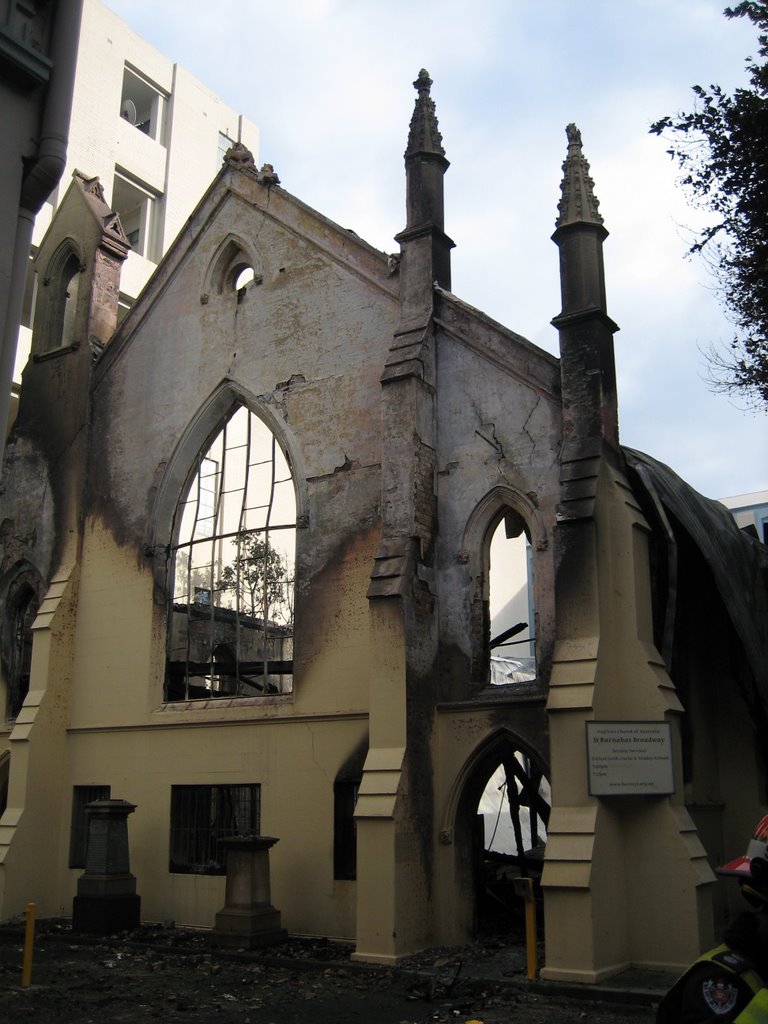
As previously mentioned (and here and here), the building in which my church (St Barnabas Anglican, Broadway, or 'Barneys') meets burned down recently.

As promised (and requested), some further thoughts on the matter:
I noticed in the days following the fire that there seemed to be two kinds of reaction, even where they were often mixed in individuals. On the one hand, some wanted to clearly say it was 'business as usual', the building was just a tool that is irrelevant to the 'real' work that Barneys does, that God was not any different, nor was our fellowship. On the other hand, some people wanted to grieve and acknowledge the grief of others at having lost something analogous to a 'family home'. So which is it to be? Or both?

How can we affirm the goodness and power of God in a world where things fall apart and burn down? We could deny the goodness of the falling-apart and flammable things. But that would be to deny that God was their creator, that "The LORD is good to all, and his compassion is over all that he has made" (Ps 145.9). If his compassion extends as far as his creation, how can he be good when the things he has made are subject to frustration and decay (Rom 8.23)?

We could include death inside his goodness, such that closure is a blessing that makes for beauty and poignancy, a way of multiplying good things by having one pass away to make room for another, a way of giving temporary things a extra specialness (like how Maccas special deals are special because this might be your one chance to get them. If they were part of the regular meal, then they would lose this glow). Or for the more refined, the apocryphal story of Michaelangelo's snowman: there is an extra beauty for the fact that it was but is no more. There is a melancholia and nostalgia that allows it to grow in the memory and imagination. Or consider the sunset: part of whose beauty is that now, just now, just here, is this particular configuration of cloud and colour; it will never be quite the same again as this moment. (Thought: is a blog an attempt to freeze and preserve what is wonderful about intelligent conversation, to make it always accessible? Just as a photo of a sunset is trying to pin down the butterfly of ephemerality). While there is indeed a bittersweetness to nostalgia based on transience, death remains 'the last enemy' (1 Cor 15.26).

A third alternative is to acknowledge the goodness of created things that leaves the tug in our hearts when they pass away, but to relegate this to 'mere creation': good but going. We are not to set our mind on such passing earthly things, but on the eternal. Earth is good, but heaven trumps earth. This is better than the first option, in that it can leave room for legitimate grief at earthly loss, and needn't imply a closure to creation. Indeed, it can become quite a useful stance when combined with C. S. Lewis' frequently stressed point that the best is not the enemy of the good. It is possible to keep first things first (trust in God, the location of Christian fellowship in Christ not buildings), without needing to deny secondary truths (how many great memories will always be associated with particular environmental contexts, and hence a sense of loss at destruction of that context). But I'm still not convinced that this is where our pilgrimage towards affirming creation ends.

The one who made the world, who dwelt with Israel in wilderness tabernacle and Zion temple even while filling heaven and earth, who abhorred not the virgin's womb, who took on human flesh (and not just temporarily, but who remains human in his present mediation: 1 Tim 2.5), whose ultimate goal is not the disentangling of heaven and earth, but their marriage (Revelation 21-22: notice that the new Jerusalem comes down to earth; God makes his dwelling amongst humans, not vice versa), this one will bring about 'the restoration of all things' (Matt 19.28; Acts 3.21), will make all things new (Rev 21.5), will resurrect the dead. Resurrection comes after death; unless a grain of wheat falls into the ground and dies, it remains a single seed. There will also be discontinuity, the resurrection of Jesus wasn't breathing life into a corpse, but transformation. It was not rewinding the sunset.

More can and must (at some point) be said here, but for now, notice that this God isn't afraid to get his hands dirty, in his freedom to bind himself to a contingent and limited creation, not to salvage what was good out of it into himself, but to dwell in it (and for it to dwell in him). He calls us not out of creation, but into it. His kingdom is indeed not 'from' the world (John 18.36) in its basis, methods and goals, but it is 'of' the world, in the sense that Jesus is the king of the Jews - and the Greeks and the whole world, as Israel's Messiah always was to be. And as we are thrown back into the world, we grow into the world, and it grows into us. As we do, creation is 'humanised'; this is indeed part of the mystery of our thanks-filled 'dominion' and 'filling' (Gen 1.28), which is also a 'serving' (Gen 2.15). Not a replacement of non-human by human, so that we squeeze all other life off the planet and die ourselves in regret, but a growing into, an integration. We become not less bodily as we grow in spirituality, but become more in tune with God's Spirit who breathes life into all things. This present life is not a secondary good that awaits its obsolescence in an apocalyptic inferno, but is a sign and anticipation of life of the aeon to come.

This, despite being by far my longest post, remains a summary and introduction to many more thoughts which I'll continue to explore in other avenues. Nonetheless, I think we can go beyond mere instrumentalism in considering the goodness of a building that we have grown into and which in turn has grown into us. The things of this world grow strangely glorious, not dim, in the light of the presence of God and in the hope of the resurrection. Christian response to loss is not a Stoicism that denies the importance of physical things, but genuine grief - with hope.
More posts on Barneys and the fire: I; II; III; IV; V; VI.
Ten points for being able to name the artist who painted the second image. And fifteen more if you can say where it is presently hung.