Showing posts with label Miroslav Volf. Show all posts

Monday, November 19, 2007

What is forgiveness? V

Echoing God's forgiveness
But how is forgiveness possible? Avoiding is easier than confronting. Excusing is more polite than accusing. Tolerating is more familiar than acquitting. And grace is just so, well, unfair! How can we as a community live this way? How are we able to swim against the stream of our culture, our habits and our hatreds? Such a mighty task, such an arduous calling seems almost superhuman.

And it is. You’ve heard the phrase ‘to err is human, to forgive divine’. I think at least the second half is spot on. To truly forgive well is something God alone can do. The scribes were shocked by Jesus' claim to forgive sins, since "who can forgive sins but God alone?" (Mark 2.6-7) Jesus doesn't dispute this claim. He simply replied with a demonstration of his authority to forgive, to the glory of God. (Mark 2.8-12)

When we are invited, lovingly commanded, to also forgive, we are just playing catch-up with God. We are echoing God’s forgiveness. It is possible for us to forgive others because God in Christ has already forgiven them. We are just acknowledging what is already the case, putting our signature under God's. “We have the right and the obligation to make God’s forgiving our own – to forgive on our part what has already been forgiven by God.” (Miroslav Volf, Free of Charge, 199)

God's prior forgiveness through Christ gvies us the model, the motivation, the authority and the obligation to forgive as we have been forgiven.
Eight points if you can correctly name this Australian natural rock formation. And five more to someone else who can give its location.
Series: I; II; III; IV; V.

Saturday, November 17, 2007

What is forgiveness? IV

(iv) Not fairness, but grace
Forgiveness is not fair. It is grace, a gift. It is not limited to "three strikes and you’re out" (or even seven, as Peter discovered: Matthew 18.21-22). It is not conditional: "I’ll forgive when he says sorry". It is a freely given gift, an unmerited cancelling of debt. Of course, like any other gift, forgiveness can be refused. Just as an offered present can be left unopened or returned, forgiveness can be rejected. We can’t force someone to accept such a present; we can only offer it generously.

So it is not that I forgive those whom I think are worth it, or who might be able to make it up to me somehow. No, we are to forgive as God in Christ has forgiven us: completely, repeatedly, freely.

But we often think we'd prefer things to be fair. Wrong has been done; and so we stand on our rights and make demands. A world where everyone gets what they deserve is predictable and feels just. However, such an approach misses the bigger picture:

“If on the bottom line of our lives lies the principle that we should get what we deserve, whether good or ill, forgiveness will sit uncomfortably with us. To forgive is to give people more than their due, it’s to release them from the debt they have incurred, and that’s bound to mess up the books.

For a Christian, however, a bottom-line principle can never be that we should get what we deserve. Our very existence is God’s gift. Our redemption from the snares of sin is God’s gift. Both are undeserved, and neither could have been deserved. From start to finish, we are always given free of charge and given more than our due. Therefore it is only fitting that we give others more than they are due.”

- Miroslav Volf, Free of Charge, 203.

Volf is pointing out that we are called to forgive as forgiven people ourselves. We are not giving anything more than has been given to us. We are first recipients of forgiveness from God. This is the point of Jesus’ parable of the unforgiving servant that follow's Peter's question in Matthew 18. A servant is forgiven millions of dollars worth of debt and yet refuses to cancel a debt of a few thousand dollars. We shake our heads because he just hasn’t got it.

To whom do you need to show grace, not fairness?
Eight points if you can guess the Sydney beach.
Series: I; II; III; IV; V.

Thursday, November 15, 2007

What is forgiveness? III

(iii) Not tolerating, but acquitting
Forgiveness is not simply “she’ll be right”, or “don’t worry about it”. When I forgive, I do not grit my teeth and bear with what’s going on. I confront, I accuse, but I can do so without destroying the relationship because I also acquit. I refuse to press charges. I refuse to hold a grudge. I do not pay the other back for the wrong done to me. I release the other from any punishment I might be tempted to inflict. And more than that, I release the other from even the guilt of the offence. I swallow the cost of the wrong. I keep no record of wrongs.

According to Miroslav Volf, when we do this, we are echoing God's forgiveness. In effect, I are saying to the one who hurt me:

“Because God in Christ doesn’t count your trespasses against you and because God has removed your guilt from you, I too don’t count against you the fact that you’ve wronged me, and I don’t consider you guilty. God has made you innocent, and therefore I consider you innocent.”

- Volf, Free of Charge:
Giving and forgiving in a culture stripped of grace
(Zondervan, 2005), 196.

In fact, it is this gift, this release from guilt and punishment, that opens the possibilities of constructive confrontation and accusation. Because the charges will not be pursued, and the guilt has been dropped by God and so by me, I am able (and am indeed obligated) to seek good in the relationship through bringing the issue into the open (H/T Jason for pointing this out).

Of course, trust may need to slowly re-grow; the relationship doesn’t magically revert to how things were. But I give a fresh start, without keeping a black mark against their name.

Whom do you need to acquit, rather than merely tolerate?
Fifteen points for naming the Sydney CBD building.
Series: I; II; III; IV; V.

Thursday, January 25, 2007

Kierkegaard on love

How is it possible to love when to do so makes us vulnerable to being hurt, rejected - or perhaps worst of all - ignored? Is it really wise to be so unsafe? Will not those who forget themselves in self-giving love be forgotten? Here is Kierkegaard's answer:

No, the one who in love forgets himself, forgets his suffering, in order to think of someone else's, forgets all his misery in order to think of someone else's, forgets what he himself loses in order lovingly to bear in mind someone else's loss, forgets his own advantage in order lovingly to think of someone else's - truly, such a person is not forgotten. There is one who is thinking about him: God in heaven. Or love is thinking about him. God is Love, and when a person out of love forgets himself, how then would God forget him! No, whle the one who loves forgets himself and thinks of the other person, God is thinking of the one who loves. The self-lover is busy; he shouts and makes a big noise and stands on his rights in order to make sure he is not forgotten - and yet he is forgotten. But the one who loves, who forgets himself, is recollected by love. There is One who is thinking of him...

- Søren Kierkegaard, Works of Love, ed. and trans. Howard Hong and Edna H. Hong (Princeton: Princeton UP, 1995), 281. Cited in Miroslav Volf, Free of Charge, 103.

The security of the divine attention makes the 'risk' of love a secure investment. Let us spend wisely.
Ten points for the Sydney suburb in the picture.

Thursday, January 04, 2007

Volf on echoing God's forgiveness

      For any single wrongdoing between two people to be forgiven rightly, all wrongdoings between them would have to come to light, and all forgiven. But that's clearly impossible in the here and now.
      All our forgiving is inescapably incomplete. That's why it's so crucial to see our forgiving not simply as our own act, but as participating in God's forgiving. Our forgiving is faulty; God's is faultless. Our forgiving is provisional; God's is final. We forgive tenuously and tentatively; God forgives unhesitatingly and definitively. As we forgive, we always wrong the offender by inadequate judgment and pride; God forgives with justice and genuine love. The only way we dare forgive is by making our forgiving transparent to God's and always open to revision. After all, our forgiveness is only possible as an echo of God's.

-Miroslav Volf, Free of Charge: Giving and Forgiving in a Culture Stripped of Grace, 219-220.

I mentioned and highly recommended this book earlier. One of the real highlights is the careful and insightful way Volf explores the similarities and differences between how God gives and forgives, and how we do so. We are to imitate God, but we are not God.
      We should forgive as God forgives, but we can't forgive as God forgives! Earlier, in discussing giving, I suggested that the adverb "as" in the phrase "as God gives" doesn't designate identity but similarity. Because we are human, we cannot give exactly as God does. But because we are created to be like the God who gives, we should give similarly to how God gives. The same applies to forgiveness. We cannot and should not forgive exactly as God does. But we were created to be like the God who forgives, we should forgive similarly to how God forgives. We don't replicate what God does. We imitate it in our way, mindful that, as the great church father Augustine said, the dissimilarity between us and God is greater than the similarity.
      Important as it is, however, imitation is not the primary way in which we relate to God. We don't just watch and learn from God, as a toddler watches and learns from his mother. A toddler and his mother are two separate people, acting independently of each other. They have two distinct bodies that occupy different spaces, and they have two intellects and wills operating independently from each other. But as we have seen throughout this book, we are not independent of God in that way. God is not absent from the space we inhabit, and our intellects and wills are carried on the wings of God's presence and activity. When we give, it is God's gifts that we pass on and it is God who gives through us. By giving, we are instruments of God's giving. The same is true of forgiveness.

-Volf, Free of Charge, 164-65.

As I said before: highly recommended and worth pondering (and giving away!). An excellent example of mixing theological rigour with stylistic accessibility.
I received no free publisher's copy for these comments. I just liked the book.

Wednesday, December 27, 2006

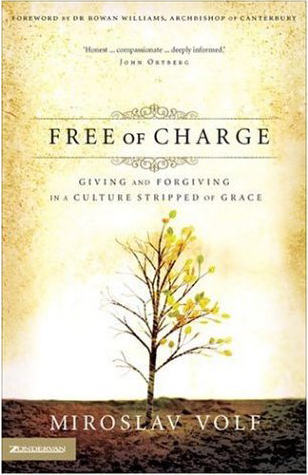
Free of Charge

Highly recommended
What is a gift? What does it mean to be a giver? How can giving be more than a business transaction? How ought we to forgive? Does repentence need to precede forgiveness? How can we forgive? Is it possible to be a little bit like God in our giving and forgiving?

Crotian theologian Miroslav Volf (author of the highly stimulating Exclusion and Embrace) wrote a popular level book for Lent 2006 called Free of Charge: Giving and Forgiving in a Culture Stripped of Grace. Jessica and I have been reading it slowly over the last couple of weeks and have really appeciated the straightforward ways he lays out the connections and distinctions between giving and forgiving with both theological depth and a light and accessible touch. These two basic modes of interpersonal interaction are at the heart of what it is to be Christian because they are very much on God's heart. Whether or not you're a believer, this book will gently stretch you and invite you into a way of life and of the heart that gets beyond the destructiveness of revenge and taking, even beyond mere justice and earning, all the way into giving and forgiving.

Revenge multiples evil. Retributive justice contains evil - and threatens the world with destruction. Forgiveness overcomes evil with good. Forgiveness mirrors the generosity of God whose ultimate goal is neither to satisfy injured pride nor to justly apportion reward and punishment, but to free sinful humanity from evil and thereby reestablish communion with us. This is the gospel in its stark simplicity - as radically countercultural and at the same time as beautifully human as anything one can imagine.

- Miroslav Volf, Free of Charge, 161. More on this book.

Wednesday, November 01, 2006

Top 20 books that have influenced me theologically

Ben Myers over at Faith and Theology has put together a list of his top twenty books that have influenced him theologically. Although these top twenty things are always somewhat arbitrary (especially the order!), and my most powerful theological influences have been personal relationships with mentors, teachers and lecturers, I've still tried taking up his challenge in the following list. Following Ben's lead, the list excludes books from other disciplines (more or less, though such lines can be hazy; I've included a Nietzsche) and is limited to one volume per author.

20. Karl Rahner, The Trinity
19. Merold Westphal, Overcoming Onto-theology
18. Irenaeus, Against Heresies
17. Dietrich Bonhoeffer, Life Together
16. T. F. Torrance, The Trinitarian Faith
15. Richard Bauckham, God Crucified
14. Miroslav Volf, Exclusion and Embrace
13. Oliver O’Donovan, Resurrection and Moral Order
12. Friedrich Nietzsche, Beyond Good and Evil
11. Athanasius, On the Incarnation
10. Jürgen Moltmann, The Coming of God
10. C. S. Lewis, The Great Divorce
9. John Stott, The Cross of Christ
8. Colin Gunton, The Triune Creator
7. N. T. Wright, Jesus and the Victory of God
6. Karl Barth, Church Dogmatics IV/1
5. Augustine, The City of God
4. Martin Luther, The Freedom of the Christian
3. J. Calvin, Institutes
2. Thomas Cranmer, Book of Common Prayer
1. Holy Scriptures
Have I forgotten something obvious? I'd love to hear which books or people have influenced you. And before I sound too pretentious (or heterodox!), a number of these books have influenced me as I've reacted against them and many remain as yet unfinished but have still been important.