Wednesday, April 20, 2011

Collaborative consumption


Collaborative Consumption Groundswell Video from rachel botsman on Vimeo.
So many of the things we own, lightening our wallets, filling up our space and burdening our lives (not to mention the planet) we could rent, borrow or share. This is indeed one of the excellent uses of the information revolution, since co-ordination of the use of material objects between multiple people has never been easier. It generates trust, saves money and reduces the burden on resources. We've been on Freecycle for years, enjoyed free hospitality from strangers through an organisation something like Couch Surfing and shared power tools through Ecomodo for those once-in-blue-moon times of need. These schemes are generally quite straightforward and it is worth looking into them rather than feeling the need to purchase and own every object you could conceivably ever need or desire.

Tuesday, April 19, 2011

Why are Christians scared of the sciences?

There is a common perception that Christianity and the sciences are mortal enemies, that faith and reason are mutually exclusive, that following Christ requires the rejection of a host of well-established scientific understandings (and vice versa).

I don't get it.

My theological convictions invite me to see scientific research as an expression of common grace rather than a threat to cultural identity. Having a self rooted and established in Christ can mean that we are liberated from the pursuit of identity in a community of like-minded opposition to perceived cultural opponents (those god-hating egg-heads!). Praise God for the sciences and for those amongst us who serve the common good through careful attention to the world that lies in front of our eyes!

Of course like all good gifts, scientific endeavour can be abused, scientific communities can express hostility to the grace of God, scientific insights be applied to destructive and enslaving technologies and the heady power of empirical observation can tempt those who taste it to reductive philosophies of scientism that (ironically) overstep the reach of empirical oberservation. The ubiquitous presence of sin and relative absence of wisdom undermines but does not erase or invalidate the dignity of scientific research. Abuse does not rule out proper use.

Indeed, the church itself can be a place of abuse, closed to divine grace and trapped in patterns that diminish life. Let us focus on the extraction of woody fibres of great magnitude protruding from our own ocular organs before presuming to conduct moral surgery on the vision of others, or pronounce others blind when we are the ones falling into a pit.

Scientists are not enemies; that label belongs on fear, greed, ignorance, folly and self-deception.

Monday, April 18, 2011

Is catastrophe inevitable?

"[I]f we are to confront adequately the threat of (social or environmental) catastrophe, we need to break out of this "historical" notion of temporality: we have to introduce a new notion of time. Dupuy calls this the "time of a project", of a closed circuit between the past and the future: the future is causally produced by our acts in the past, while the way we act is determined by our anticipation of the future and our reaction to this anticipation:
The catastrophic event is inscribed into the future as destiny, for sure, but also as a contingent accident: it could not have taken place, even if, in futur antérieur [looking back from the future], it appears as necessary. ... if an outstanding event takes place, a catastrophe, for example, it could not not have taken place; nonetheless, insofar as it did not take place, it is not inevitable. It is thus the event's actualization - the fact that it takes place - which retroactively creates its necessity."
"If - accidentally - an event takes place, it creates the preceding chain which makes it appear inevitable: this, and not commonplaces on how underlying necessity expresses itself in and through the accidental play of appearances, is in nuce the Hegelian dialectic of contingency and necessity. In this sense, although we are determined by destiny, we are nonetheless free to choose our destiny. According to Dupuy, this is also how we should approach the ecological crisis: not to appraise "realistically" the possibilities of catastrophe, but to accept it as Destiny in the precise Hegelian sense - if the catastrophe happens, one can say that its occurrence was decided even before it took place. Destiny and free action (to block the "if") thus go hand in hand: at its most radical, freedom is the freedom to change one's Destiny.

"This, then, is how Dupuy proposes to confront the disaster: we should first perceive it as our fate, as unavoidable, and then, projecting ourselves into it, adopting its standpoint, we should retroactively insert into its past (the past of the future) counterfactual possibilities ("If we had done this and that, the calamity we are now experiencing would not have occurred!") upon which we then act today. We have to accept that, at the level of possibilities, our future is doomed, that the catastrophe will take place, that it is our destiny - and then, against the background of this acceptance, mobilize ourselves to perform the act which will change destiny itself and thereby insert a new possibility into the past. Paradoxically, the only way to prevent the disaster is to accept it as inevitable. For Badiou too, the time of the fidelity to an event is the futur antérieur: overtaking oneself vis-à-vis the future, one acts now as if the future one wants to bring about were already here.

"What this means is that one should fearlessly rehabilitate the idea of preventative action (the "pre-emptive strike"), much abused in the "war on terror": if we postpone our action until we have full knowledge of the catastrophe, we will have acquired that knowledge only when it is too late. That is to say, the certainty on which an act relies is not a matter of knowledge, but a matter of belief: a true act is never a strategic intervention in a transparent situation of which we have full knowledge; on the contrary, the true act fills in the gap in our knowledge."

- Slavoj Žižek, First as Tragedy, Then as Farce (London: Verso, 2009), 150-52.
Internal quote from Jean-Pierre Dupuy, Petite metaphysique des tsunami (Paris: Seuil, 2005), 19.

This somewhat dense passage is either nonsense, or very profound. It can be difficult to tell, and perhaps only hindsight will let us know for sure. But this is precisely Žižek's point: that we act (largely) in the dark, and certainly in the dark about whether future events are inevitable or not. A terminal diagnosis could prove to be wrong. But this doesn't mean we just write off such a diagnosis, no, we embrace it and feel the full weight of living under a death sentence, and then live as those who will be resurrected.
Images by HCS. The eagle-eyed may have notice that the young man attempting to prevent the apparently inevitable collapse in the second image is your truly, age 11.

Sunday, April 17, 2011

Open source hardware

This seems like quite a simple and noble idea: the development and sharing of free, open source hardware designs that make use of local and recycled materials in order to construct cheap, functional versions of the most useful machines. Projects like this are a reminder that for-profit operations don't have a monopoly on innovation and social benefit and represent a broadening of our social and moral imagination.

Saturday, April 16, 2011

Fixing Facebook (a little)

Speaking of Facebook, I was helpfully pointed to this advice, which shows you how to reverse a recent automatic change that Facebook unilaterally made (unannounced) to news feed settings. The new default settings means that you only seen items from people you interacted with in the weeks before the change was introduced or anytime since then. Any friends you haven't contacted in Facebook world during that window have been quietly excised from your feed. If you'd like to reverse this, instructions and further explanation can be found here.

Friday, April 15, 2011

In search of the perfect Bible

Stumbling briefly last night through the mirky recesses of Facebook, I noticed that for some reason many Sydney Anglicans currently seem obsessed (once again) with the question of the merits of various English translations of Holy Scripture. Some are saying "I follow Paul", others "I follow Apollos", and yet others "I follow Christ". Extravagant claims are made for one version or another, one opening the eyes of the blind, a second making the lame to walk while a third comes with a free set of steak knives.

Removing tongue from cheek, there are indeed relevant differences between the various options and such discussion is not empty of benefit, but all the major and well-known translations are generally very good and the benefits of one over another are relatively slight. Yet the marketers are not content with this, seeking to create artificial scarcity to generate an economy of fear and desire (and sell more units), and so claims are made that cannot possibly be true of any one translation.

The question of which translation is the "best" is context-dependent. It depends who is reading and for what purpose (and sometimes even the passage in question). The ideal study version for a scholar is going to be different to the ideal version for children and those still learning English. The merits of different approaches shine in different contexts.

And this is how it ought to be. The search for the perfect English Bible is a chasing after the wind. The Scriptures may be venerated, but not worshipped. The are holy, but not themselves divine. We are happy to translate them because their value ultimately lies not in the words, but in the word they communicate, that is, in their message, the good news about Jesus. The words are our access to this word, and it is our delight to pay close attention to them (and for some to work hard at the difficult and imperfectible task of translation), but in the end we pay attention because they point to the life, death, resurrection and ascension of the one who is the true Word.

But don't take my word for it, read this excellent piece by a translator of Holy Scripture with years of experience in the craft.

Or better still, follow the simple advice that transformed the life of Saint Augustine: take and read.

Thursday, April 14, 2011

Lent: Simplicity and contentment

Lent is a time for the deliberate discipleship of our desires through refraining and focusing. Often this is portrayed as a somewhat arbitrary burden to be carried, as though the carrying of a burden were itself good. But fasting (or refraining from some regular activity) is not an end in itself, but a means to sharpen our hungering and thirsting for righteousness, for God’s justice. Such disciplines as we accept for this period are not meritorious works of supererogation earning divine brownie points, nor do we seek out pain so as to enjoy the relief from it all the more at its end. We are, in Rowan Williams’ evocative phrase, setting out on "a journey into joy". Lent is a time of preparation for the good news of Easter, but in the light of the cross and resurrection, we discover that the very disciplining of our desires is already good news, not merely preparation for it. The gospel does not add ethics as an appendix, the fine print of obedience you sign up for when you accept the gift of forgiveness. No, ethics is already good news. The disciplining of desire is also the liberation of desire; by learning self-control, we become free. We are learning to love rightly and so learning to be more human.

I submit that a key aspect of this joyful journey for many western Christians is an exodus of liberation from consumerism, the state of bondage in which we are consumed by what we consume. Our toys so often own us. In such a context, learning to delight in less is an affirmation of a life with more of the things that matter. The simple life is not only a matter of justice (living simply so that others can simply live) – though it is certainly that in a world of ever more apparent ecological limits – the simple life is also the good life. Receiving all God’s gifts with thanks enables us to let (many of) them go and to let go the desire for more that makes us discontent. Let us instead become discontent with our discontentment, which robs of us of peace and perspective.

The pursuit of justice, insofar as it is woven within the Christian good news, is also part of this same joyous adventure. It is not a fight, but a dance. We do not create it or establish it; we share from what we have ourselves received. Our goal is not the spread of consumerist “wealth” to every member of society and every corner of the globe. Our goal is that in walking the way of the cross, all may discover it to be the way of light.

Not yet concrete enough? Go and sell your possessions, then come follow Christ.
Originally posted at Theopolis.

Wednesday, April 13, 2011

Are Australians rich?

On average, yes, almost twice as wealthy as a decade ago. It would be interesting to see these stats broken down into bands in order to make inequality visible.

Tuesday, April 12, 2011

In lieu of a comments policy

One of the many updates that is well overdue on this site is an explicit comments policy. One day, I will get to it, along with fixing all the problems in the sidebar, adding tabs for easier navigation and perhaps revising the general appearance.

Until then, I thought I would make clear that any comments whose primary purpose is advertising a commercial product will be deleted without notice. More of these have been appearing recently and while I suspect that most of them come from search engines (and so won't read this post), at least this can be considered some kind of warning.

This blog is not available for commercial advertising. I do not and will not use Google AdSense. I have turned down a few dozen offers of free products or financial benefits from people or companies wanting to use this platform to promote their wares.

I believe in our shared ability and responsibility to shape one another's desires and refuse to become a mercenary in this regard. If I want to persuade others to desire something, it will be because I believe it is a worthy object of desire, not because I'm being paid to do so.

Please explain: Preferential and proportional voting

One of the criticisms made against proportional voting is that it makes it easier for extremists to gain a seat in parliament since a successful candidate only needs to secure a relatively small percentage of the vote. Indeed, it had been looking like Pauline Hanson, the extremist Australians most love to hate, was going to get a seat in the NSW Upper House after the recent election.

However, it was not to be, because proportional voting in Australian Upper House elections is combined with preferential voting, and so even though Hanson won more primary votes than the two other candidates with whom she was competing for the final two seats, on preferences, they both overtook her.

Preferential voting prevents extremist candidates from winning in races where multiple candidates split the vote, since it allows voters the chance to indicate who is their last preference, as well as their first. UK voters, vote "yes" to electoral reform on 11th May.

Monday, April 11, 2011

Threatening to leave

In other news, Jimmy Riches, 9, of Little Waddington, has threatened to take his bat and ball away from the local village boys' game of cricket unless his special rules are retained. Since he owns the only equipment in the small settlement, he demanded to set the terms on which the game is to be played. "Jimmy's code" included extra lives for Jimmy while batting and all his runs counting triple, plus being allowed to be sole umpire for contentious calls. The other boys felt these rules gave Jimmy an unfair advantage and sought to soften them, suggesting that perhaps he should only score double and that he had to state how many extra lives he had today before coming to the crease. Jimmy rejected these modifications and has warned that if the other boys insist on them, he will go and play with the lads in the next village.

Sunday, April 10, 2011

Child sacrifice: A political debate

A two-party system
A: For the sake of national security and prosperity, we must sacrifice ten children each month to Moloch. Moloch is an angry god, but fair. If we burn ten children alive on the temple altar, Moloch will ensure that we are well-fed and our enemies do not prevail against us. That is how things have been and we must observe the ancient traditions.

B: No, no, no, no – have you no heart? No conscience? You want to kill one hundred and twenty innocent children each year? Are you nuts? How horrible! Of course we should only sacrifice seven children each month. And we should make sure that the priests are well trained, that the sacrificial fire is sourced from sustainable wood and, for the sake of equal access, the victims are selected on a points-based system.
Image by CAC.

Saturday, April 09, 2011

Inequality and the promise of growth

Economic growth promotes social stability by keeping the lid on revolution through the promise of wealth: one day, if only you keep working hard, you too can be rich.

Growth as the price of stability has enabled the pressing question of justice and equity to be deferred, since even if the rich are getting obscenely rich, at least all have the promise of betterment in a rising economy. But take away the expectation of growth, and the disparities of wealth become more pressingly obvious.

The same effect is realised when growth is confined to the rich. When Hosni Mubarak become Egyptian president in 1981, about twenty percent of the population lived on less than US$2 per day. After three decades during which Egypt experienced annual economic growth rates of seven per cent or more, at the time of the revolution, about forty percent lived on less than US$2 per day. There had been extraordinary growth, but the benefits went to the elite without "trickling down".

During those same three decades, the income of the bottom 90% of US workers has remained flat while that of the top 10% has skyrocketed. At the same time, the rich have successfully shifted the tax burden onto the rest. Again, the benefits of growth have not been a larger pie to be shared amongst all, but have increasingly lined the pockets of the most powerful, multiplying their power.

But not everywhere has the same story. China's boom has seen hundreds of millions move out of absolute poverty. Indeed, never before have so many escaped the burdens of grinding need in such a short space of time. Nonetheless, it has again been the richest who have benefitted the most and inequality in China is higher than anytime since the revolution. And political stability may well require this growth to continue.

If the prospect of growth becomes dim (as I think it is over the next few decades), then the question of justice must come to the fore. Whether this occurs through violent and unpredictable revolution or through reform is largely the choice of each society. Few seem to be choosing the latter, however. Indeed, globally, the rich are getting richer and only seem more intent than ever to remain in control of the reins of power. That is the path of violence, not that I am advocating or condoning it.

Of course, the absolutely poor deserve the right to develop their basic economy to a level required for the possibility of living a humane life. This is nowhere near present levels of western consumption, and nations that are well above this level have a moral duty to pursue justice through planned de-growth, or rather, pursuing things that are better than growth. It is quite possible to live a more human life while (indeed often through) embracing less. A simpler lifestyle is a gift to oneself as well as one's global neighbour.

Finally, it bears repetition: the pursuit of endless growth is increasingly terrible for ecology, which after all, owns the global economy. Growth as we currently know it likely cannot continue for more than a few more decades (at best) without so severely undermining the ecological health of the planet that the economic costs of ecological degradation overwhelm any further growth. If we want to live in a stable society, let us throw off the love of money, that poisonous stimulant slowly killing us all.

Friday, April 08, 2011

Shadows of the Divine: an exhibition

An exhibition at New College
To mark the 400th anniversary of the King James Bible, this upcoming exhibition features works from the internationally renowned Methodist Church Art Collection - including pieces by Sutherland, Frink, Roualt, Eric Gill and Craigie Aitchison - alongside recent works by leading Scottish and Scottish-based artists and a rare first edition Scottish 1611 King James Bible. The Methodist Church Art Collection is the most significant denominational collection of art outside of the Vatican and of course the King James Version the most influential English translation of the holy scriptures in history.

The free exhibition will be hosted at New College in Edinburgh from 14th May to 11th June, Monday to Saturday 10am-5pm.
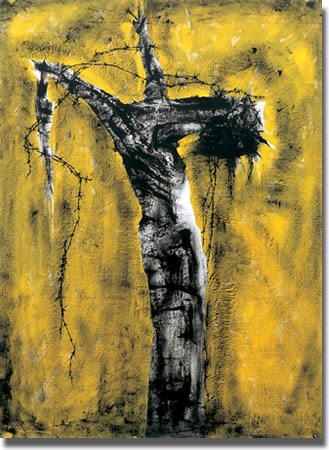
Crucified Tree Form by Theyre Lee-Elliott, 1959.

Thursday, April 07, 2011

Bank makes money: in other news, dog bites man

Major US bank launders billions of dollars of Mexican drug money.

That big banks generally make stratospheric profits means they are also the target of much suspicion and criticism, a fair bit of which is justified, as the above story illustrates. If you haven't already seen it, watch Inside Job. The problem is not a few bad apples, but a rotten system. Contemporary banking practices are the embodiment of hypercapitalism's myopic obsessions.

"It is easier for a camel to pass through the eye of a needle than for someone who is rich to enter the kingdom of God."

- Mark 10.25 (NRSV).

Wednesday, April 06, 2011

Democracy and plutocracy

"Plutocracy and democracy don't mix. Plutocracy too long tolerated leaves democracy on the auction block, subject to the highest bidder. Socrates said to understand a thing, you must first name it. The name for what's happening to our political system is corruption - a deep, systemic corruption."

- Bill Moyers, "Shades of Howard Zinn: It's Okay If It's Impossible".

This lecture, delivered late last year at Boston University by journalist Bill Moyers, is worth reading in full if you are interested in how hypercapitalism is corrupting democracy. If you haven't watched the video I posted a few days ago, go and do that first, then read the lecture. Here's another taste:
"I must invoke some statistics here, knowing that statistics can glaze the eyes; but if indeed it's the mark of a truly educated person to be deeply moved by statistics, as I once read, surely this truly educated audience will be moved by the recent analysis of tax data by the economists Thomas Piketty and Emmanuel Saez. They found that from 1950 through 1980, the share of all income in America going to everyone but the rich increased from 64 percent to 65 percent. Because the nation's economy was growing handsomely, the average income for 9 out of 10 Americans was growing, too - from $17,719 to $30,941. That's a 75 percent increase in income in constant 2008 dollars.

"But then it stopped. Since 1980 the economy has also continued to grow handsomely, but only a fraction at the top have benefited. The line flattens for the bottom 90% of Americans. Average income went from that $30,941 in 1980 to $31,244 in 2008. Think about that: the average income of Americans increased just $303 dollars in 28 years. That's wage repression."
I am increasingly convinced that ecological problems cannot be separated from economic, political and spiritual ones. Unless we face the reality of the hyper-rich largely running a political system that oversees an economic model designed to extract maximum profits at whatever price in which the majority willingly participate through hope of sharing in a life of more stuff, then no amount of technological fixes will paper over the cracks we are causing in creation.

And so the corrupting influence of corporate money (both directly through campaign contributions and indirectly through the perceived necessity of bowing down to "the economy") on mainstream western media and (generally) both sides of politics in various countries means that our ecological woes are largely suppressed (unless they can be quantified in reduced profits).

I do apologise for posting repeatedly on the USA. It is not that there are no local expressions of the same phenomena in nations where I live or hold citizenship (nor significant differences), simply that the USA is a picture of the global predicament.
Image by CAC.

Tuesday, April 05, 2011

Equality or liberty?

One of the classes in undergraduate philosophy I took many years ago was on distributive justice, the question of what a just distribution of social goods looks like and how to pursue it. One of the key questions in the course concerned the relative roles of notions of equality and freedom.

At one end of the scale is strict egalitarianism, in which all resources are to be redistributed so that all have the same amount of everything. But this immediately runs into trouble the moment anyone tries to use of these resources. Imagine that a nation tries this approach, and tallies up all the goods held by its members and decides to spread them evenly amongst its citizens. If, during this redistribution, I lose most of my books (since I assume I probably have many more than average) and gain a few shoes (since I don't seem to have nearly as many of these as some people), then it seem that I've actually moved to a less desirable state. I've lost something I value highly and gained something I care little about (beyond having one decent pair). And if, as a result, I decide to swap some of my excess shoes with a neighbour to regain a few books, then we have introduced inequality into the system.

At the other end of the scale was strict libertarianism, in which the exploitation and exchange of resources is determined only by the market. Everything is for sale to the highest bidder as long as any contracts for sale are entered into freely, then the results can fall where they may. Those with the ability to gain more for themselves can do so unimpeded by any obligation to those who can't or won't (unless they voluntarily choose to give out of charity).

Egalitarianism identifies justice with a particular outcome (equality in the distribution of the relevant social goods), libertarianism with a particular procedure (agreements to which both parties consent). Of course, most people fall somewhere in the middle in an attempt to gain elements of both.

What I remember about the course was a very simplified illustration where we were asked to choose between various possible political and economic arrangements which were assumed to give various distributions of wealth and other social goods. The numbers represent some arbitrary unit of material wealth. Which of these systems would you prefer if you knew the outcome was going to be the following for one fifth of the population?

A. 5 - 5 - 5 - 5 - 5
B. 9 - 7 - 5 - 4 - 4
C. 20 - 10 - 5 - 3 - 2

Notice that option A is strictly egalitarian; all segments of society share its wealth equally. Options B and C are mild and more extreme versions of inequality, though with larger total wealth. In trying to evaluate these admittedly fairly abstract examples, one of the things that came up in the class was the moral relevance of knowing where the poverty line was. If on "5" you could still feed, clothe and house a family with decent medical care and the opportunity to perform meaningful tasks in a community, but on "4" you couldn't, then the first option is looking pretty good. If you could do it on "4" but no lower, then the middle option might be preferred. However, if it only takes "2" to do so, then the last option might also be morally permissible and have the advantage of being a bigger pie overall, if that is something that is important for some reason.

There are many shortcomings to this simple exercise, two of which are the respective ecological costs of the various options (is the third pie the largest because it is degrading the ecological health of the planet faster than the other two?) and the social cost of inequality (would the middle group in option C actually be less happy than those with "5" in option B or A because they would be comparing themselves unfavourably to those with "20"?). Nonetheless, it focuses our attention on a question of justice. Is there something wrong with some having much while others have little or is it only when some are in absolute need of some basic good that there is a problem? That is, grinding poverty may be agreed to be a social evil, but is inequality per se?

An interesting recent US survey into perceptions of equality was conducted by professors at Harvard and Duke. The image below summarising their results is striking in demonstrating not only that a random sample of 5,000 respondents would prefer a more egalitarian society than they currently perceive to be the case, but also that their perception significantly underestimates just how deep the divide between rich and poor in their own nation actually is.

Indeed, inequality in America requires more than a single graph to grasp. Here are a whole string of them. How similar or different are other countries? I don't have comparable statistics to hand, though my impression is that the current phase of capitalism over the last few decades is increasing inequality around the world.

Why is this a problem? The social effects of inequality are explored in this book, but the larger problem is that our current economic model is thoroughly unsustainable and the present levels of inequality will only lead to more pain down the road once the promise of forever growing material wealth for all fades from view. More on that anon.

Monday, April 04, 2011

The bugs are winning

Antibiotics are one of the truly remarkable discoveries of the modern era.* By suppressing or eliminating infections, the widespread availability of relative cheap antibacterial drugs has contributed to significant reductions in the mortality rate and consequent increases in life spans. Antibiotics have thus serves as an enabling cause for the unprecedented global population boom of the last century or so.

However, microbes may now have us at checkmate, developing resistances and immunities to our antibiotics faster than we are producing new ones. Despite five decades of warnings from public health authorities, global response has been slow and poorly communicated. Resistant strands are spreading and some are immune to all contemporary drugs.

And it is largely our fault. The overuse and misuse of antibacterial drugs have enabled and encouraged these strains to gain a foothold and spread. Whenever their use is either unnecessary or discontinued prior to a complete course, the surviving bugs (who will be the ones least susceptible to the drug) are left to breed. Just as we have "helped" evolution in our animal husbandry for centuries, selecting the most productive livestock to preserve their genes, so we are helping the evolution of superbugs, selecting those who don't fall down at the first sight of an antimicrobial drug. We are killing off the weaklings and leaving the heroes to breed. And they are fearsome warriors, being perhaps the most effective and feared killers throughout the history of civilisation.

Being the son of a physician, important health lessons like avoiding the abuse of antibiotics were inculcated early. We used them only for bacterial problems that lacked other solutions and always finished our course of drugs. Yet personal responsibility is only effective when widespread. My vigilance seems wasted when others take a few pills as a precaution every time they feel under the weather.

This issue seems to suffer from some remarkable similarities with climate change: a dangerous by-product of a highly desirable human activity with an insidious effect over long periods of time requiring global regulative co-ordination and a personal culture of restraint. It is hard to see in either case how a response adequate to the scale of the problem can be mobilised in the timeframe required amidst the various competing interests and under the ponderous influence of cultural inertia.

Like many of our battles, we go into this one ill-prepared, with failing equipment and not always even sure who the real enemy is. What does it look like to lose well?
*More specifically, I am referring to antibacterial drugs, since there are other microbes than bacteria and other agents that suppress them than antibacterial drugs. However, in common usage, most people mean the latter when using the term antibiotics.

Sunday, April 03, 2011

God with us, for us, in us

Today's sermon from our rector had a memorable little coda I hadn't heard before (actually, I think it may have appeared in his prayer after the sermon).

Christmas: God with us.
Easter: God for us.
Pentecost: God in us.

Saturday, April 02, 2011

Rescue

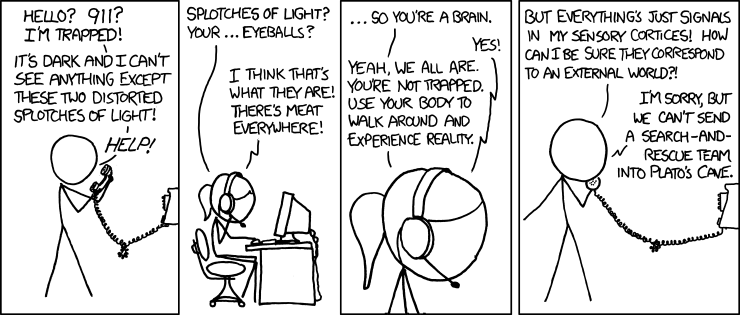
From xkcd.

Friday, April 01, 2011

Working hard?

Andrew Cameron, my former ethics lecturer, recently gave a talk at the Centre for Christian Living on a Christian ethical analysis of work. Worth a listen if you happen to work or know someone who does.